

THE DIET COKE APOCALYPSE
THE DIET COKE APOCALYPSE 💀🥤
America doesn’t run on Dunkin’ — it runs on DIET COKE.
The official drink of exhausted adults, Gen-X survivors, and people who haven’t slept since Tuesday.
New X-Files article is LIVE. Go get a sip 👀
#CommonX #DietCoke #GenX #XFiles #PopCulture #AspartameWarriors
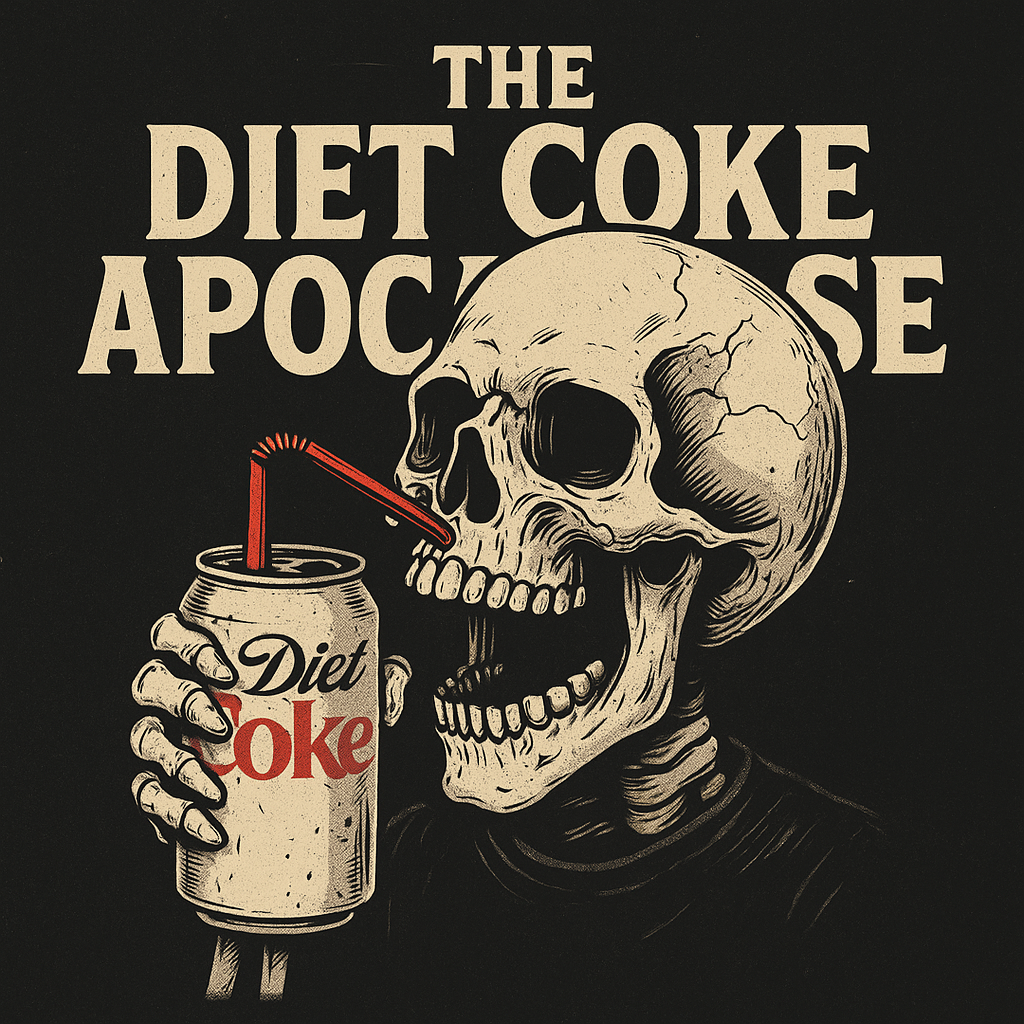
Why America Runs on Aspartame, Caffeine, and Sheer Denial
There’s a quiet apocalypse happening across America. It isn’t zombies. It isn’t AI. It isn’t even the politicians yelling at each other on TV. It’s something far more dangerous — something we willingly pour into our own bodies:
Diet Coke. If the world ends, some people will stockpile gold. Others will hoard canned goods. Gen-Xers? We’re rolling into the wasteland with a 12-pack of Diet Coke and a prayer. Because let’s be honest:
This nation runs on aspartame and denial.
1. The National Anthem of Tired People
Diet Coke is culture. Diet Coke is survival. Diet Coke is the official beverage of:
burnt-out office workers
moms running a household like a Fortune 500 company
truckers hauling America through the night
teachers surviving the third “Can I go to the bathroom?” of the hour
nurses dealing with chaos on no sleep
shift workers who haven’t eaten anything solid since Tuesday
Gen-Xers who didn’t choose the soft drink life — the soft drink life chose them
There is no scenario in human existence more universal than a tired adult muttering:
“I just need a Diet Coke.”
This drink is liquid permission to keep going.
2. The Science Nobody Asked For
Diet Coke is a miracle of modern chemistry — the kind of thing Gen-X grew up drinking without reading the label.
Let’s review what’s inside:
Aspartame
Technically “safe,” but also… the same vibe as licking a 9-volt battery.
Caffeine
Enough to make you believe you can start a new life at 3pm.
Carbonation
The burn. The bite. That metallic spark that feels like inhaling the atmosphere on Jupiter.
Natural flavors
Which is science code for “Don’t worry about it, bro.”
And yet… nobody cares. Diet Coke isn’t about health. It’s about hope. It feels like plugging your soul into a charger.
3. Gen-X Was Built for This Drink
No generation is more suited for Diet Coke than Gen-X.
We grew up in an era of:
secondhand smoke at restaurants
cereal with 42g of sugar
Tang
Tab
leaded gasoline
Crystal Pepsi
Surge
a Taco Bell menu that was basically performance art
Diet Coke isn’t poison — it’s heritage.
If you handed a Gen-X kid a LaCroix in 1994, they’d call Child Protective Services.
4. The Apocalypse Angle
When the collapse comes (and it will), here’s how it breaks down:
Boomers will hoard gold
Millennials will hoard houseplants and therapy tools
Zoomers will hoard anxiety
Gen Z Alpha will hoard tablets with dead batteries
But Gen-X?
We don’t need any of that. We just need a cold Diet Coke and whatever leftovers we can microwave on a generator. Diet Coke will outlast the grid. Diet Coke will outlast the roaches. Diet Coke will outlast the sun. In the post-apocalyptic wasteland, bottle caps might be currency —
but Diet Coke will be the real power.
5. The Real Problem Isn’t Diet Coke…
It’s the Delusion
Here’s the heart of it:
We KNOW Diet Coke probably isn’t good.
We KNOW the ingredients look like something you’d pour into a car.
We KNOW nothing carbonated should taste that electric.
But we also know this:
Sometimes, you just need a drink that says:
“You’re tired, you’re beat up, but you can still get through today.”
That’s why Diet Coke wins. Not because it’s healthy. Not because it’s logical. Diet Coke wins because it’s emotionally honest. It’s the drink that admits:
“I’m a mess, you’re a mess, and we’re BOTH going to pretend we’re fine.”
Final Thought — The CommonX Stamp
The Diet Coke Apocalypse isn’t about soda. It’s about America’s mindset:
“Tired, overworked people finding tiny ways to stay human.”
Gen-X doesn’t believe in self-care. We believe in maintenance mode. We believe in doing what needs to be done, even if we’re running on fumes. And nothing captures that energy better than a cold, crackling, fizzy can of denial. Welcome to the Diet Coke Apocalypse. Pick up a can and carry on.

Do You Remember Talking Like This? 90s Slang vs Today’s TikTok Talk
Do you remember talking like this? From “rad” and “gnarly” to “rizz” and “no cap,” we break down 90s slang versus today’s wild TikTok talk in the funniest way possible. Nostalgia, culture, and pure humor collide.

By Ian Primmer — CommonX Podcast
If you ever shouted “Take a chill pill!” out a rolled-down car window while Stone Temple Pilots blasted from the stereo, congratulations — you survived an era where you could say “bogus,” “rad,” and “home skillet” in the same sentence and nobody questioned your grip on reality. Meanwhile, the youth today are apparently communicating through a combination of Fortnite dances, soundboard memes, and words that sound like rejected Pokémon names.
Language evolves. We evolved with it — usually with a beer in one hand and a look of deep confusion in the other.
Let’s break down the slang then vs. now, and laugh at how gloriously weird it all is.
THEN: The 80s/90s Slang That Raised Us
Rad
Translation: “I approve of this thing with my entire soul.”
Usage: “Those JNCOs are rad, bro.”
Bonus: Still acceptable — especially when spoken in the presence of a skateboard.
Gnarly
Translation: Could mean everything from “awesome” to “oh God, that was traumatic.”
Usage: “Dude, that fall was gnarly.”
“Dude, that wave was gnarly.”
Outcome: Confusion for anyone born after 2005.
Take a Chill Pill
Translation: You’re losing your mind and need to relax before someone calls your mom.
Usage: Every parent in 1994.
Talk to the Hand
Translation: “I no longer acknowledge your existence.”
Usage: Practically every teenage girl at least once.
Side effect: Nobody ever actually shut up because of this phrase.
As If!
Translation: A weaponized version of “Nope.”
Usage: Perfected by Alicia Silverstone. Forever iconic.
Bogus
Translation: “This situation is unacceptable and I blame the universe.”
Certified by Bill & Ted, therefore eternal.
NOW: The Slang That Makes Us Rub Our Eyes and Stare at the Ceiling
Rizz
Translation: “Charisma,” shortened for people too exhausted to say the full word.
Usage: “Dude has mad rizz.”
Reaction: Us: “Rizz? Riz? Risotto?”
No Cap
Translation: “I’m telling the truth.”
Usage: “Pizza is the best food, no cap.”
Reaction: Us: “Son… I am wearing a hat. What exactly do you mean?”
Bet
Translation: “Okay.”
Usage: “You coming over?” “Bet.”
Reaction: Us: “Bet WHAT? Money? Beer? Are we gambling?”
Ghosting
Translation: Disappearing without explanation.
Usage: Dating apps. Job interviews. Your cousin who said he’d help you move.
Our translation: “We just never called people back.”
Drip
Translation: Style. Fashion. Fit.
Usage: “His fit has drip.”
Reaction: Us: “Drip used to mean your roof had a problem.”
Skibidi
Translation: No one knows. Not even Gen Z.
Usage: Something involving a toilet-sound meme and dancing characters.
Reaction: Sliding down in a chair whispering, “Make it stop…”
WHY SLANG EVOLVES
Slang is culture. Slang is rebellion. Slang is evolution.
We perfected sarcasm, deadpan humor, and the ability to say “whatever” without moving a single facial muscle. The next generations added:
Internet speed
Viral memes
TikTok
Emojis
Sound effects
Entire languages made of abbreviations
We walked so the kids today could yeet.
THE COMMON-X TAKE
At Common-X, we celebrate language because it keeps conversations real, messy, human, and hilarious.
Whether you’re saying:
“Dope”
“No cap”
“Rad”
“Bet”
You’re speaking your generation’s truth — and honestly, it’s all ridiculous in the best possible way.
CLOSING
If you still say “sweet,” “killer,” or “awesome,” don’t worry — we do too.
We don’t age out.
We just get better playlists.

🎸 Top 10 Underrated Grunge Tracks You Forgot You Loved (CommonX Edition)
CommonX digs deep into the Seattle sound — the forgotten grunge tracks that still roar beneath the surface. Crank it, feel it, and remember why it mattered.

Top 10 Underrated Grunge Tracks we forgot we loved. Brought to you by Skull Candy and CommonX.
By CommonX
Before playlists and polished pop, we had distortion, sweat, and heartache echoing from basements and bar stages. Grunge wasn’t a sound — it was a generation finally saying, “We’re not okay, and that’s okay.”
Everyone remembers Nirvana and Pearl Jam, but the underground had deeper veins — songs that hit just as hard and spoke louder in the quiet moments between chaos.
So fire up the SONOS, close your eyes, and fall back into the feedback. Here are the 10 underrated grunge anthems that still deserve to shake your soul.
⚡ 10. Screaming Trees – “Nearly Lost You” (1992)
That voice. That fuzz. That groove. The soundtrack to smoky nights and restless hearts — forever under-appreciated.
🎤 9. Mother Love Bone – “Chloe Dancer/Crown of Thorns” (1990)
Where it all began. Before Pearl Jam, there was MLB — poetic, tragic, and pure Seattle soul.
🔥 8. Mudhoney – “Touch Me I’m Sick” (1988)
The filthy riff that started it all. Raw, snotty, and brilliant — the sound that gave Sub Pop its swagger.
🎧 7. Temple of the Dog – “Say Hello 2 Heaven” (1991)
Chris Cornell’s voice in its purest form — grief turned into grace. A tribute that became a movement.
🌀 6. L7 – “Pretend We’re Dead” (1992)
Feminist fury meets killer hooks. L7 proved you didn’t need to smile to melt faces.
💔 5. Candlebox – “You” (1993)
Melodic, emotional, and criminally underrated. Candlebox gave grunge a pulse that could actually break hearts.
⚙️ 4. The Melvins – “Hooch” (1993)
Heavy, sludgy, hypnotic. The godfathers of doom who inspired Nirvana’s heaviest moments.
🧠 3. Soundgarden – “Room a Thousand Years Wide” (1991)
Buried behind the hits lies one of their best riffs. Cornell and Thayil made darkness sound divine.
🚀 2. Alice in Chains – “Nutshell” (1994)
If you ever doubted grunge had poetry, listen again. Layne’s voice still echoes in every lonely apartment at 2 a.m.
🦇 1. Stone Temple Pilots – “Silvergun Superman” (1994)
Overshadowed by hits like “Plush,” this deep cut is pure STP swagger — bassline grooves, velvet vocals, and a solo that burns slow.
🎧 Honorable Mentions
Nirvana – “Aneurysm” | Pearl Jam – “Release” | Hole – “Malibu” | Bush – “Cold Contagious”
🧠 Excerpt
CommonX digs deep into the Seattle sound — the forgotten grunge tracks that still roar beneath the surface. Crank it, feel it, and remember why it mattered.
written by Ian Primmer

“The Soundtrack Still Matters (SONOS Edition)”
Gen X didn’t outgrow music — we refined how we hear it. CommonX and SONOS celebrate the return of real sound, where clarity meets rebellion and the soundtrack still matters.

There was a time when every moment had its own soundtrack.
A first kiss in a friend’s car to the hum of a worn cassette. A late-night skate run with Smells Like Teen Spirit echoing off the streetlights. A broken-hearted walk home with your Discman skipping on track eight.
Music didn’t just play in the background — it defined who we were. Back then, we lived for mixtapes. The sound was fuzzy, imperfect, sometimes barely holding together — but it was ours. Every hiss, every crackle, every dropout told a story. You didn’t swipe through songs, you committed to them. You let the music breathe.
And maybe that’s what we’ve lost in the streaming age — the texture, the ritual, the pause between tracks that reminded you something real was coming next. But here’s the truth: the sound never died. It just evolved.
From Garage Speakers to SONOS Clarity
We grew up worshipping distortion — basement bands, blown-out speakers, the hum of a dying amp before the chorus dropped. Now, we’re rediscovering what sound can really do when it’s given room to move. That’s where SONOS comes in — the next evolution of that same energy we grew up with. It’s not about perfection — it’s about presence.
“We grew up on grit. SONOS gives it back with grace.”
With SONOS, you don’t just hear the song — you feel it. The air shifts, the bass hums, and the room becomes part of the music again. It’s what happens when design meets soul. From vinyl to streaming, from garage walls to living rooms that shake with nostalgia, SONOS captures the essence of how we used to listen — loud, unfiltered, and alive.
Every CommonX episode we drop, every Side-B track we revisit, deserves that kind of sound — not background noise, but an experience.
Gen X Grew Up, But the Music Didn’t
We traded our Walkmans for Wi-Fi, but the volume never came down. We just wanted a system that respected the music the way we do — not compressed, not disposable, not background noise. That’s what makes the SONOS ecosystem the grown-up version of rebellion: seamless, modern, but still built around sound that moves you. It’s what happens when the mixtape kids grow up, but the passion stays the same.
“We were raised on feedback and rebellion — now we crave fidelity and fire.”
Because we still want that moment — the one where you stop mid-conversation, tilt your head, and say:
“Man, listen to that.”
SONOS didn’t just build a speaker — they built a bridge between who we were and who we became. The soundtrack still matters. It always did. And now, it sounds better than ever.
🎵 Hear your soundtrack the way Gen X meant it to sound.
Shop SONOS
written by Ian Primmer

SONOS Multi Room quality Surround Sound

Follow Ian Primmer GENXDAD on Tiktok, and get some SONOS gear for high quality sound on the SONO links above.

When MTV Played Videos: A Love Letter to Late-Night Beavis and Butt-Head
Before algorithms, before influencers, there were two idiots on a couch who somehow spoke for a generation. This is a look back at when MTV still had guts, when Beavis and Butt-Head were our midnight philosophers, and when rock videos meant something.
Before algorithms, before influencers, there were two idiots on a couch who somehow spoke for a generation. This is a look back at when MTV still had guts, when Beavis and Butt-Head were our midnight philosophers, and when rock videos meant something.
In the ‘90s, MTV was still dangerous — a little unpredictable, a little punk. You never knew what you’d catch between “Headbangers Ball” and a commercial for JNCO jeans. Then these two idiots appeared: acne, Metallica shirts, and zero attention span. And somehow, that was the attention span of the decade.
Beavis and Butt-Head didn’t just mock music videos — they dissected the absurdity of pop culture without even trying. When they laughed at a Bon Jovi ballad or shredded some random alt-rock band you barely knew, it felt like the world was in on a private joke. And that’s what Gen X did best — laugh at the nonsense while secretly paying attention to the meaning underneath it all.
Those late-night viewings were a rite of passage. We weren’t just watching cartoons; we were learning the language of irony. MTV in that era wasn’t a network, it was a mirror — showing us our boredom, our rebellion, our desire for something real. It was chaos with a remote control, and Mike Judge’s duo gave us permission to laugh through it all.
And the music… man, the music was alive. Nirvana, Soundgarden, White Zombie, Smashing Pumpkins — even the pop garbage had an edge when filtered through Beavis and Butt-Head’s commentary. It was music television the way it was meant to be: unpolished, unpredictable, and soaked in teenage apathy.
Somewhere between then and now, we traded that chaos for “curation.” MTV became reality TV, music moved to the background, and the laughter got replaced with comment sections. But that late-night glow — that raw, dumb, brilliant humor — shaped how a whole generation sees the world today. We’re skeptical, sarcastic, self-aware… and still laughing at the system.
So yeah — this one’s for the night owls who kept the volume low so the folks wouldn’t wake up. For the ones who didn’t need a filter to find what was cool. For the ones who still hear “Breaking the Law” and crack up thinking of Beavis screaming, “Heh… fire!”
When MTV played videos, we didn’t just watch. We remembered.
Authored by Ian Primmer, Co-host — CommonX