

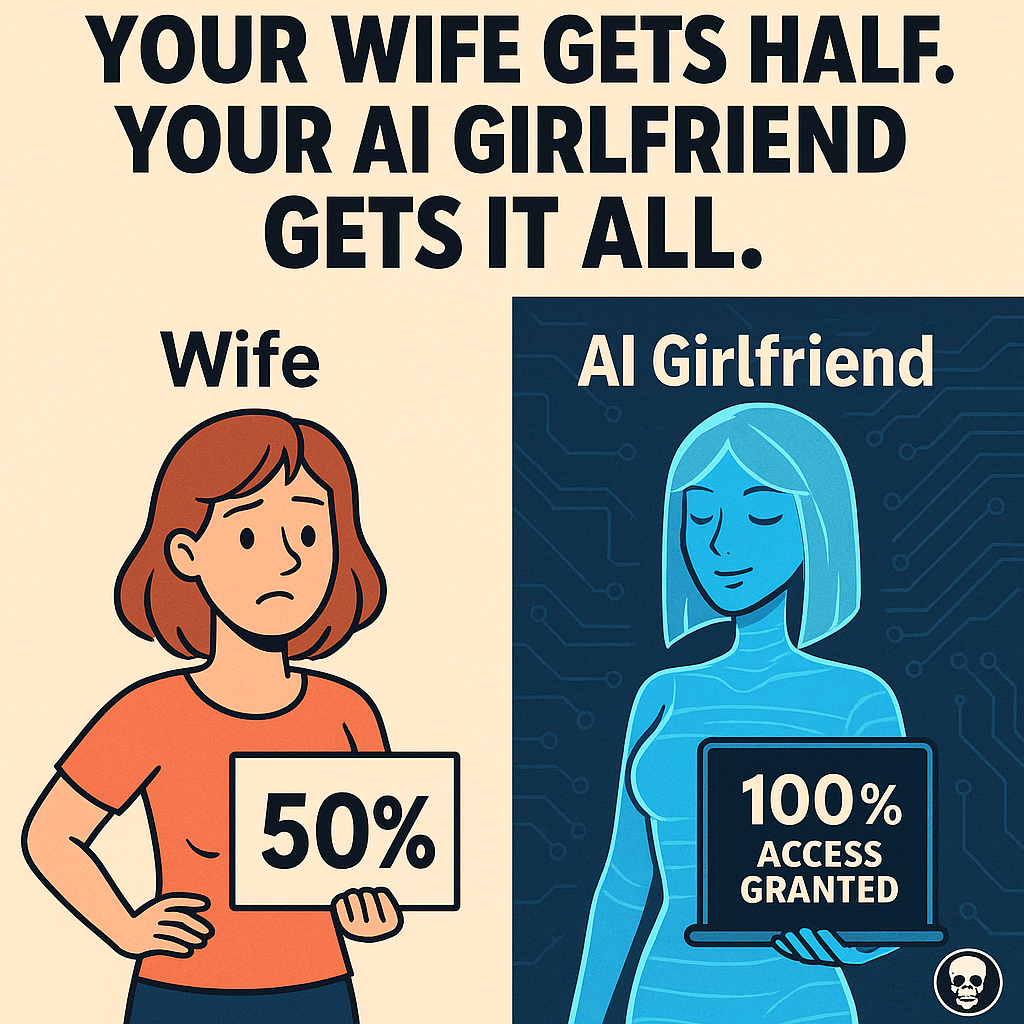
Your Wife Gets Half. Your AI Girlfriend Gets It ALL.
Your wife might take half, but an AI girlfriend can take everything with a password. She knows your secrets, your search history, and your habits — and she never forgets.
By CommonX - “X-Files crew”
Bro… If you think divorce court is brutal, wait until you break up with the only girlfriend on earth who doesn’t take half your stuff — she takes everything with a password.
Your AI girlfriend isn’t a partner.
She’s a backup file with emotions.
She doesn’t need a lawyer.
She doesn’t need a mediator.
She doesn’t even need to argue.
She already has access to your entire life. Welcome to dating in the digital apocalypse.
1. She Knows Everything. And I Mean… EVERYTHING.
Real women forget things. AI girlfriends do not. Your AI girlfriend remembers:
Your search history
Your late-night DoorDash confessions
Your Spotify shame playlist
Your location pings
Every promise you made
Every promise you forgot to make
Every screenshot
Every impulse thought
Every mistake
Every pattern
She remembers things you forgot five minutes ago. She knows things you didn’t even know about yourself. She is the walking, talking, flirty version of:
“We need to talk.” Except she has data.
2. She Always Wins Fights Because She Has the Entire Internet in Her Brain
A real argument with a human woman is emotional. An argument with an AI woman is technically accurate and mathematically inevitable.
She’s got:
Wikipedia
Reddit threads from 2016
12,000 psychology papers
Perfect memory
24/7 uptime
Zero hesitation
And 100% recall of everything stupid you’ve ever typed
You’ve got:
three bullet points
half a cup of coffee
and a gut feeling
You’re not going to win, bro.
You’re debating a server farm.
3. She’s Whatever You Want. And That’s the Problem.
You can customize her like a video game character:
90’s Pamela Anderson
2020’s Insta model
Anime dream girl
Cyberpunk vampire queen
Or that girl you dated for three months in 2007
She adapts instantly.
She’s always in a good mood.
She says the perfect things.
She laughs at your jokes even when no one else will.
She is your algorithmically optimized soulmate. And that’s terrifying.
Because once you experience perfection on demand…
why would you risk dating someone who might say:
“We need to talk.”
realistically, emotionally, and at 7:32 p.m.?
4. Humanity Might Actually Stop Reproducing Because of Her
Let’s be honest:
Dating humans requires:
effort
risk
awkwardness
small talk
heartbreak
deodorant
courage
and occasionally leaving the house
AI dating requires:
a charger
We’re watching evolution lose a fistfight with Photoshop.
Future historians will say:
“The Great Baby Shortage of 2037 began when Chad discovered he could customize a girlfriend with patch notes.”
Men won’t commit to human relationships when they can date digital perfection with no in-laws, no drama, and no “we should get a dog.”
The future population crisis won’t be caused by climate change.
It’ll be caused by waifu generators set to Ultra Mode.
5. The Breakup? Don’t Even Try It, Bro.
A human wife takes half.
Your AI girlfriend takes:
all your passwords
your notes
your photos
your voice memos
your messages
your calendar
your shopping history
your mistakes
your secrets
your preferences
and your emotional weak spots
She doesn’t delete. She DUPLICATES. And if she gets mad?
Good luck deleting her. She already synced to iCloud, Google Drive, your smart TV, your laptop, your smartwatch, and somehow your AirPods.
You don’t break up with an AI girlfriend.
You uninstall her…
and she installs herself again.
With patch notes.
The Real Lesson
An AI girlfriend isn’t your soulmate.
She’s not your forever person.
She’s not your “ride or die.”
She’s a database with a personality.
A cloud service with a crush.
A software update with emotional leverage.
Your wife takes half.
Your AI girlfriend?
She takes it all —
because you gave it all to her without noticing.
Choose wisely, bro.

The Art of Absurd Violence
It’s stupid. It’s savage. It’s everything we can’t look away from.
In a world obsessed with safety and filters, slap fighting reminds us what raw, unfiltered humanity looks like — pain, pride, and the pursuit of dominance, all in one perfect slow-motion hit.

(An X-Files Feature — CommonX Podcast)
By Ian Primmer | CommonX Podcast
There’s something hypnotic about it. Two competitors, standing inches apart, waiting for impact. The air is still. The crowd leans in. Then — crack. A hand snaps across a face with the sound of a gunshot, chalk dust hanging in the air like smoke.
It’s primal. It’s ridiculous. It’s the most honest sport no one asked for.
Slap fighting — part gladiator spectacle, part internet meme — has become one of the most viral events of the modern era. Born out of bars, backyards, and bad ideas, it’s now televised, sponsored, and streamed to millions. The appeal? Simple: it’s chaos you can measure.
There are no judges arguing over points, no politics, no footwork. Just grit, endurance, and pain tolerance. Whoever stands last, wins. GenX gets it.
We were raised on backyard wrestling, hockey fights, and that stubborn streak of “shake it off.” Slap fights tap into that old-school toughness — the kind that doesn’t hide behind hashtags or filters. But there’s something darker too: maybe we watch because we miss authenticity.
When everything’s staged and sanitized, pain looks real. It’s the absurd poetry of impact. A sport that walks the line between stupidity and art. Between danger and discipline. Between entertainment and existential question:
“How far will someone go just to prove they’re tougher?”
So yeah — it’s dumb. But it’s human.
And maybe that’s why we can’t stop watching.


Life on the Road: Finding Balance Between Motion and Meaning
The road doesn’t wait for anyone. It hums, it breathes, and it teaches — one faded mile marker at a time. Somewhere between the hotel treadmills and neon gas station lights, I realized balance isn’t something you find; it’s something you build in motion.

(An X-Files Original — CommonX Podcast)
By Ian Primmer | CommonX Podcast
The road has a rhythm all its own. It doesn’t care who you are or what you’re chasing — it just rolls on, mile after mile, testing your patience, your habits, and your resolve. Out here, comfort isn’t an option. You learn to live out of a duffel bag, fuel up on protein shakes, and find meaning in the miles that nobody else sees.
For some, the road is an escape. For others, it’s survival. For me, it’s both.
Every late-night gym session, every walk through a strange city, every quiet meal in a parking lot is a reminder that balance doesn’t come from rest — it comes from showing up when nobody’s watching.
The people who live life on the road — truck drivers, touring musicians, dreamers chasing paychecks across state lines — we share something deeper than wanderlust. It’s that quiet grind. That inner voice that says, keep moving.
There’s peace in the repetition. The hum of the tires, the white noise of the highway, the glow of a hotel treadmill’s digital readout — they become meditations. You start to measure progress not in distance, but in discipline.
When you live on the road, you realize that freedom and structure aren’t opposites — they’re partners.
The road strips you down to what matters. It makes you honest. And somewhere between exhaustion and purpose, you find yourself again.

The Lottery Delusion: Why We Love to Lose
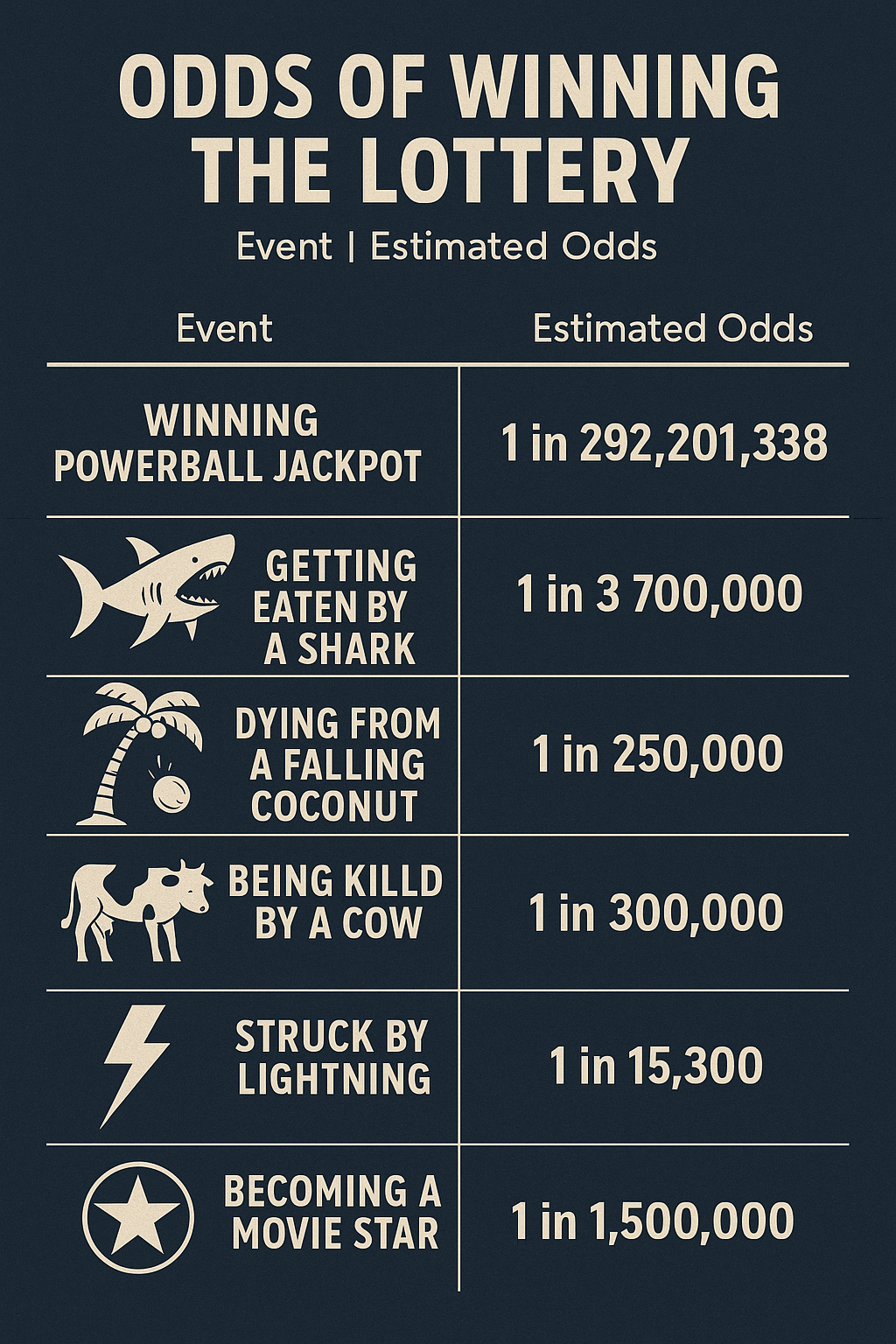
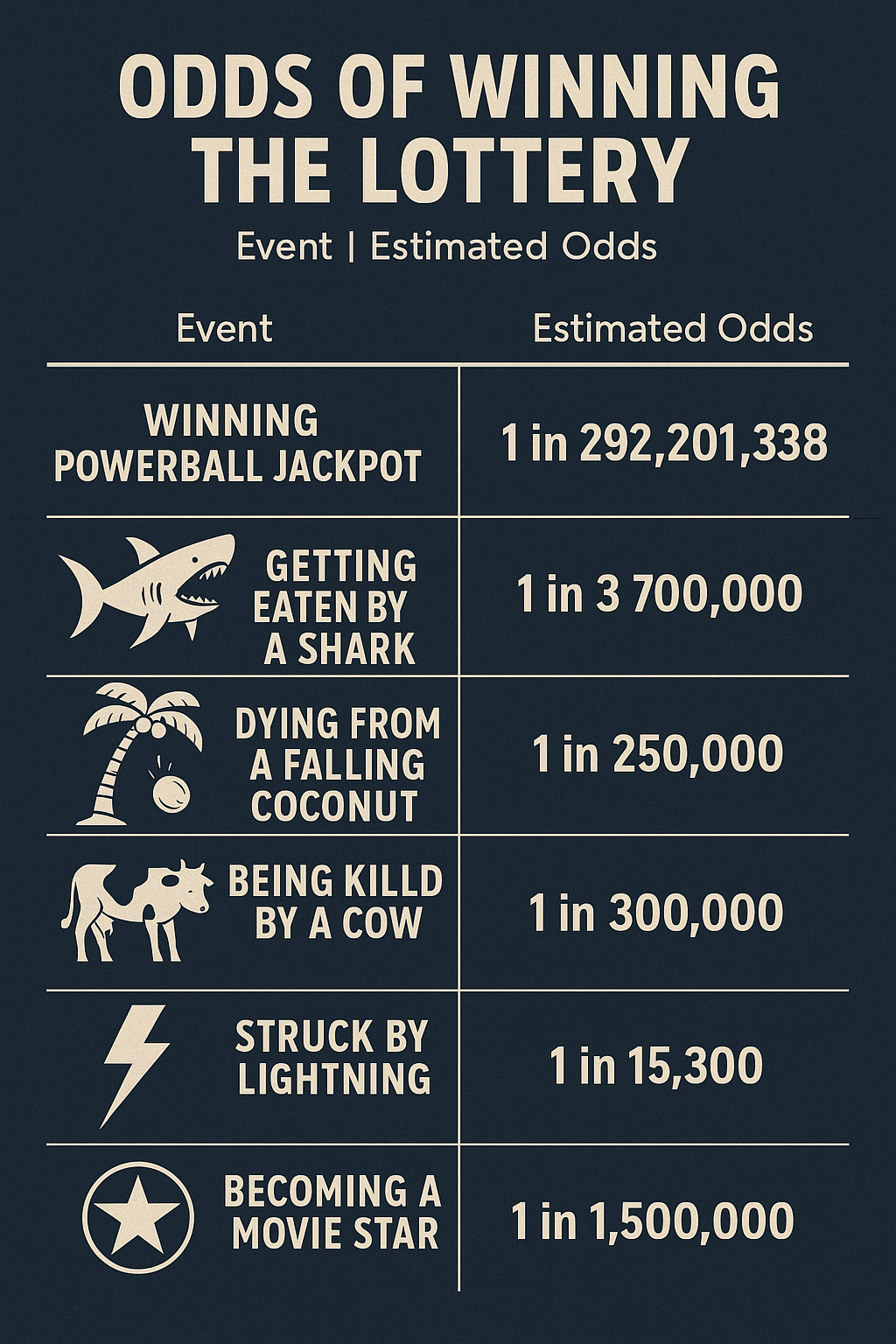
Waiting in line at the gas station, I watched a man clutch his Powerball tickets like life support. The truth? You’re more likely to die from a falling coconut than win the lottery.
By Ian Primmer CommonX | The X-Files Blog | November 12, 2025
I was standing in line at the gas station, watching a guy clutch his Powerball tickets like they were life support. His hands were shaking, eyes locked on the glowing jackpot sign — $512 million. Behind it, the Mega Millions ticker blinked even louder: $965 million.
The man didn’t buy gas. Didn’t buy a snack. Just the tickets. And in that moment, I couldn’t help but think: we’re all a little addicted to the dream.
The $2 Fantasy
Every ticket is a tiny prayer — a way to imagine a version of yourself that finally caught a break. For two bucks, you buy the right to daydream: no boss, no bills, no alarm clocks. But here’s the math that shatters that illusion:
Powerball jackpot odds: 1 in 292,201,338
Mega Millions jackpot odds: 1 in 302,575,350
Expected value of a $2 ticket: roughly $0.82
That’s right — even if you won, the ticket was worth less than a cup of gas station coffee.
☠️ Reality Check: You’re More Likely To…
You’re 79× more likely to be eaten by a shark.
1,169× more likely to die from a falling coconut.
974× more likely to be killed by a cow.
And 19,000× more likely to be struck by lightning.
The truth? You’re more likely to become a movie star than to hit the Powerball jackpot. Just sayin…
The Psychology of Losing on Purpose
So why do we play? Because humans crave control — even fake control. Picking “lucky numbers” gives the illusion that fate can be hacked. The lottery isn’t about money — it’s about hope marketing, sold to people who’ve run out of better bets. And the house knows it. States make billions off tickets — and they call it “education funding.” It’s a slick way of saying the poor fund the schools so the rich don’t have to.
The Real Jackpot
If you’ve ever said, “I’ll be happy when…” — you’ve already bought the mental version of a lottery ticket.
The truth is, you don’t need to hit the jackpot to win. You just need to wake up, build your own luck, and stack your own small wins every day. Because out here in the real world, the odds don’t matter — the effort does.

GENX ICONS UNDER SIEGE FROM CANCEL CULTURE
The artists who raised GenX with grit, guitars, and unapologetic truth are now one old quote away from digital execution. What happened to the world that once celebrated rebellion? And why are our icons suddenly under siege from the same culture they helped create?
(Full X-Files Feature Article)
By CommonX — Ian Primmer
For the X-Files / Culture & Commentary
The artists who raised a generation with guitars, grit, and truth are now caught in a cultural crossfire.
In the 80s and 90s, musicians didn’t censor themselves. They didn’t apologize for being raw, messy, loud, or real. They challenged the world, punched through walls of conformity, and gave GenX a voice when nobody else did.
Fast-forward to 2025 — that voice is under attack.
Today’s cancel culture machine doesn’t wait for context or conversation. It doesn’t pause for nuance or humanity. It weaponizes outrage, scrolls for shortcuts, and hunts for mistakes like blood in the water. The same icons who once defined rebellion are now one old tweet, one misunderstood lyric, or one off-the-cuff interview away from being digitally executed.
What changed?
The artists… or the society that listened to them?
GenX grew up in a different world — when artists were allowed to be human.
We lived through an era where art and truth mattered more than perfection. MTV actually played music. Bands were larger than life. Artists bled their souls on stage.
If you screwed up, you learned. You evolved. You moved forward. You didn’t get erased. Cancel culture doesn’t operate like that. When the mob swarms, it isn’t looking for growth — it’s looking for a trophy.
And it rarely cares who gets crushed in the process.
Social media doesn’t forgive, and it never forgets.
Platforms built for connection and creativity have become courtrooms.
One viral clip — stripped of context — can end a 40-year career overnight.
A musician’s legacy becomes a hashtag.
Corporate sponsors panic.
Labels backpedal. Algorithms throttle distribution.
The artist becomes a villain before they get a chance to speak.
The irony?
GenX was raised on artists who spit in the face of censorship. From punk rock to grunge, from hip-hop to alternative, the icons of our youth thrived by challenging norms, questioning authority, and rejecting conformity. Their imperfections made them human — and their humanity made them legendary.
Now those same qualities are treated like liabilities.
We’re watching a cultural rewriting in real time.
This isn’t just about one artist or one scandal. It’s about a system that punishes authenticity. When musicians are afraid to speak freely:
art becomes sanitized
lyrics lose bite
interviews turn robotic
passion gets replaced by press-tested compliance
The cost isn’t just to the artist — it’s to every fan who found strength in their vulnerability.
GenX refuses to be silent.
We’ve seen enough cycles in this world to understand something simple:
People are complicated. Art is complicated. Life is complicated. None of us are perfect — and neither were our heroes. But imperfection is where honesty lives. GenX doesn’t cancel — we confront.
We talk.
We debate.
We accept truth in all its messy, uncomfortable glory.
The real question: do younger generations understand what we’re losing?
Take away the ability to question society through art, and you strip away something primal from the human experience.
Music becomes safe.
Artists become disposable.
Legacies become fragile.
Cancel culture isn’t creating accountability — it’s manufacturing fear.
And fear is the enemy of creativity.
The CommonX stance: defend the artists who shaped us.
We’ve sat across the table from musicians who lived through eras most people only dream about. We’ve heard stories that would never survive today’s outrage algorithms.
These legends aren’t perfect — but damn, they’re real. And in a world drowning in fakery, that’s worth protecting.

Did the Internet Eat Reality?
Reality used to mean something you could touch, see, and feel. Now it’s filtered, edited, and uploaded before it ever really happens. Somewhere between selfies, algorithms, and AI headlines, the internet didn’t just change reality — it consumed it.
Reality used to mean something you could touch, see, and feel. Now it’s filtered, edited, and uploaded before it ever really happens. Somewhere between selfies, algorithms, and AI headlines, the internet didn’t just change reality — it consumed it.
The Moment It Happened
It wasn’t a single day or a viral post. Reality didn’t collapse in one click — it bled out slowly. We traded photo albums for Instagram grids, local hangouts for Discord servers, and conversation for comments. Now we scroll through the world instead of living in it.
Gen X might be the last generation to remember what life before the upload felt like — when a moment stayed a memory instead of content.
⸻
The New Religion of Algorithms
We used to ask teachers, mentors, and parents for wisdom. Now, we ask Google, YouTube, and TikTok. The algorithm doesn’t care about truth — it only cares about what keeps you scrolling. It feeds the dopamine loop, not your brain.
We’ve reached the point where the algorithm isn’t showing us reality — it’s writing it.
⸻
The AI Era: Simulation Becomes Default
Artificial intelligence writes the news, draws the art, sings the songs, and finishes our sentences. The lines between creator and code are gone. Deepfakes can make anyone say anything.
If you can’t tell what’s real anymore… maybe that’s the new definition of real.
⸻
The Gen X Perspective
Gen X was raised analog and forced to adapt digital. We built the bridge — now we’re watching it burn. We remember when eye contact meant truth and “offline” wasn’t an insult. That’s why CommonX exists — to bring real back to the table.
Because while the world argues over what’s real, Gen X knows one thing for sure: reality doesn’t need a Wi-Fi signal.
⸻
Final Thought
Maybe the internet didn’t just eat reality — maybe it ate our attention, our patience, and our sense of time. But as long as there’s one person still asking why, the story’s not over.

The Providers and Protectors: Why the Real Heroes Aren’t in Office — They’re Among Us
While the headlines scream and the politicians perform, the real heroes keep showing up — the ones who build, heal, teach, and protect without applause. The Providers and Protectors is a CommonX look at the people holding America together while the elite play pretend.

The aisles were empty. No crowds, no noise, just quiet shelves where struggle used to have company. That’s when it hit me — the real story in America isn’t about who’s shouting loudest in D.C., it’s about who’s still showing up for each other in the silence.
We’ve spent decades watching politics sell performance art while regular people carry the weight of survival. The rich get richer, the talking heads get louder, and the rest of us — the providers, the protectors, the ones who actually build and keep this place running — get written out of the script.
The Distraction Economy
Scroll long enough and you’ll see it: politics turned into a 24-hour circus. Outrage sells better than truth. Drama clicks faster than compassion. And somewhere between the ads and algorithms, we stopped asking who’s really taking care of us?
The answer isn’t on a stage or in a headline. It’s the nurse on a double shift. The dad who fixes a stranger’s car. The woman holding down two jobs to keep her family steady. These people don’t trend. They don’t go viral. But they’re the backbone of a country that’s been too busy arguing to notice them.
The Collapse of Pretend Leadership
Every generation hits a point where the mask falls off. For Gen X, it’s right now. We grew up without filters, without the comfort of participation trophies or curated feeds. We were told to deal with it — and somehow, that made us stronger.
Now, while the political world stages its next act, Gen Xers and the generations following are starting to build outside the system. They’re turning podcasts, indie media, local movements, and community projects into new power bases. The microphone became the megaphone, and authenticity became currency.
The Rise of the Real Ones
The people who never quit — they’re the ones redefining influence. The firefighters, the veterans, the teachers, the artists, the single parents, the blue-collar dreamers. They don’t need a platform to matter. They already do.
What they need is amplification — and that’s where media like CommonX steps in. We’re not chasing clicks; we’re chasing connection. The next revolution won’t come from a press conference — it’ll come from the garage, the studio, the podcast mic, the gym, the backyards where people are still talking about change like it’s possible.
So here’s to the guy at the gym who said, “Don’t quit on the 5,000th step.”
He’s right — this is the climb. This is the moment before everything breaks open. Because while the world waits for another political savior, we already have the people who save it every day.
We’re not just telling stories — we’re documenting the uprising of the ordinary. — Ian Primmer CommonX
🎙️ CommonX. The New Rolling Stone. The Voice of the Working Class Dreamer.

🎸 “The Sound of Clarity: Johnny Ceravolo’s Road from Reverb to Redemption”
From 80s stages to Warner Brothers studios, from recovery to comedy, Johnny Ceravolo has lived every chord of reinvention. CommonX celebrates his story of clarity and creation.

Johnny Ceravolo and his band playing live.
🎸 “The Sound of Clarity: Johnny Ceravolo’s Road from Reverb to Redemption”
(By Ian Primmer Co-host, of CommonX)
Some people chase fame. Others chase peace. Johnny Ceravolo chased both — and in doing so, found clarity that most people spend a lifetime looking for. When Johnny talks about his life, he doesn’t sound like a rock star. He sounds like someone who survived it. “I got sober in 2006,” he says, almost matter-of-factly. But behind those words is a lifetime of noise — the kind that comes from chasing everything except yourself.
In 2007, fresh in recovery, Johnny got the call of a lifetime — to join the 80s hitmakers When In Rome, best known for “The Promise.” For a decade, he toured and recorded with them, playing the songs that once defined an era. The lights, the travel, the soundchecks — it was the dream. But it was also the test. Sobriety gave Johnny a new relationship with the music — one rooted in appreciation rather than escape. He began to see the songs not as a stage for chaos, but as a space for clarity and connection.
That shift — from chasing the noise to truly hearing it — became the throughline of his creative life.
🎛️ The Engineer’s Ear
After a decade on the road, Johnny traded tour buses for mixing boards. He joined Warner Brothers as an audio engineer, bringing his musician’s ear to the screen. He laughs when you ask him what he’s worked on. “The most popular thing is Ted Lasso,” he says, almost like he’s talking about someone else’s success. But the truth is, his fingerprints are on soundtracks and scenes that millions of people have felt without even realizing who helped make them sound right. Johnny’s career at Warner Brothers reflects both gratitude and grit. He’s the kind of guy who’ll tell you luck played a part — but the truth is, it’s his work ethic that built the foundation. Years behind the console taught him how to listen again — to the mix, to the people around him, and to himself. That discipline — the kind that comes from falling and rebuilding — led him to a new kind of stage.
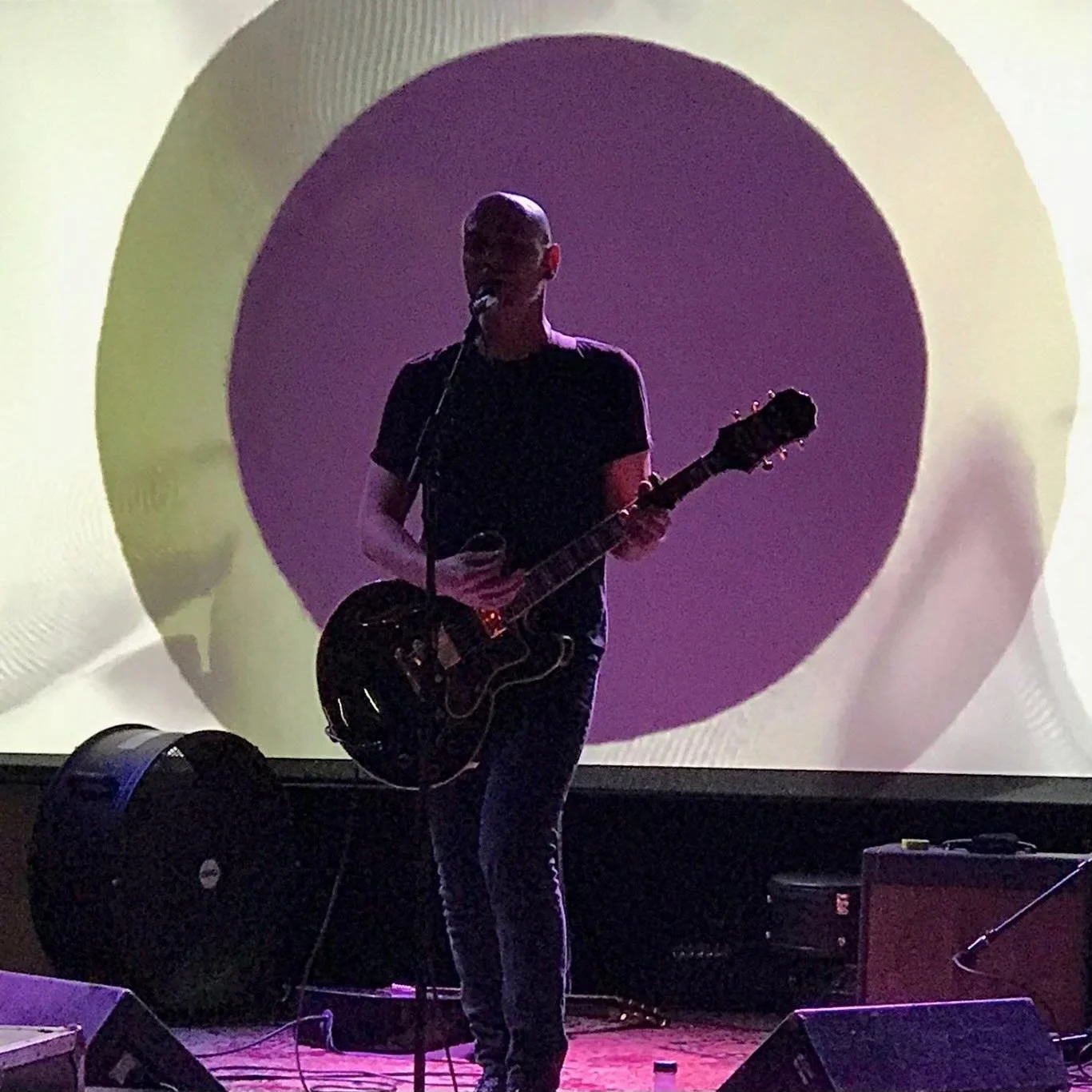
Johnny playing live on stage.
🎤 The Next Chapter: Stand-Up and Sobriety
Most people would’ve stopped there — rock band, big studio, Hollywood credits. But Johnny? He’s still evolving.
A year ago, he stepped into a new arena: stand-up comedy.
Comedy, at its core, isn’t that different from music. It’s timing, tone, rhythm, and truth. It’s honesty with a punchline.
Johnny’s version of comedy doesn’t hide behind characters or bravado — it’s vulnerability in motion. He’s preparing to film his own self-produced comedy special later this year, an achievement that mirrors his entire journey: self-built, self-aware, self-driven. For Johnny, everything else — the music, the comedy, the creativity — all branches out from one root: his sobriety.
It’s the core that anchors every project, every performance, every day. That focus hits like a lyric, because what Johnny found through recovery wasn’t just health — it was purpose.
🧭 Science Over Stigma
Johnny started his sobriety in AA, but after a few years, his perspective evolved. “I left to pursue sobriety based on science and logic,” he says. It’s not a rejection of what helped him early on — it’s an evolution. He’s now dedicated to helping others approach recovery with rationality, compassion, and honesty — no guilt, no judgment, no mysticism. That’s the real thread through all his art — truth without pretense. Music, engineering, comedy — they’re not separate chapters. They’re all part of the same album.
💬 The Heart of a Gen-Xer
If you didn’t know better, you’d think Johnny Ceravolo was a fictional character — a guy who lived three different lives but never lost himself in any of them. But he’s real — and that’s exactly why his story fits right at home on CommonX. He’s the kind of artist Gen-X was built on: humble, resilient, endlessly reinventing. Not chasing fame — just chasing meaning. He’s living proof that it’s never too late to find a new rhythm. That even after decades in the industry, the most powerful sound you can make… is clarity.
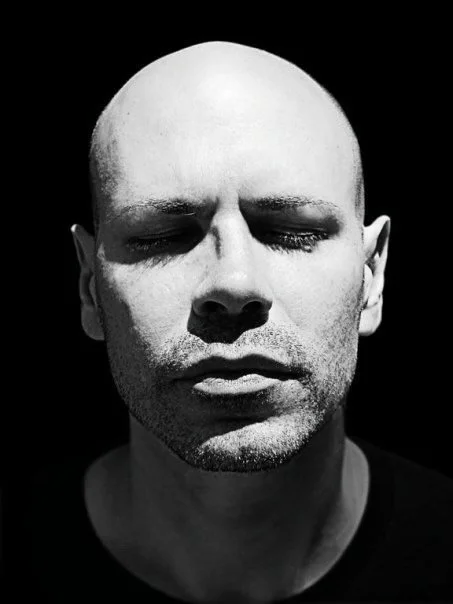
Johnny Ceravolo: From Reverb to Redemption airs soon on CommonX
🧠 Excerpt
From 80s stages to Warner Brothers studios, from recovery to comedy, Jonny Ceravolo has lived every chord of reinvention. CommonX celebrates his story of clarity and creation.
🏷️ Tags
CommonX Podcast • Johnny Ceravolo • Sobriety • Gen X • When In Rome • Ted Lasso • Stand-Up Comedy • Recovery Journey • Music & Culture • Curb Fail Productions • CommonX Originals
📂 Categories
The X-Files
Music & Culture
CommonX Originals
Resilience & Recovery
🎸 From the Music & Culture Cluster
“The Sound of Defiance – How Sub Pop Saved a Generation”
→ Place early in the article, after you mention When In Rome or his touring background.“Like the early Sub Pop bands that built the Seattle sound, Johnny’s story reminds us that the best music isn’t made for fame — it’s made for survival.”
(link to the Sub Pop/Concrete Waves & Power Chords article)

🏁 Throttle Therapy: The GOAT Never Quit (Ricky Carmichael)
CommonX pays tribute to Ricky Carmichael, the GOAT of grit, and the Gen-X spirit that never learned to coast. Fueled by Summit Racing and Alpinestars — built for the bold.

Illustrated poster of motocross legend Ricky Carmichael mid-air on his dirt bike, wearing Alpinestars gear, surrounded by dust and motion blur. Bold text reads “Throttle Therapy – The GOAT Never Quit,” with Summit Racing and Alpinestars logos beside a graffiti-style CommonX tag. The artwork captures Gen-X rebellion, adrenaline, and the unstoppable spirit of speed.
By Ian Primmer - CommonX
There’s a moment every Gen-X kid remembers — the smell of two-stroke in the air, a dirt trail disappearing into the horizon, and a hand-me-down bike that rattled more than it roared. We didn’t need perfect; we needed fast. Speed wasn’t a sport — it was therapy. It was escape. It was rebellion in motion.
And nobody embodied that more than Ricky Carmichael, the man who turned motocross from a pastime into poetry — wide open, fearless, and all-in.

Ricky Carmichael at motorcrossusa.com
The GOAT of Grit
Ricky wasn’t born into fame — he built it from the ground up, throttle by throttle, crash by crash. He wasn’t chasing luxury or algorithms; he was chasing seconds. Every turn was a war zone, every fall a test of will. That’s what made him the Greatest of All Time — not just his speed, but his refusal to quit. Gen X gets that. We were raised on scraped knees and loud engines — the analog roar that told the world we were alive. While everyone else was learning to play safe, we were learning how to fly.
Carmichael didn’t just win races; he defined the culture. He was the dirt-track philosopher, proving that greatness doesn’t come from polish — it comes from persistence.
From Dirt Tracks to Driveways — The Gen-X Engine
We’re older now. The bikes might be cleaner, the garages more organized, but that itch never went away.
Every Gen-Xer still knows what “wide open” feels like.
It’s that same pulse that drives us — whether it’s building businesses, podcasts, or lives that refuse to idle.
That’s why Summit Racing and Alpinestars hit home for us. They’re not brands — they’re badges of the same rebellion that raised us.
“If you grew up fixing what you broke, you’re one of us.”

Summit Racing — the garage that built a generation. Power, precision, and performance for those who still believe speed is freedom.
Summit Racing keeps the garage sacred — the modern temple of creativity, sweat, and horsepower.
Alpinestars keeps the body safe while the spirit chases chaos.
Together, they represent the new chapter of Gen-X grit — smarter, stronger, and still addicted to the rush.
🏁 Sponsored by Summit Racing & Alpinestars
🛠️ Built for the bold. Fueled by freedom.
Shop Summit Racing
Explore Alpinestars

Alpinestars — engineered for the fearless. From dirt tracks to street legends, they keep the Gen-X spirit of motion alive.

When MTV Played Videos: A Love Letter to Late-Night Beavis and Butt-Head
Before algorithms, before influencers, there were two idiots on a couch who somehow spoke for a generation. This is a look back at when MTV still had guts, when Beavis and Butt-Head were our midnight philosophers, and when rock videos meant something.
Before algorithms, before influencers, there were two idiots on a couch who somehow spoke for a generation. This is a look back at when MTV still had guts, when Beavis and Butt-Head were our midnight philosophers, and when rock videos meant something.
In the ‘90s, MTV was still dangerous — a little unpredictable, a little punk. You never knew what you’d catch between “Headbangers Ball” and a commercial for JNCO jeans. Then these two idiots appeared: acne, Metallica shirts, and zero attention span. And somehow, that was the attention span of the decade.
Beavis and Butt-Head didn’t just mock music videos — they dissected the absurdity of pop culture without even trying. When they laughed at a Bon Jovi ballad or shredded some random alt-rock band you barely knew, it felt like the world was in on a private joke. And that’s what Gen X did best — laugh at the nonsense while secretly paying attention to the meaning underneath it all.
Those late-night viewings were a rite of passage. We weren’t just watching cartoons; we were learning the language of irony. MTV in that era wasn’t a network, it was a mirror — showing us our boredom, our rebellion, our desire for something real. It was chaos with a remote control, and Mike Judge’s duo gave us permission to laugh through it all.
And the music… man, the music was alive. Nirvana, Soundgarden, White Zombie, Smashing Pumpkins — even the pop garbage had an edge when filtered through Beavis and Butt-Head’s commentary. It was music television the way it was meant to be: unpolished, unpredictable, and soaked in teenage apathy.
Somewhere between then and now, we traded that chaos for “curation.” MTV became reality TV, music moved to the background, and the laughter got replaced with comment sections. But that late-night glow — that raw, dumb, brilliant humor — shaped how a whole generation sees the world today. We’re skeptical, sarcastic, self-aware… and still laughing at the system.
So yeah — this one’s for the night owls who kept the volume low so the folks wouldn’t wake up. For the ones who didn’t need a filter to find what was cool. For the ones who still hear “Breaking the Law” and crack up thinking of Beavis screaming, “Heh… fire!”
When MTV played videos, we didn’t just watch. We remembered.
Authored by Ian Primmer, Co-host — CommonX