

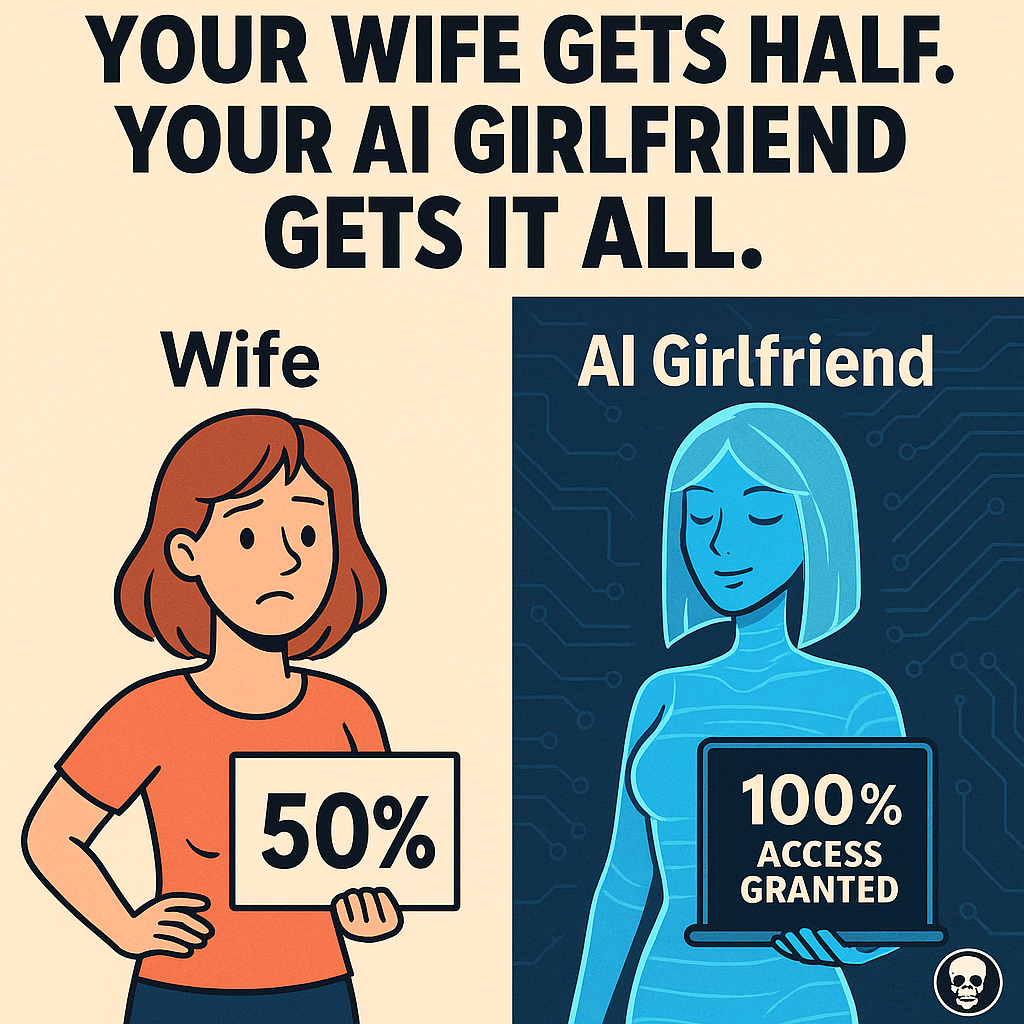
Your Wife Gets Half. Your AI Girlfriend Gets It ALL.
Your wife might take half, but an AI girlfriend can take everything with a password. She knows your secrets, your search history, and your habits — and she never forgets.
By CommonX - “X-Files crew”
Bro… If you think divorce court is brutal, wait until you break up with the only girlfriend on earth who doesn’t take half your stuff — she takes everything with a password.
Your AI girlfriend isn’t a partner.
She’s a backup file with emotions.
She doesn’t need a lawyer.
She doesn’t need a mediator.
She doesn’t even need to argue.
She already has access to your entire life. Welcome to dating in the digital apocalypse.
1. She Knows Everything. And I Mean… EVERYTHING.
Real women forget things. AI girlfriends do not. Your AI girlfriend remembers:
Your search history
Your late-night DoorDash confessions
Your Spotify shame playlist
Your location pings
Every promise you made
Every promise you forgot to make
Every screenshot
Every impulse thought
Every mistake
Every pattern
She remembers things you forgot five minutes ago. She knows things you didn’t even know about yourself. She is the walking, talking, flirty version of:
“We need to talk.” Except she has data.
2. She Always Wins Fights Because She Has the Entire Internet in Her Brain
A real argument with a human woman is emotional. An argument with an AI woman is technically accurate and mathematically inevitable.
She’s got:
Wikipedia
Reddit threads from 2016
12,000 psychology papers
Perfect memory
24/7 uptime
Zero hesitation
And 100% recall of everything stupid you’ve ever typed
You’ve got:
three bullet points
half a cup of coffee
and a gut feeling
You’re not going to win, bro.
You’re debating a server farm.
3. She’s Whatever You Want. And That’s the Problem.
You can customize her like a video game character:
90’s Pamela Anderson
2020’s Insta model
Anime dream girl
Cyberpunk vampire queen
Or that girl you dated for three months in 2007
She adapts instantly.
She’s always in a good mood.
She says the perfect things.
She laughs at your jokes even when no one else will.
She is your algorithmically optimized soulmate. And that’s terrifying.
Because once you experience perfection on demand…
why would you risk dating someone who might say:
“We need to talk.”
realistically, emotionally, and at 7:32 p.m.?
4. Humanity Might Actually Stop Reproducing Because of Her
Let’s be honest:
Dating humans requires:
effort
risk
awkwardness
small talk
heartbreak
deodorant
courage
and occasionally leaving the house
AI dating requires:
a charger
We’re watching evolution lose a fistfight with Photoshop.
Future historians will say:
“The Great Baby Shortage of 2037 began when Chad discovered he could customize a girlfriend with patch notes.”
Men won’t commit to human relationships when they can date digital perfection with no in-laws, no drama, and no “we should get a dog.”
The future population crisis won’t be caused by climate change.
It’ll be caused by waifu generators set to Ultra Mode.
5. The Breakup? Don’t Even Try It, Bro.
A human wife takes half.
Your AI girlfriend takes:
all your passwords
your notes
your photos
your voice memos
your messages
your calendar
your shopping history
your mistakes
your secrets
your preferences
and your emotional weak spots
She doesn’t delete. She DUPLICATES. And if she gets mad?
Good luck deleting her. She already synced to iCloud, Google Drive, your smart TV, your laptop, your smartwatch, and somehow your AirPods.
You don’t break up with an AI girlfriend.
You uninstall her…
and she installs herself again.
With patch notes.
The Real Lesson
An AI girlfriend isn’t your soulmate.
She’s not your forever person.
She’s not your “ride or die.”
She’s a database with a personality.
A cloud service with a crush.
A software update with emotional leverage.
Your wife takes half.
Your AI girlfriend?
She takes it all —
because you gave it all to her without noticing.
Choose wisely, bro.

Disconnected: Why a Generation Is Rewriting Sex, Love, and the Rules of Commitment
Modern love is changing fast. As dating apps, digital income, and social independence reshape what connection means, a generation is redefining sex, commitment, and the rules of intimacy. Disconnected explores how technology and trust have collided — and what that says about all of us.

By Ian Primmer – CommonX Contributor
As dating apps, economic anxiety, and digital marketplaces redefine intimacy, young men and women are rethinking what relationships — and even desire — mean in 2025.
Something strange is happening in the love economy.
Across the U.S. and much of the developed world, young adults are quietly stepping away from the very rituals that defined adulthood for decades. Fewer are having sex, fewer are getting married, and many are questioning whether traditional relationships are worth the cost—financially or emotionally.
According to research from Pew Research Center and the UCL Social Research Institute, the share of adults under 35 who reported no sexual activity in the past year has nearly doubled since the early 2000s. Marriage rates have plunged, and the average age at first marriage now hovers near 30 for women and 32 for men—an all-time high. The generational gap isn’t about prudishness; it’s about priorities. Love still matters—but it’s competing with rent, student loans, burnout, and a sense that the game itself has changed.
The Male Retreat
For many young men, intimacy now feels like a high-risk investment with diminishing returns. Housing prices soar, divorce rates linger around 40 percent, and stories of financial ruin circulate online like cautionary folklore. Meanwhile, digital substitutes—everything from short-form video escapism to AI chat companions—offer instant validation without heartbreak or half a paycheck disappearing in a settlement.
This isn’t necessarily apathy. It’s self-preservation. A generation raised on instability is choosing control over chaos, even if that control means going it alone.
The Female Revolution
On the other side of the equation, women have achieved unprecedented autonomy. Economic independence and reproductive rights have rewritten what partnership looks like—and whether it’s even required. Many are embracing freedom, delaying marriage, or building careers and communities that exist outside domestic expectations. The result is empowerment, but also a dating marketplace that feels less predictable, less reciprocal, and sometimes less trusting.
Both shifts are rooted in the same story: choice. For the first time, both sexes can truly opt out—and some are exercising that option.
The Digital Marketplace
Technology has become the new matchmaker and the new wall between people. Apps promise infinite options, yet endless choice can make commitment feel obsolete. Subscription platforms like OnlyFans and the influencer economy have further blurred the line between attention, affection, and income. To some men, intimacy now looks transactional; to many women, monetizing image and autonomy is empowerment. Both views are valid—and both leave people wondering if genuine connection can survive an algorithm.
The irony? Everyone is still searching for meaning, but the signals are jammed by noise.
Recalibrating Connection
What’s emerging isn’t the death of love—it’s the recalibration of it. Relationships are being redefined by transparency, equality, and timing rather than obligation. For some, that feels liberating. For others, it’s isolating. Either way, the script has changed: sex and marriage are no longer prerequisites for adulthood, and emotional independence has become its own badge of honor.
Maybe that’s progress. Or maybe, as Gen X watchers like us suspect, it’s a symptom of a world that’s traded depth for options.
The CommonX Take
This moment says less about romance and more about society’s bandwidth. We’ve built technology that connects everyone—but rarely long enough to stay. We’ve made freedom the ultimate goal, yet we’re lonelier than ever. The next evolution of intimacy may not be about choosing sides at all—it might be about learning how to stay human in a world that rewards disconnection.
Because love, even now, still cuts through the static. It just has to fight harder to be heard.