

X-Files: Victor Varnado — Comedy, AI, and the Art of Thinking Differently
Comedian and AI entrepreneur Victor Varnado joins the CommonX Podcast for a grounded, thought-provoking conversation about artificial intelligence, creativity, and why human perspective still matters in an algorithm-driven world.
Every once in a while, CommonX gets a guest who doesn’t just talk about the future — they’re actively building it.
Victor Varnado is one of those people.
A comedian, writer, and technologist, Victor joined the CommonX Podcast for a conversation that effortlessly moved between humor, artificial intelligence, creativity, and what it really means to adapt in a rapidly changing world.
From Comedy to Code
Victor’s background in comedy isn’t a side note — it’s the foundation. Comedy trains you to spot patterns, question assumptions, and communicate complex ideas in a way that actually lands. That mindset carries directly into his work in AI, where clarity and creativity matter just as much as technical skill.
On the show, Victor broke down how AI isn’t some distant sci-fi threat or miracle solution — it’s a tool. And like any tool, it reflects the intentions of the people using it.
For Gen-X especially, that idea hits home. We’ve lived through analog, digital, and now algorithmic revolutions. The lesson isn’t fear — it’s literacy.
AI Isn’t Replacing Creativity — It’s Challenging It
One of the biggest takeaways from this episode was Victor’s pushback on the idea that AI is “killing” creativity. Instead, he argues it’s forcing creators, writers, and thinkers to sharpen their edge. The question isn’t “Will AI replace us?” It’s “What are we doing that can’t be replaced?” Victor suggests that AI can be used as a tool to enhance our creativity, not replace it.
That’s where lived experience, humor, ethics, and original thinking still matter — and always will.
MagicBookifier.ai and Practical AI — A writing to to help people write
CommonX listeners can use Victors writing tool for free using promo code: COMMONX at Magicbookifier.com. Victor also talked about MagicBookifier.ai, a platform designed to help people work with AI instead of being overwhelmed by it. The focus isn’t hype — it’s practical use, accessibility, and helping everyday people understand how these tools can actually serve them.
That philosophy fits squarely inside the CommonX lane: real conversations, real people, no smoke and mirrors.
Why This Conversation Matters
This episode wasn’t about chasing trends. It was about perspective.
Victor brought a rare mix of humor, humility, and insight — reminding us that technology doesn’t move culture forward on its own. People do.
And if there’s one thing Gen-X understands better than most, it’s how to adapt without losing your soul.
🎙️ Listen to the full conversation with Victor Varnado on the CommonX Podcast — coming soon!

Why Tensions Are Rising Between ICE Agents and American Citizens
A fatal ICE shooting in Minneapolis has ignited protests and renewed questions about federal enforcement, public trust, and how communities and agents collide in high-pressure situations. In this CommonX X-Files report, we examine what’s known, what’s still being investigated, and why tensions between ICE and American citizens are rising across the country.

If you’ve felt it lately — that uneasy sense that everyday people and federal enforcement are bumping into each other more often — you’re not imagining things.
Over the past week, the tension has boiled over after a fatal encounter in Minneapolis involving a U.S. Immigration and Customs Enforcement (ICE) officer and a 37-year-old woman, Renée Nicole Good, during a federal operation. The incident has sparked protests, conflicting official narratives, and a broader national argument about enforcement tactics, accountability, and public trust.
This X-Files isn’t here to inflame anything. It’s here to do what CommonX does best: stick to verified facts, identify what’s still unknown, and explain why people are reacting so strongly.
What happened in Minneapolis — the verified basics
Multiple outlets report that Renée Nicole Good was fatally shot during a federal enforcement operation in Minneapolis. Public reporting describes competing accounts of what led up to the shooting and whether the use of force was justified.
The Department of Homeland Security has stated the officer acted in self-defense, while local and state leaders have publicly challenged aspects of the federal narrative.
ABC News has published a detailed, time-stamped timeline based on available video, which has become central to how the public is interpreting what happened.
Why this story became bigger than one city
One reason this spread fast is simple: the trust gap is already wide, and high-stakes enforcement in public spaces puts that gap on full display.
In Minneapolis, protests followed quickly. Reuters reported arrests overnight and damage reported near hotels believed to be housing federal agents. At the same time, city officials urged people to remain peaceful to avoid escalation.
Reuters also reports protest organizers planning over 1,000 events nationally, signaling the story has moved from “local tragedy” into “national flashpoint.”
The core issue: tactics, training, and escalation
A lot of the argument isn’t about whether the federal government can enforce immigration law. It’s about how enforcement is carried out when:
agents are operating in neighborhoods,
crowds gather,
vehicles are involved,
and split-second decisions can end a life.
The Washington Post reports the Minneapolis shooting has intensified scrutiny of ICE training and use-of-force tactics, including debate among experts over best practices around vehicles and officer positioning.
This is where tension grows: when people believe an encounter could have been de-escalated — and the other side believes the threat was real in the moment.
Conflicting investigations make people more suspicious
When investigations appear fragmented or contested, suspicion spikes. Minnesota’s Bureau of Criminal Apprehension (BCA) published a statement indicating it remains open to conducting a full investigation if federal authorities resume a joint approach or share evidence and reports.
When the public sees “different agencies, different accounts, different access to evidence,” trust erodes — even before final facts are established.
What CommonX thinks Americans are reacting to
Here’s the honest read:
People aren’t just reacting to one incident — they’re reacting to the feeling that the rules of engagement between citizens and enforcement are getting blurrier, and the consequences are heavier.
Some citizens see an enforcement posture that feels aggressive and unchecked. Others see federal agents doing a dangerous job and being surrounded, filmed, confronted, and forced into rapid decisions.
Both fears can exist at once — and that’s exactly why these moments turn into national tension.
Where we go from here
We’ll keep this simple and grounded:
More verified details will emerge (video, investigations, policies).
Public demonstrations will continue and the national conversation will sharpen.
The long-term question will be whether agencies adjust tactics and transparency to rebuild trust.
CommonX will follow the facts — and we’ll update as official findings become clear.

THE EPSTEIN FILES: WHAT THE 2025 REVELATIONS SAY ABOUT POWER IN AMERICA
The Epstein Files didn’t just drop—they detonated. America froze as a dark chapter of power, privilege, and systemic failure came into the light. Here’s what the 2025 revelations really say about the culture we grew up in—and why Gen X saw this coming.

America didn’t just read the Epstein Files — it felt them. When the documents dropped, the country reacted the same way it does when something truly historic happens:
screens froze, comment sections detonated, and an entire nation collectively exhaled a long, uncomfortable “…wow.”
This wasn’t gossip. This wasn’t political sport. This wasn’t a celebrity scandal to chuckle about and forget. This was a cultural pressure point. And once again, the people who grew up seeing through the cracks — Gen X — felt all of it in their bones.
Because the Epstein Files aren’t just about a man.
They’re about a machine.
A system.
A network.
A pattern that’s repeated across decades, industries, and institutions. And in 2025, America finally seems ready to admit it.
A Generation Built to See Through the Fog
Gen X doesn’t shock easily.
We came up in the era of:
the Michael Jackson trials
R. Kelly’s rise, fall, and implosion
P. Diddy now facing his reckoning
Clinton-era political scandals
the Catholic Church abuse revelations
Hollywood’s “open secrets” finally exposed
televangelists collapsing under their own hypocrisy
corporations protecting their own
We were the latchkey kids who learned early that:
adults lie,
institutions fail,
the powerful protect themselves,
and truth rarely arrives gift-wrapped.
So when the Epstein Files surface — revealing another labyrinth of privilege, connection, money, power, and access — Gen X responds with the exact energy we were built on:
“Yeah… that tracks.” Not because we’re cynical. But because we’ve seen this movie too many times to pretend we don’t know the script.
A Shockwave That Hit Everything at Once
The unique force of the Epstein Files is that they didn’t strike just one world — they hit every world simultaneously.
Politics
Both parties immediately scrambled to get ahead of public perception. Everyone tried to signal innocence, outrage, or distance. But the public wasn’t buying the rehearsed lines.
Hollywood
An industry built on fantasy was forced to face its darkest shadow again. Silence, statements, PR clean-ups — all of it unfolded in real time.
Social Media
If traditional media was cautious, the internet was not. People reacted from the gut — anger, confusion, empathy, disgust.
Everyday Americans
Most people felt the same two emotions at once:
Protect the victims.
Don’t jump to conclusions about individual names.
It’s rare for America to feel conflicted and unified at the same time — but this moment created exactly that.
Why the Human Cost Matters Most
Scroll past the noise and you reach the truth:
the core of this story is not the powerful — it’s the powerless. The victims. Many of whom were kids when the system failed them. Their courage is the reason any of this is public. Their voices are why society is even having this conversation. Their pain is the part too many people want to ignore.
This article, this moment, this national spotlight — none of it should exist without remembering who it’s actually for.
Not the headlines.
Not the celebrities.
Not the political scorecards.
The survivors.
A System That Protects Itself
This is the real reason America can’t look away. The Epstein Files reveal what people already suspected for decades:
wealth grants immunity
connections provide insulation
institutions cover for their own
accountability is selective
justice is rarely equal
It’s not a “left vs right” problem.
It’s not a “Hollywood vs Washington” problem.
It’s not even a celebrity problem.
It’s a power problem.
And America is finally starting to question why power works differently for different people.
Why Gen X Might Be the Only Generation That Truly Gets It
Every generation sees this moment differently:
Millennials are outraged.
Gen Z is horrified.
Boomers are confused and conflicted.
But Gen X? We’re the ones who understand the pattern. We saw the cracks form before anyone wanted to admit they were there. We grew up learning that institutions weren’t designed to protect people like us — and certainly not the vulnerable. This moment isn’t surprising to Gen X.
It’s validating.
And disturbing.
And far too familiar.
It’s the reminder that the fight for truth isn’t new — it’s just louder now.
Where America Goes From Here
The Epstein Files aren’t an ending. They’re a beginning. A beginning where:
survivors are heard
institutions are questioned
blind loyalty collapses
celebrities lose their protective shield
politics stops being a team sport
power is forced into the light
The real story isn’t the list of names. It’s the list of lessons. America isn’t reacting to a scandal. America is reacting to a shift.
A moment where a country that’s been numb for years finally feels something again.
Disgust.
Empathy.
Anger.
Sadness.
Determination.
A moment where we stop pretending these things can’t happen. A moment where we stop assuming the powerful are untouchable. A moment where we start demanding better — for the victims, for the truth, and for the future.
The CommonX Closing Note
If there’s one thing this moment proves, it’s this: America is done giving the powerful the benefit of the doubt. And Gen X — the generation built on grit, skepticism, and brutal honesty — is leading the conversation. Not because we want to. But because somebody has to.
The Epstein Files are a dark chapter. But darkness only wins when we stop shining light on it. And right now? America is wide awake.
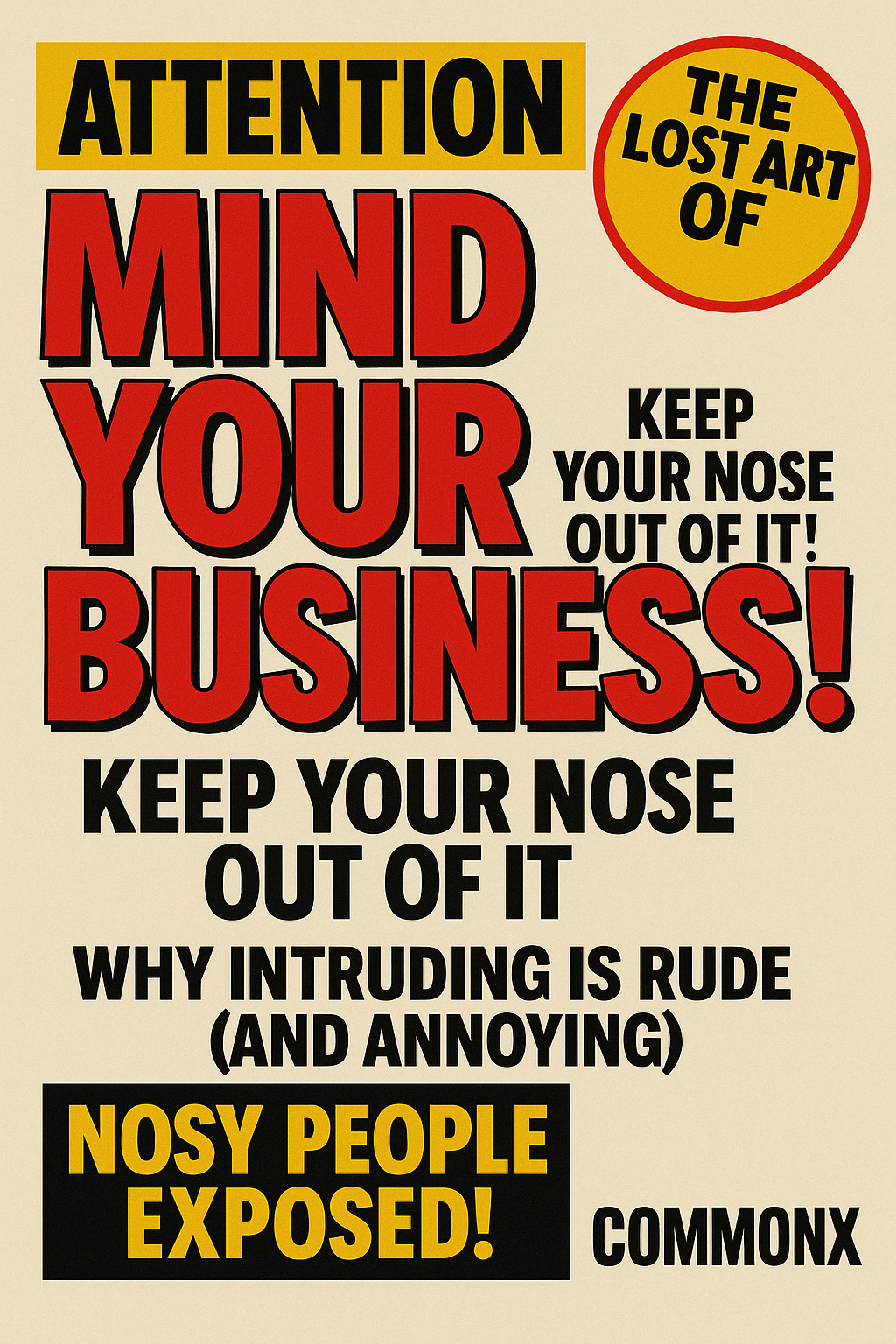
THE LOST ART OF MINDING YOUR OWN BUSINESS
People used to stay in their lane — now everyone has an opinion about everything you do. Here’s the funny, brutally honest look at why society stopped minding its own business and why getting back to it might save your sanity.

Once upon a time, people minded their own business. They stayed in their lanes. They kept their noses where God intended them to be — on their face, not in someone else’s life.
But somewhere between the invention of Facebook, the rise of influencers, and Karen culture going full nuclear, humanity lost the ability to just shut up and look away.
Welcome to 2025, where everyone thinks they’re:
a detective,
a life coach,
a therapist,
a parental supervisor,
a neighborhood watch captain, and
a moral authority…
…all before noon.
So let’s break this down CommonX-style.
1. People forgot that curiosity isn’t a personality.
Look — we all get curious sometimes. But modern nosiness is a whole different beast.
People now treat YOUR life like it’s THEIR personal Netflix show.
Who are you dating?
What are you eating?
Why did you post that?
Why did you not post that?
Why are you wearing that shirt?
Why are you quiet today?
Why didn’t you reply?
Why don’t you smile more?
Bro… relax. Take a deep breath. Drink some water. Touch literal grass. Being nosy isn’t a hobby — it’s a disease.
2. Social media convinced everyone that they’re part of your story.
Once you post anything — ANYTHING — people think they earned a backstage pass to your entire life.
You make one comment?
Suddenly they’re in your DMs like:
“ACTUALLY, here’s what I think about a situation that has nothing to do with me…” Cool. Thanks for your TED Talk, Susan. Nobody asked. Posting isn’t an invitation. It’s just posting.
3. Misery loves company — and nosy people love drama.
People don’t poke their noses around because they care. They poke around because they’re bored. Life’s not exciting? No problem — just latch onto someone else’s and pretend you’re helping. The modern nosy person LOVES:
stirring pots
spreading “concerns”
taking screenshots
misinterpreting everything
playing victim
whisper campaigns
being offended on behalf of people who aren’t offended
It’s a personality glitch.
4. Everyone thinks they’re the morality police now.
You can’t do ANYTHING without somebody jumping in with an unsolicited opinion.
Eating meat?
Monster.
Eating vegan?
Snowflake.
Lifting weights?
Toxic masculinity.
Not lifting?
No discipline.
Quiet?
Suspicious.
Funny?
Trying too hard.
Successful?
You must’ve cheated.
Struggling?
You must’ve done something wrong. No matter what you do, some nosy human surveillance drone will find a way to be mad about it.
5. People assume “access” when they’ve earned none.
Just because someone knows your name does NOT mean you owe them:
explanations
apologies
clarifications
emotional labor
updates
insight
justifications
responses
your entire psychological profile
Access is EARNED — not taken.
6. The solution is embarrassingly simple: MIND YOUR OWN BUSINESS.
Don’t like what someone’s wearing? Look away. Don’t like someone’s relationship? Not your life. Don’t like what someone posted Scroll. Don’t like how someone parents their kid? Parent your own.
Don’t like how someone talks, walks, lifts, eats, thinks, or votes? Cool. That’s what being an adult is — coexisting with people who aren’t copies of you. The world would be 80% calmer overnight if people just:
“Focused on their own shit.”
7. The people who mind their business are ALWAYS happier.
They’ve got:
less drama
more peace
more focus
better relationships
better mental health
actual hobbies
time to build something real
time to reflect
time to improve themselves
You know why? Because they’re not wasting their life narrating someone else’s.
Final Word
Minding your own business isn’t rude.
It’s not cold.
It’s not antisocial.
It’s a superpower.
It’s emotional maturity.
It’s personal freedom.
It’s respecting boundaries.
It’s understanding that the universe doesn’t revolve around your opinions. And if more people practiced it? Life would instantly get quieter, saner, happier, and WAY less annoying.
So here’s the official CommonX decree:
Mind your business.
Drink water.
Lift weights.
Build your life.
Let people live.
Nosy people are exhausting. Be the opposite.
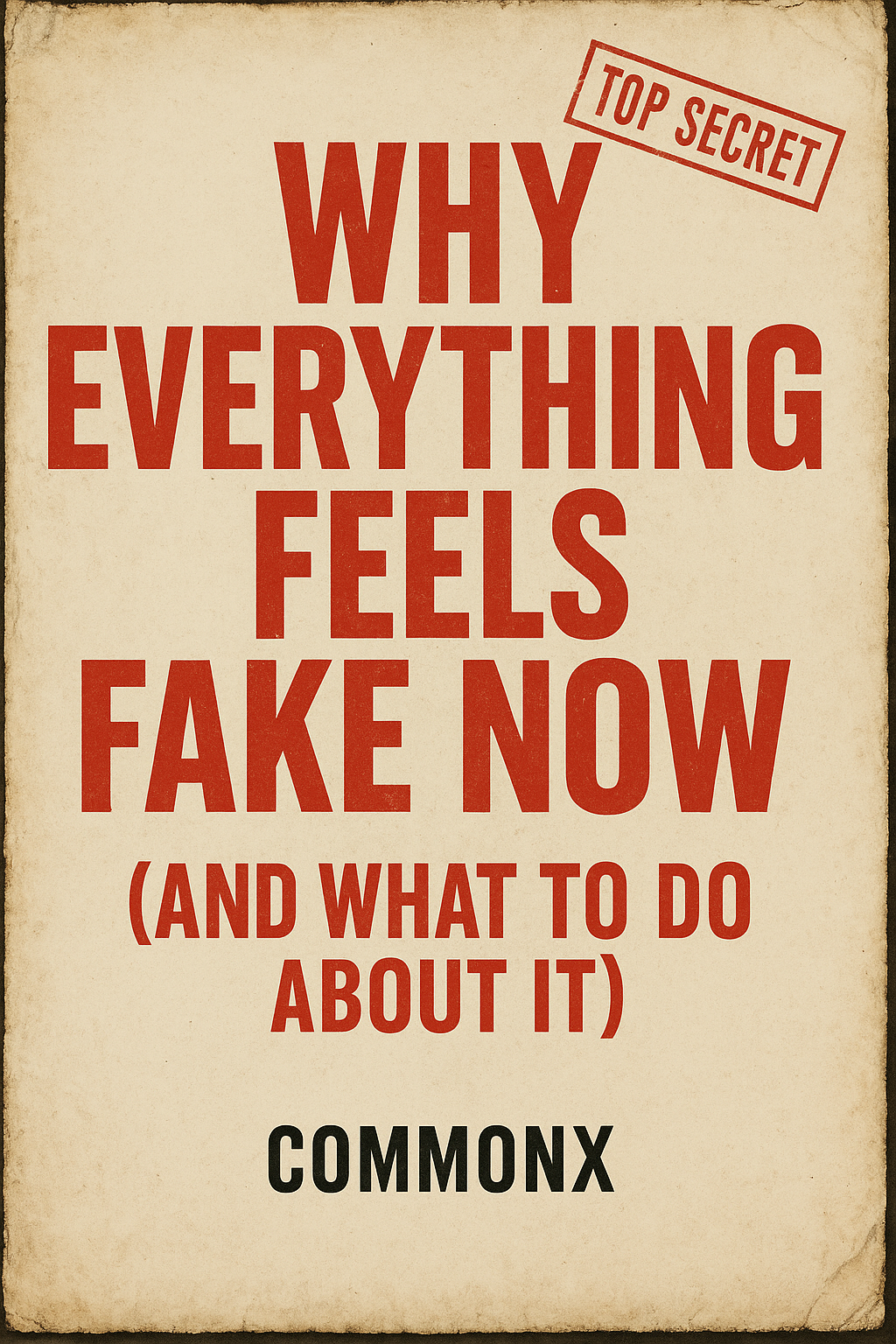
WHY EVERYTHING FEELS FAKE NOW (AND WHAT TO DO ABOUT IT)
If the world feels staged, scripted, and hollow lately, you’re not imagining it. Here’s why modern life feels so fake — and what you can actually do to bring real moments, real connection, and real meaning back into your daily life.

You don’t have to be a philosopher, a scientist, or a spiritual guru to notice it — something about the world feels… off lately.
People feel off.
Conversations feel off.
Work feels off.
Relationships feel off.
The internet feels very off.
Everything feels a little staged, scripted, filtered, packaged, polished, and hollow. It’s not that life is meaningless — it’s that the meaning has been watered down until it tastes like room-temperature tap water.
If you’ve been feeling it too, you’re not crazy.
You’re not alone.
You’re just awake.
So here’s the breakdown:
Why everything feels fake now — and what the hell we can actually do about it.
1. We replaced real experiences with “content opportunities.”
People don’t just live their lives anymore — they curate them. Vacations aren’t vacations. They’re photo shoots.
Outings with friends turn into staged clips. Anniversaries become slideshow captions. Meals get treated like museum exhibits. We’re not documenting life. We’re performing it. Real moments feel rare because we’re too busy trying to capture them instead of being in them.
2. Everyone is branding themselves 24/7.
We used to have personalities. Now we have personal brands.
People change how they talk, dress, and act based on how it will look online instead of how it feels inside. You aren’t talking to a person anymore — you’re talking to their PR department. And when everyone is trying to be a “version” of themselves, you stop seeing the real thing.
3. We’re drowning in ads disguised as authenticity.
The influencer who “just loves this product”? Paid.
The celebrity who “randomly discovered this brand”? Paid. The heartfelt post with hashtags at the bottom? Paid. We’re stuck in a world where the line between genuine and sponsored is basically invisible. When everything becomes marketing, nothing feels real.
4. Technology outran humanity.
We built:
AI faces
AI voices
AI art
AI relationships
AI conversations
AI EVERYTHING
But we never stopped to ask how much artificial life a real human psyche can tolerate before it cracks. We live in the most “connected” era in human history — and yet nothing feels personal. Screens simulate connection, but they don’t deliver it.
5. Outrage is the new entertainment.
Everyone is performing emotions now. Anger is exaggerated. Sadness is monetized. Happiness is faked. Grief is staged. Opinions are calculated. Everything is turned up to 11 because subtlety doesn’t get clicks. And when emotions become currency, the real ones go broke.
6. Algorithms decide what you see — not your own eyes.
Your “feed” is not a window. It’s a mirror. It only reflects what you’ve already clicked on, liked, watched, or paused on for a second too long. You’re not seeing the world. You’re seeing your personalized simulation of it. Everything feels fake because everything is tailored — nothing is universal anymore.
7. Everyone is terrified of having an unfiltered opinion.
People walk on eggshells. Everyone’s afraid to offend someone, somewhere.
So instead of speaking from the heart, we speak from a script. We don’t talk to understand — we talk to avoid trouble. When people are scared to be real, everything around them becomes fake.
8. Modern life hides all the real struggle behind closed doors.
Nobody posts:
the breakdown
the bills
the sleepless nights
the fear
the arguments
the loneliness
the insecurity
the “I don’t know what I’m doing” moments
They post the mask. They post the highlight reel. Meanwhile everyone is quietly falling apart behind the scenes thinking they’re the only one. You’re not. Everyone feels this.
So… what do we do about it?
Luckily, the solution isn’t complicated.
It’s not easy,
but it’s simple.
Here’s how you start feeling real again:
1. Talk to real humans — in person.
The quickest way to kill the “fake world” feeling is to sit down with someone face-to-face. Voices. Bodies. Eye contact. Tone. Real reactions. It resets your brain like a hard reboot.
2. Do one thing every day that has zero content value.
Literally:
a walk without posting
a meal without photographing
a hobby nobody knows about
a workout without a selfie
a moment that isn’t shared
Real life grows in private.
3. Limit your scrolling — increase your doing.
Scrolling makes everything feel fake.
Action makes everything feel real.
Move your body.
Touch grass.
Build something.
Learn something.
Clean something.
Create something.
Reality rewards movement.
4. Say how you actually feel.
Even once a day. Give your real opinion. Ask the real question. Speak the real truth. Authenticity is rare now — that’s why it hits so hard.
5. Rediscover the boring stuff.
Real life is:
morning routines
chores
small talk
fixing things
cooking
paying bills
lifting weights
being tired
laughing with friends
showing up
It’s not glamorous.
It’s real.
6. Protect a part of your life from the internet.
Not everything is meant for display. Some love, some struggle, some joy is meant to be lived — not posted.
7. Choose depth over dopamine.
Deep conversations. Deep friendships. Deep work. Deep experiences. The world feels fake because everyone is addicted to surface-level stimulation. Be the opposite.
FINAL WORD
Everything feels fake now… because we’re living too much through screens, simulations, branding, and noise.
But the real world is STILL THERE. It didn’t disappear — it just got buried. You just have to go dig it back up. The moment you do? Life hits different again. And you remember what “real” actually feels like.

Nobody Knows How to Disagree Anymore — A Field Guide for 2025
We used to know how to disagree without blowing up friendships, blocking family members, or turning every conversation into a battlefield. In 2025, disagreement feels impossible — here’s why, and how to fix it.
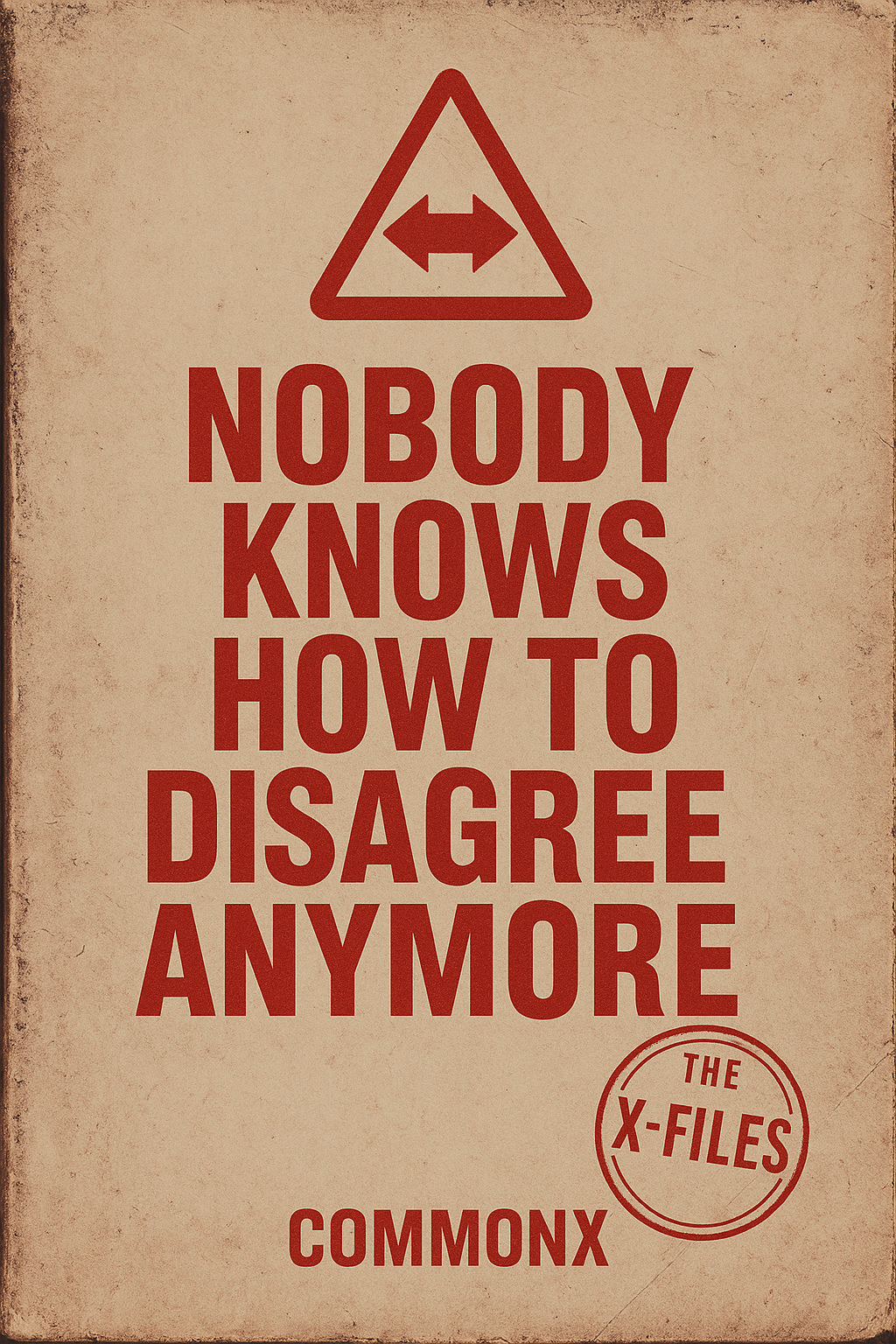
We used to know how to disagree. Not perfectly. Not gracefully. But at least we could sit at the same table, talk about something uncomfortable, and walk away without blocking each other like bitter exes. Now?
Modern disagreement feels like stepping into a minefield wearing gasoline underwear. Somewhere along the way, society didn’t just lose the art of debate — we lost the ability to even stand in the same room as someone who thinks differently. Welcome to 2025. Here’s your field guide.
1. People don’t listen anymore — they reload.
You can see it in their eyes. As soon as you start talking, they’re not absorbing, analyzing, or trying to understand. They’re just waiting for you to stop so they can fire back. This isn’t conversation. This is intellectual laser tag. Nobody wins. Everybody walks away annoyed.
2. Everyone thinks they’re the main character now.
When you believe you’re the star of reality, every disagreement becomes a personal attack on your identity.
It’s no longer: “I disagree with your point.”
It’s: “You’re attacking my entire worldview, my childhood, my ancestors, my aura, my chakras, my dog, and my great-grandpa’s military service.” Relax. It’s not that deep. Sometimes people just see things differently.
3. The loudest “opinions” often come from people who haven’t lived anything.
The internet gave a megaphone to people who used to only talk big in the break room. Now they preach like philosophers with the life experience of a warm soda can. Disagreement gets messy when half the room learned everything from:
30-second videos
Out-of-context clips
Reaction channels
Influencers who haven’t been outside since 2019
You can’t argue with someone who doesn’t live in reality anymore.
4. People forgot you can disagree and still respect someone.
This is the missing skill. You don’t have to align on every worldview to sit at a table, have a drink, or split a pizza with someone. Your best friends shouldn’t be clones. Disagreement is not betrayal. It’s not aggression. It’s conversation.
5. Everything is labeled “hate” now — even simple opinions.
Say you don’t like pineapple on pizza?
You’re a food bigot.
Say you prefer dogs over cats? You’re anti-feline and should be deplatformed.
Say you don’t enjoy a celebrity’s work? Congrats, you’re “spreading negativity.”
We’ve stretched the definition of “hate” so far that the word has lost all meaning. Not everything you disagree with is an attack. Not everything you feel uncomfortable hearing is “harm. Grow thicker skin. We all survived dial-up internet — we can survive a conversation.
6. Disagreement used to be a path to understanding — now it’s entertainment.
Debate has been replaced by:
dunk videos
stitch reactions
“ratioing”
sarcastic memes
performative outrage
People don’t want resolution. They want likes. You can’t solve anything when the crowd wants blood, not clarity.
7. We mistake feelings for facts — and treat both as sacred.
Facts used to matter. Feelings used to matter. Now we confuse the two and protect both like priceless artifacts. Feelings are valid. Facts are useful. But they are not the same thing. You can disagree with someone without invalidating their humanity.
8. Everyone lives in different worlds now — customized by algorithms.
Back in the day, everyone watched the same news, same shows, same cultural moments.
Now?
Your feed is tailored to every soft preference you’ve ever made. We don’t disagree because we’re divided. We disagree because we live in entirely separate universes without realizing it. How do you debate someone who literally doesn’t see what you see?
9. Nobody teaches conflict management anymore.
Schools teach:
advanced calculus
gender bread diagrams
quadratic formulas
But not:
how to talk respectfully
how to set boundaries
how to disagree without exploding
how to end a conversation with dignity
how to handle opposing views
We’re emotionally undertrained.
10. The cure for all of this is stupidly simple.
To fix disagreement in 2025, we don’t need:
committees
task forces
new laws
social media guidelines
a national rebranding campaign
We need something older than all of that:
Actual conversation. In person. With people who don’t think exactly like you. Sit down. Ask questions. Listen to understand. Speak to communicate — not win. You don’t have to avoid conflict. You just have to stop treating it like war.
FINAL WORD
The world isn’t falling apart because we disagree. It’s falling apart because we don’t know how to do it anymore. Disagreement is normal. Healthy. Necessary.
It’s how iron sharpens iron, how ideas evolve, how culture stays balanced. If everyone thought exactly the same, life would be creepy, boring, and probably illegal. So be the person who can disagree with grace, humor, curiosity, and strength. In 2025, that makes you rare. Maybe even heroic.


The Unwritten Rules of Being a Man in 2025 — According to Gen X
Gen X never needed gurus or influencers to explain manhood—we learned through trial, error, and showing up. In 2025, these unwritten rules matter more than ever.

Ask a Gen X man about “the rules,” and he’ll usually shrug and say something like,
“Rules? We just kinda figured it out as we went.”
But that’s the secret.
Gen X didn’t grow up with YouTube gurus, 19-year-old influencers selling “alpha” courses, or 47 podcasts telling you how to be a man.
We had trial, error, a toolbox, a Walkman, and whatever wisdom we could steal from older cousins or Metallica lyrics.
Now it’s 2025 — and the world is louder, softer, stranger, faster, and more confusing than ever.
So here they are.
Not written in any book.
Not taught in any class.
But lived, practiced, and passed on quietly by the last generation that grew up without an undo button.
1. If you say you’re going to do something, you do it.
Gen X didn’t learn honor from philosophy books — we learned it from watching adults show up five days a week, punch in, punch out, and not complain.
The rule is simple: Your word is your currency. Spend it wisely.
2. You don’t have to be loud to be strong. The strongest men we knew didn’t talk about it.
They fixed your bike. Carried the heavy stuff.
Said “I’m proud of you” once a decade — which meant it was sacred.
Today’s world rewards noise. Gen X rewards consistency.
3. Know how to fix at least three things without Googling it
A clogged drain.
A loose door hinge.
A tire that needs changing.
Not because you need to be “macho,”
but because being useful is the original superpower.
4. Don’t treat women like princesses — treat them like partners.
Gen X men figured something out:
Women don’t need saving.
They need someone who stands beside them, not above them.
Partnership > pedestal.
5. If you mess up, own it. Immediately.
Gen X grew up without social media.
When you screwed up, the whole school heard about it by lunch.
We learned real fast:
Accountability stops the bleeding.
Avoidance makes it a circus.
6. Don’t ghost your friends — check in on them.
Especially the quiet ones.
Especially the strong ones.
Especially the ones who “seem fine.”
We’ve buried enough of our generation to know this rule matters.
7. Find a craft, a workout, or a discipline — and stick with it.
Lifting.
Running.
Welding.
Painting.
Woodworking.
Drums.
Writing.
A man needs a skill that keeps him sane when the world goes sideways.
8. Respect your parents — even if they’re complicated.
Gen X had the most chaotic childhood decade in modern history.
Latchkey kids.
Broken homes.
Divorced parents.
No supervision.
Yet we still understand this truth: Forgiveness isn’t approval — it’s freedom.
9. Be dangerous — but controlled.
A man who can fight but chooses peace?
That’s a man worth listening to.
A man who can’t fight and pretends he can? That’s Twitter.
10. Never stop evolving.
The world changes.
Technology shifts.
Jobs disappear.
Families transform.
But resilience?
That’s Gen X’s final superpower.
We adapt.
We rebuild.
We grow — even at 45, 55, 65.
Because being a Gen X man in 2025 means this:
You don’t have to be perfect.
You just have to show up — stronger, wiser, and more grounded than yesterday.
11. You don’t brag about the struggle — you show the results.
Everybody talks now.
Everybody posts everything.
Gen X?
We work in silence, then walk in with results.
12. You leave things better than you found them.
Your relationships.
Your body.
Your home.
Your career.
This world.
If you’re a real Gen X man, you’re not here to impress — you’re here to contribute.
Final Word
Being a man in 2025 doesn’t mean being perfect or tough or emotionless.
It means being grounded.
It means leading quietly.
It means pushing forward when it sucks.
It means taking care of the ones who depend on you — and letting them take care of you when you’re the one who needs the help.
Gen X didn’t ask to be the bridge generation.
But we became it anyway.
Because real men don’t wait for someone else to go first.
We just step forward.

Disconnected: Why a Generation Is Rewriting Sex, Love, and the Rules of Commitment
Modern love is changing fast. As dating apps, digital income, and social independence reshape what connection means, a generation is redefining sex, commitment, and the rules of intimacy. Disconnected explores how technology and trust have collided — and what that says about all of us.

By Ian Primmer – CommonX Contributor
As dating apps, economic anxiety, and digital marketplaces redefine intimacy, young men and women are rethinking what relationships — and even desire — mean in 2025.
Something strange is happening in the love economy.
Across the U.S. and much of the developed world, young adults are quietly stepping away from the very rituals that defined adulthood for decades. Fewer are having sex, fewer are getting married, and many are questioning whether traditional relationships are worth the cost—financially or emotionally.
According to research from Pew Research Center and the UCL Social Research Institute, the share of adults under 35 who reported no sexual activity in the past year has nearly doubled since the early 2000s. Marriage rates have plunged, and the average age at first marriage now hovers near 30 for women and 32 for men—an all-time high. The generational gap isn’t about prudishness; it’s about priorities. Love still matters—but it’s competing with rent, student loans, burnout, and a sense that the game itself has changed.
The Male Retreat
For many young men, intimacy now feels like a high-risk investment with diminishing returns. Housing prices soar, divorce rates linger around 40 percent, and stories of financial ruin circulate online like cautionary folklore. Meanwhile, digital substitutes—everything from short-form video escapism to AI chat companions—offer instant validation without heartbreak or half a paycheck disappearing in a settlement.
This isn’t necessarily apathy. It’s self-preservation. A generation raised on instability is choosing control over chaos, even if that control means going it alone.
The Female Revolution
On the other side of the equation, women have achieved unprecedented autonomy. Economic independence and reproductive rights have rewritten what partnership looks like—and whether it’s even required. Many are embracing freedom, delaying marriage, or building careers and communities that exist outside domestic expectations. The result is empowerment, but also a dating marketplace that feels less predictable, less reciprocal, and sometimes less trusting.
Both shifts are rooted in the same story: choice. For the first time, both sexes can truly opt out—and some are exercising that option.
The Digital Marketplace
Technology has become the new matchmaker and the new wall between people. Apps promise infinite options, yet endless choice can make commitment feel obsolete. Subscription platforms like OnlyFans and the influencer economy have further blurred the line between attention, affection, and income. To some men, intimacy now looks transactional; to many women, monetizing image and autonomy is empowerment. Both views are valid—and both leave people wondering if genuine connection can survive an algorithm.
The irony? Everyone is still searching for meaning, but the signals are jammed by noise.
Recalibrating Connection
What’s emerging isn’t the death of love—it’s the recalibration of it. Relationships are being redefined by transparency, equality, and timing rather than obligation. For some, that feels liberating. For others, it’s isolating. Either way, the script has changed: sex and marriage are no longer prerequisites for adulthood, and emotional independence has become its own badge of honor.
Maybe that’s progress. Or maybe, as Gen X watchers like us suspect, it’s a symptom of a world that’s traded depth for options.
The CommonX Take
This moment says less about romance and more about society’s bandwidth. We’ve built technology that connects everyone—but rarely long enough to stay. We’ve made freedom the ultimate goal, yet we’re lonelier than ever. The next evolution of intimacy may not be about choosing sides at all—it might be about learning how to stay human in a world that rewards disconnection.
Because love, even now, still cuts through the static. It just has to fight harder to be heard.