
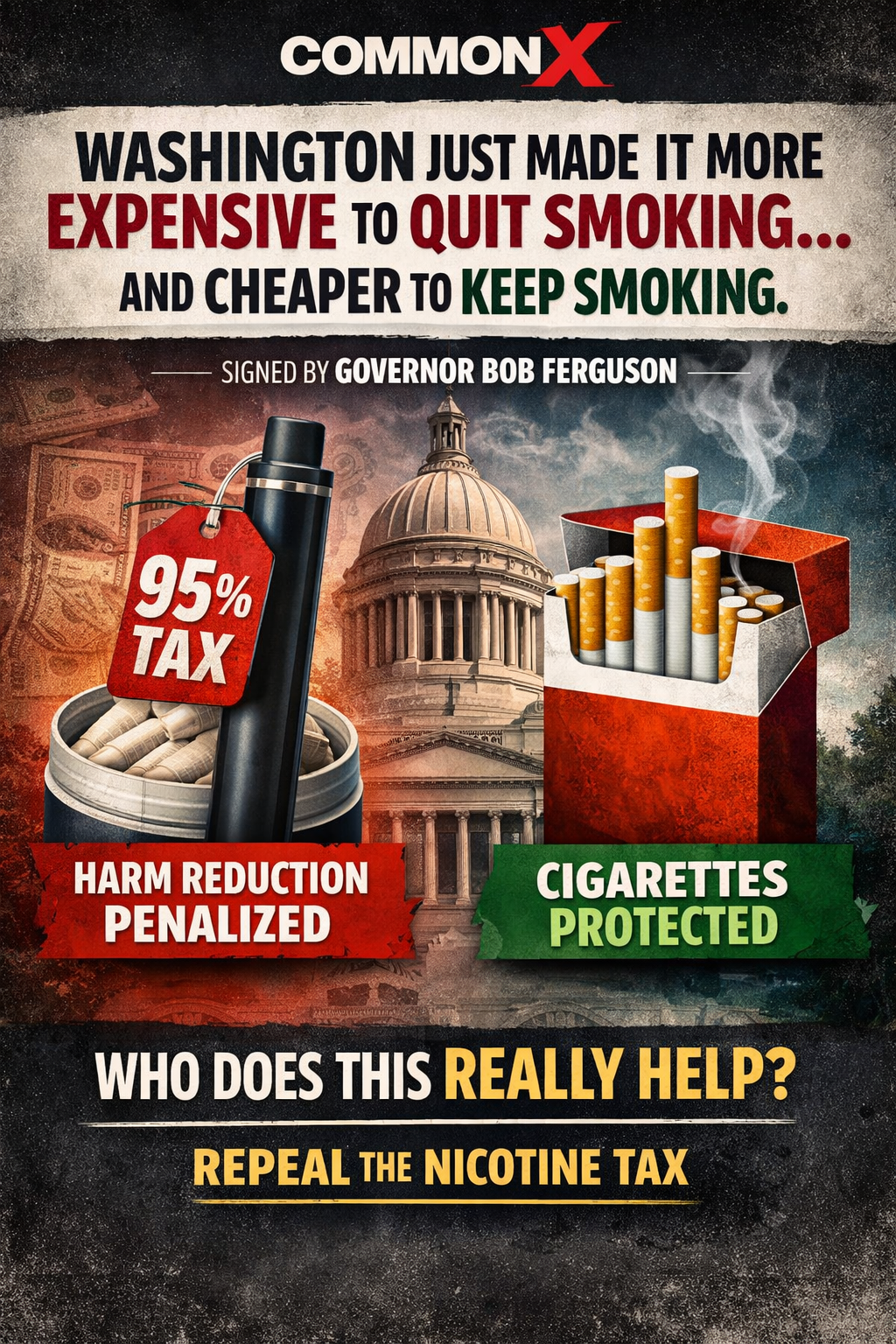
Washington State Just Made It More Expensive to Quit Smoking — and Cheaper to Keep Smoking
Washington just made it more expensive to quit smoking and easier to keep smoking. A new 95% tax on nicotine alternatives like vapes and pouches is about to hit former smokers where it hurts — their wallets — while cigarettes escape the same punishment. Signed into law by Governor Bob Ferguson, the policy raises serious questions about whether Olympia is protecting public health… or protecting revenue.
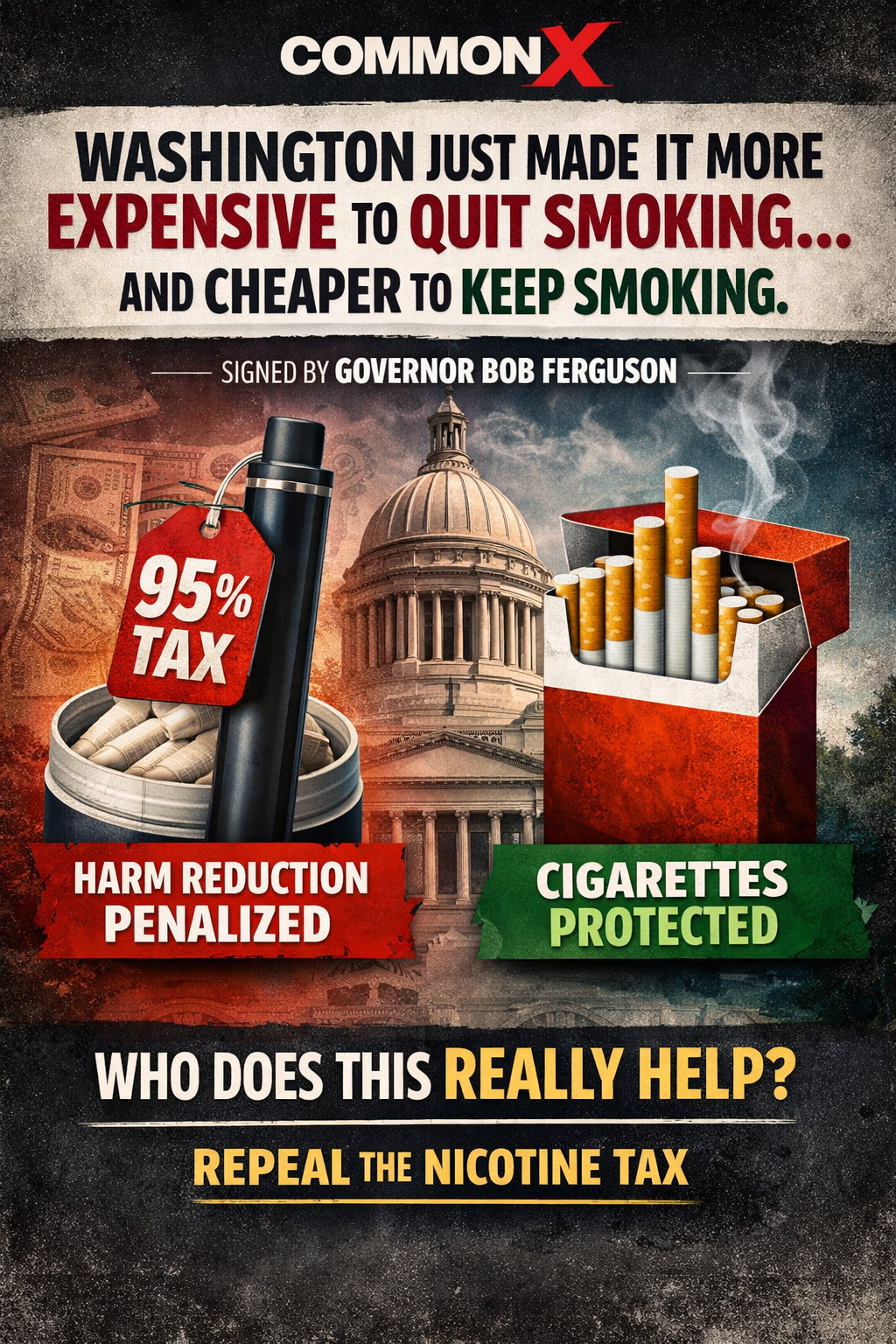
How a new state tax signed by Governor Bob Ferguson could push ex-smokers back into cigarettes — and what citizens can do about it.
By Ian Primmer — CommonX Podcast
OLYMPIA, WA — Beginning January 1, 2026, Washington state will impose a 95 % excise tax on nearly all nicotine-containing products — including synthetic nicotine pouches, vaping devices, and other alternative nicotine products — by bringing them under the state’s tobacco products tax. The change was made through Senate Bill 5814, signed into law by Governor Bob Ferguson as part of the 2025 legislative session.
What that means in real terms: a pack of nicotine pouches or a disposable vape that used to cost $7 might now cost more than $15 with the tax added — nearly doubling the cost of products many people depend on to stay away from cigarettes.
A Public-Health Contradiction
When Washington expanded its tobacco tax law to include nicotine products, lawmakers said they were adapting to a changing market — but critics argue the result is a policy that punishes people for quitting cigarettes. Because cigarettes themselves are taxed under a different structure, this new tax can make safer alternatives more expensive, even though federal regulators consider some of those products to be lower-risk than combustible tobacco.
For many former smokers, vaping and nicotine pouches have been key tools to quit the far deadlier habit of smoking. But when the cost of these alternatives soars, the financial incentive to stay smoke-free weakens — and some may find themselves sliding back toward cigarettes, the very thing they worked hard to quit.
Governor Ferguson’s Role
Governor Ferguson had the authority to veto the tax provisions in the budget but instead approved the package that included the nicotine tax increase. His signature means this policy now stands as law and will begin affecting consumers and small businesses early next year.
Critics argue that this decision contradicts broader public-health goals — and that it was driven more by revenue needs than by science-based health policy.
The Unintended Consequences
Public-health research shows that when healthier alternatives to smoking become less affordable than cigarettes, substitution patterns can reverse: people who are trying to quit may keep smoking instead of using taxed alternatives — exactly the opposite of what public health policy should encourage. Some legal challenges have already been filed, arguing that the way the law is being applied to vapes and other products may exceed what the Legislature actually intended.
How We Fix It
This policy isn’t set in stone — and Washington residents have at least three clear paths to change it.
1. Initiate a Ballot Measure to Repeal or Amend the Tax
Washington’s Constitution allows citizens to gather signatures to put a measure on the ballot that would:
Repeal the expanded nicotine tax,
Or adjust it so cigarettes and nicotine-replacement products are taxed equitably,
Or exempt nicotine products used as smoking-cessation tools.
To qualify, an initiative typically needs signatures from about 8 % of the votes cast in the last governor’s election, spread across at least five counties. That’s roughly 325,000 valid signatures in total — a heavy lift, but feasible with coordinated effort.
2. Support or File a Legal Challenge
Already, some petitions argue that the tax is being applied in a way that conflicts with existing statutes or exceeds legislative authority. Those cases could delay enforcement or narrow how the tax is interpreted if courts agree.
3. Elect New Representatives with Better Health-Policy Judgement
Policy change flows from the ballot box as well as the initiative process. Supporting candidates who understand harm reduction and public-health science can shift the legislature’s priorities in future sessions.
Why This Matters
This isn’t just a tax story — it’s a public-health story about people who worked for years to quit smoking and now face a policy that could push them back into the very habit that harms them most. It’s a story about accountability and policy that actually helps people make healthier choices. And voters, not Olympia alone, should decide whether Washington’s government has gotten it right.
Governor Ferguson thinks he can’t be stopped, yes WE can stop him!

Why Tensions Are Rising Between ICE Agents and American Citizens
A fatal ICE shooting in Minneapolis has ignited protests and renewed questions about federal enforcement, public trust, and how communities and agents collide in high-pressure situations. In this CommonX X-Files report, we examine what’s known, what’s still being investigated, and why tensions between ICE and American citizens are rising across the country.

If you’ve felt it lately — that uneasy sense that everyday people and federal enforcement are bumping into each other more often — you’re not imagining things.
Over the past week, the tension has boiled over after a fatal encounter in Minneapolis involving a U.S. Immigration and Customs Enforcement (ICE) officer and a 37-year-old woman, Renée Nicole Good, during a federal operation. The incident has sparked protests, conflicting official narratives, and a broader national argument about enforcement tactics, accountability, and public trust.
This X-Files isn’t here to inflame anything. It’s here to do what CommonX does best: stick to verified facts, identify what’s still unknown, and explain why people are reacting so strongly.
What happened in Minneapolis — the verified basics
Multiple outlets report that Renée Nicole Good was fatally shot during a federal enforcement operation in Minneapolis. Public reporting describes competing accounts of what led up to the shooting and whether the use of force was justified.
The Department of Homeland Security has stated the officer acted in self-defense, while local and state leaders have publicly challenged aspects of the federal narrative.
ABC News has published a detailed, time-stamped timeline based on available video, which has become central to how the public is interpreting what happened.
Why this story became bigger than one city
One reason this spread fast is simple: the trust gap is already wide, and high-stakes enforcement in public spaces puts that gap on full display.
In Minneapolis, protests followed quickly. Reuters reported arrests overnight and damage reported near hotels believed to be housing federal agents. At the same time, city officials urged people to remain peaceful to avoid escalation.
Reuters also reports protest organizers planning over 1,000 events nationally, signaling the story has moved from “local tragedy” into “national flashpoint.”
The core issue: tactics, training, and escalation
A lot of the argument isn’t about whether the federal government can enforce immigration law. It’s about how enforcement is carried out when:
agents are operating in neighborhoods,
crowds gather,
vehicles are involved,
and split-second decisions can end a life.
The Washington Post reports the Minneapolis shooting has intensified scrutiny of ICE training and use-of-force tactics, including debate among experts over best practices around vehicles and officer positioning.
This is where tension grows: when people believe an encounter could have been de-escalated — and the other side believes the threat was real in the moment.
Conflicting investigations make people more suspicious
When investigations appear fragmented or contested, suspicion spikes. Minnesota’s Bureau of Criminal Apprehension (BCA) published a statement indicating it remains open to conducting a full investigation if federal authorities resume a joint approach or share evidence and reports.
When the public sees “different agencies, different accounts, different access to evidence,” trust erodes — even before final facts are established.
What CommonX thinks Americans are reacting to
Here’s the honest read:
People aren’t just reacting to one incident — they’re reacting to the feeling that the rules of engagement between citizens and enforcement are getting blurrier, and the consequences are heavier.
Some citizens see an enforcement posture that feels aggressive and unchecked. Others see federal agents doing a dangerous job and being surrounded, filmed, confronted, and forced into rapid decisions.
Both fears can exist at once — and that’s exactly why these moments turn into national tension.
Where we go from here
We’ll keep this simple and grounded:
More verified details will emerge (video, investigations, policies).
Public demonstrations will continue and the national conversation will sharpen.
The long-term question will be whether agencies adjust tactics and transparency to rebuild trust.
CommonX will follow the facts — and we’ll update as official findings become clear.