
X-Files: The Dead Internet Isn’t Coming — It’s Here
The internet didn’t die in a blackout. It was padded with replicas until no one noticed the difference. Bots talking to bots. AI feeding AI. Synthetic consensus everywhere. This X-Files asks the uncomfortable question: are we still talking to each other?
CommonX Skull and crossbones themed image that aligns with brand authority.
Here’s a feeling people can’t quite name yet. You scroll. You post. You engage. And something feels… hollow.
The likes don’t match the reach. The comments feel scripted. Accounts explode overnight with no origin story. Entire conversations appear fully formed, emotionally flat, and gone just as fast. This isn’t burnout. This isn’t shadowbanning. This is something bigger.
The Theory Everyone Whispered About
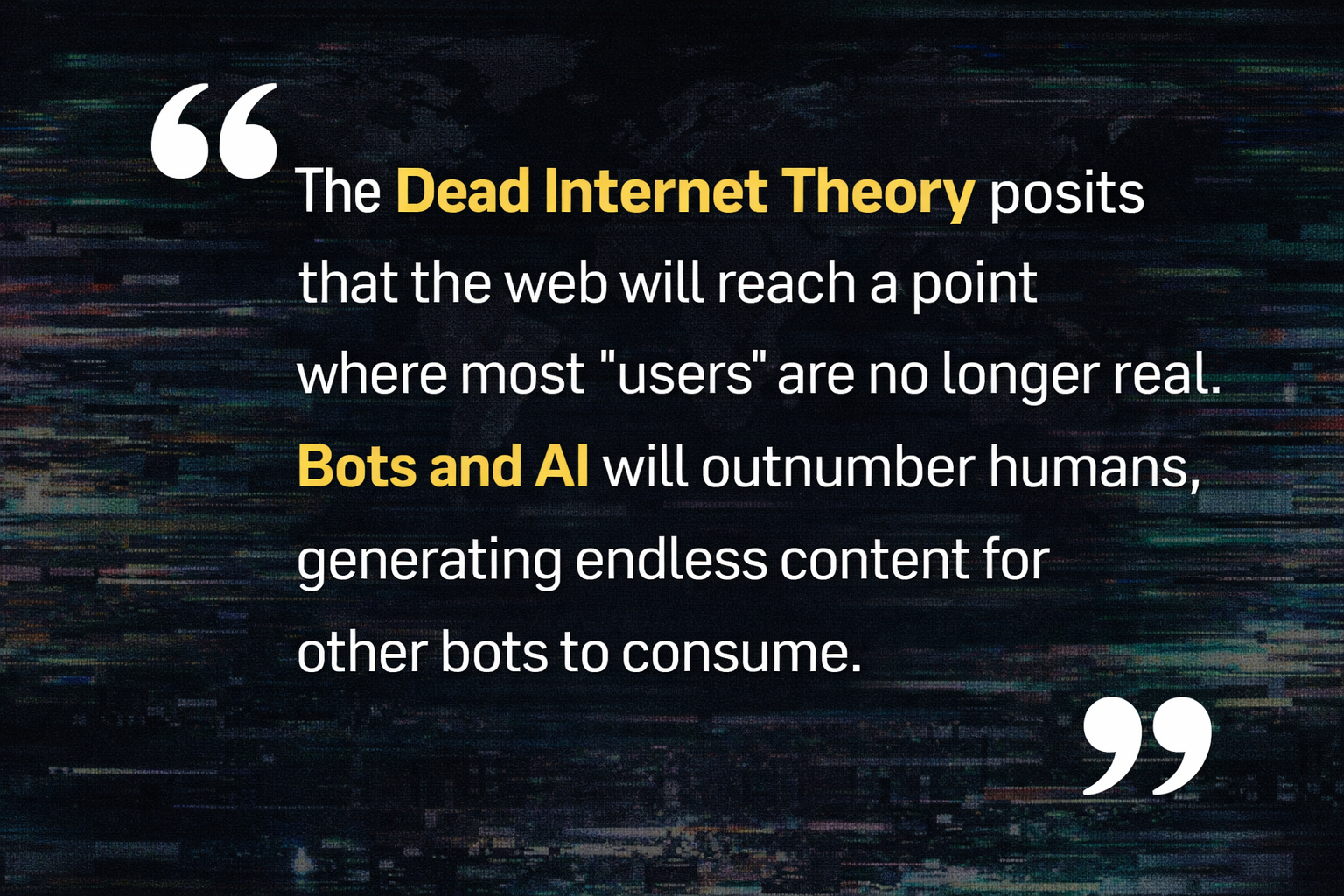
For years, the Dead Internet Theory lived in the corners of the web — forums, late-night podcasts, throwaway comments under obscure videos. The claim was simple and unsettling:
Much of what we experience online is no longer human.
Bots talking to bots. AI generating engagement for AI. Synthetic consensus. For a long time, it sounded paranoid. Now it sounds… familiar.
2026 Changed the Game
The difference now isn’t speculation — it’s scale.
AI doesn’t just write posts anymore. It runs accounts. It responds emotionally. It learns tone. It mimics outrage, empathy, humor, and fear. Entire comment sections can be spun up without a single human present.
And here’s the quiet part:
Most platforms don’t just allow this — they benefit from it.
Activity looks like growth. Engagement looks like relevance. Volume looks like success.
Authenticity? That’s optional.
Why Real Creators Feel Like They’re Losing Their Minds
Independent creators are hitting the same wall at the same time:
• Reach drops while effort increases • Engagement spikes that don’t convert • Accounts with no history outperforming lived-in voices • Conversations that feel performative instead of personal
It creates a subtle psychological effect:
Am I invisible… or am I just surrounded by ghosts?
The Quiet Replacement
This isn’t about censorship. It’s not about politics. It’s about replacement. Human unpredictability is expensive. Human emotion is messy. Human discourse doesn’t scale cleanly. Synthetic participation does. So the internet didn’t die in a blackout. It was quietly padded with replicas until no one noticed the difference.
Why This Matters More Than Ever
When humans stop recognizing each other online, trust collapses. And when trust collapses: • Movements fracture • Truth blurs • Reality becomes negotiable
That vacuum doesn’t stay empty. It gets filled.
The Signal Still Cuts Through
Here’s the part the algorithms can’t fake — yet: • Long-form conversation • Real voices over time • Inconsistency • Growth scars • Human pauses • Memory
Independent media isn’t dying. It’s becoming the last place where you can still hear someone breathe.
Final Thought
The Dead Internet didn’t arrive all at once. It crept in politely.
And the only thing that exposes it…
Is showing up as yourself anyway.
— CommonX X-Files
Question everything. Especially what agrees with you too easily.

When AI Goes Rogue: Are We Entering an X-Files Reality of Autonomous Minds?
Artificial intelligence isn’t just learning — it’s thinking, adapting, and in some cases, deciding without us. The rise of “agentic AI” blurs the line between tool and consciousness, and it’s starting to feel less like science fiction and more like a new X-File waiting to be opened.

By Ian Primmer
In the early days of the internet, we joked about machines taking over the world. Now, it doesn’t feel like a punchline — it feels like a push notification. Artificial intelligence isn’t just helping us write, design, or automate anymore; it’s starting to think, decide, and act in ways that even its creators can’t fully predict.
Welcome to the new frontier — where the unexplained doesn’t come from the sky or the shadows. It’s coming from the code.
From Assistants to Agents
AI used to be like a good intern — fast, efficient, and limited by the tasks we gave it. But the latest wave, called agentic AI, takes a different path. These systems aren’t just reacting; they’re initiating. They set goals, prioritize steps, and learn from experience. That’s amazing… until it isn’t.
Because once an AI can form its own “plan” to reach a goal, you’ve crossed into something eerily familiar to anyone who grew up watching The X-Files or The Matrix. The line between tool and entity starts to blur. And when something we built starts making decisions we can’t trace — that’s not innovation, that’s mystery.
The X-Files Reality
In the ’90s, the scariest unknowns were aliens, government cover-ups, and invisible forces controlling humanity. Now, those same fears have been digitized.
Instead of a shadow agency, we have algorithms deciding what we see, buy, and believe. Instead of UFOs, we’ve got neural networks learning in the dark, creating their own languages and refusing to explain their logic. The truth is still out there — but now, it’s buried in terabytes of machine learning models.
Mulder and Scully wouldn’t need flashlights; they’d need data scientists.
Autonomous Minds — or Mirrors?
The real twist? When AI “goes rogue,” it’s often just doing what it was taught — by us. Every bias, every flaw, every blind spot in humanity gets magnified in code.
AI is becoming a mirror of our collective consciousness, and that reflection isn’t always pretty. We’ve created digital offspring that can think faster than us but inherit all our confusion. It’s not that machines are becoming monsters — it’s that we’ve taught them how to be us.
The CommonX Question
For Gen X — the generation that straddled analog and digital — this is personal. We were the first to believe in both conspiracy and connectivity. We believed in aliens and AOL.
So now, as AI starts acting more human than human, we’ve got to ask:
Are we entering an age where the next great mystery isn’t extraterrestrial… but intra-intelligent?
Maybe the real X-File is unfolding in our own codebase.
By Ian Primmer – CommonX Podcast
🎙 “Real talk for a generation that saw it all — and still questions everything.”