
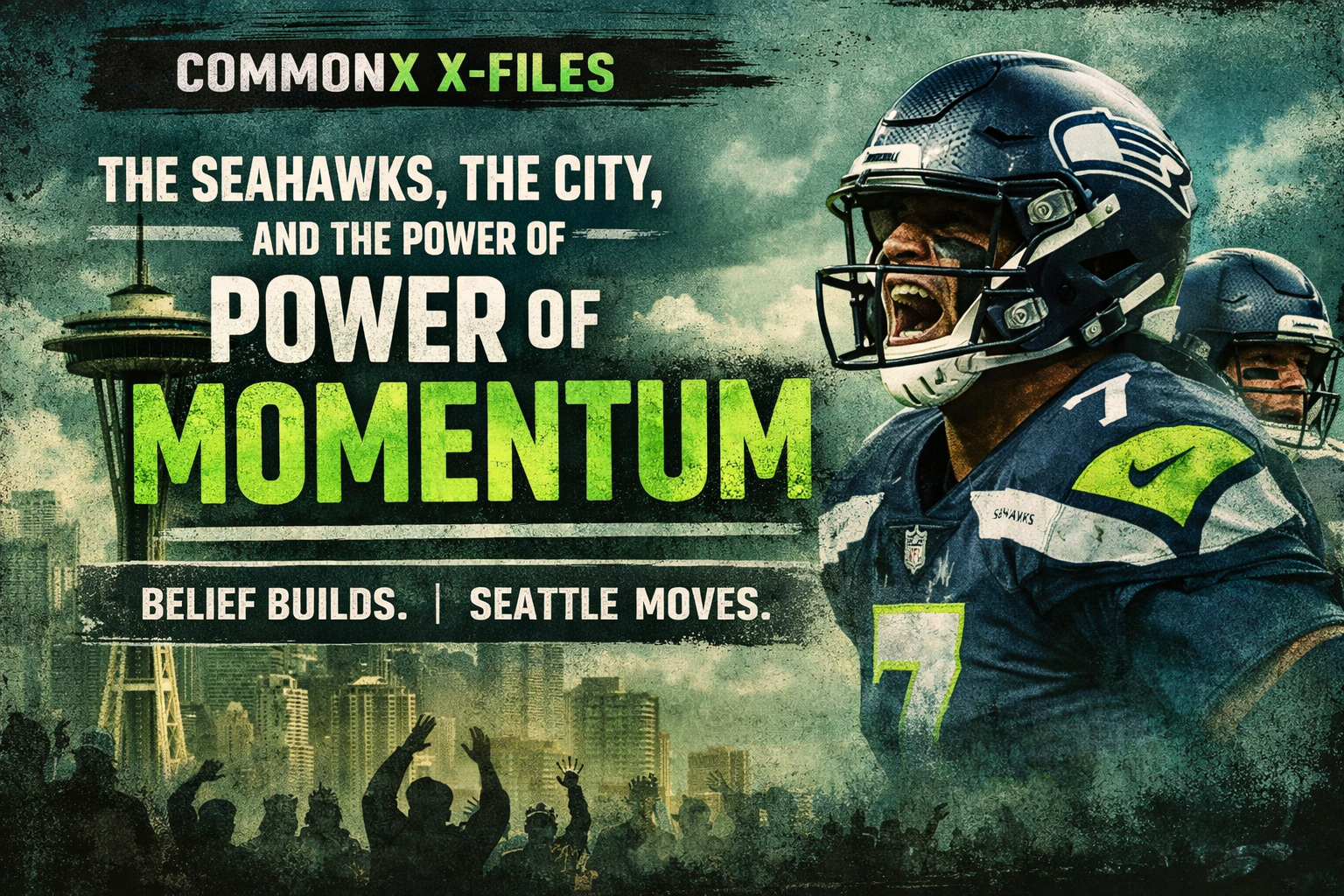
The Seahawks, the City, and the Power of Momentum
It’s more than football. It’s momentum, belief, and a city remembering who it is. As the Seahawks surge forward, Seattle moves with them.
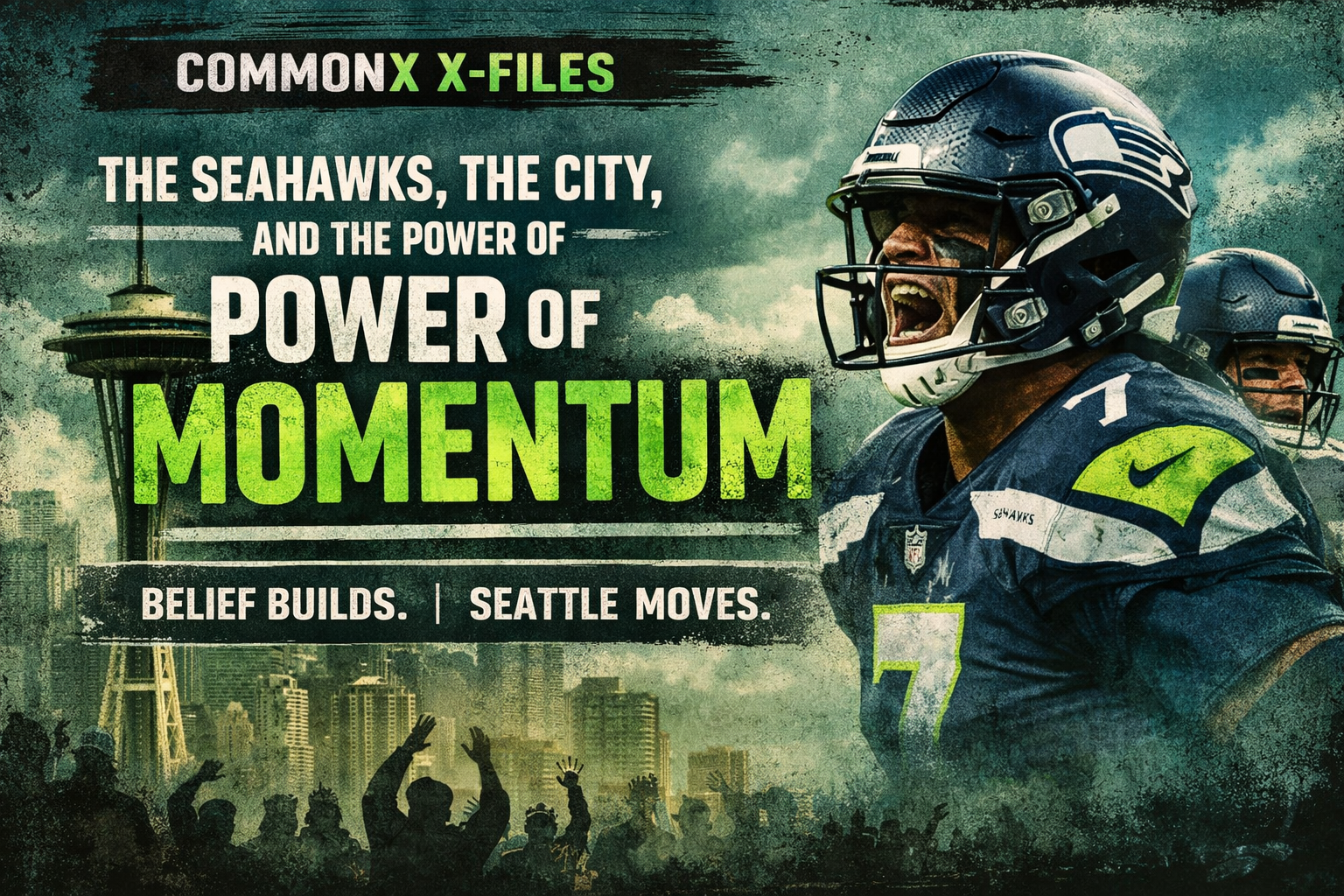
By Ian Primmer, Co-host, CommonX Podcast
Something is happening in Seattle.
You can feel it before you can explain it. In the way people talk. In the way they argue less and believe more. In the way Sundays suddenly matter again. This Seahawks run isn’t just about wins and losses — it’s about momentum, and what happens when a city remembers who it is.
Momentum doesn’t show up politely. It doesn’t wait for analysts to agree. It just starts moving — and either you feel it, or you don’t. Seattle feels it.
Seattle has never been handed anything. This city is built on doubt and grit. On rain-soaked patience. On people doing the work without asking for applause. Whether it’s music, tech, labor, or sports, Seattle has always lived in the space between overlooked and undeniable. The Seahawks reflect that identity.
Underrated teams. Questioned quarterbacks. Systems that “shouldn’t work.” And yet, when the Hawks are right, they don’t just win games — they rewrite expectations. This run feels different because it feels familiar. It feels like Seattle being Seattle again.
Momentum is contagious — and rare. In a fractured culture, it’s one of the last forces that still unites people. Politics divide. Media fragments. Algorithms silo. But sports still cut through everything. For a few hours, strangers agree. Cities breathe in sync.
Momentum isn’t just confidence. It’s alignment.
When a team starts believing in itself at the same time a city starts believing again, something bigger happens. You don’t just watch. You lean in. That’s where Seattle is right now. And the timing matters.
People are tired. Tired of chaos. Tired of bad news. Tired of being told nothing works anymore. That’s why wins matter right now. Not because they fix everything — but because they remind people that momentum still exists. That effort still compounds. That belief still scales.
The Seahawks aren’t just playing football. They’re offering proof of concept. Proof that momentum hasn’t disappeared. Proof that belief still moves people. Proof that the city hasn’t lost its edge.
This isn’t nostalgia. It’s recognition.
A team finding rhythm.
A city finding its voice.
A moment where effort meets opportunity. Momentum doesn’t ask permission. The Seahawks don’t ask permission to compete.
Seattle doesn’t ask permission to believe.
And right now — the city is moving.

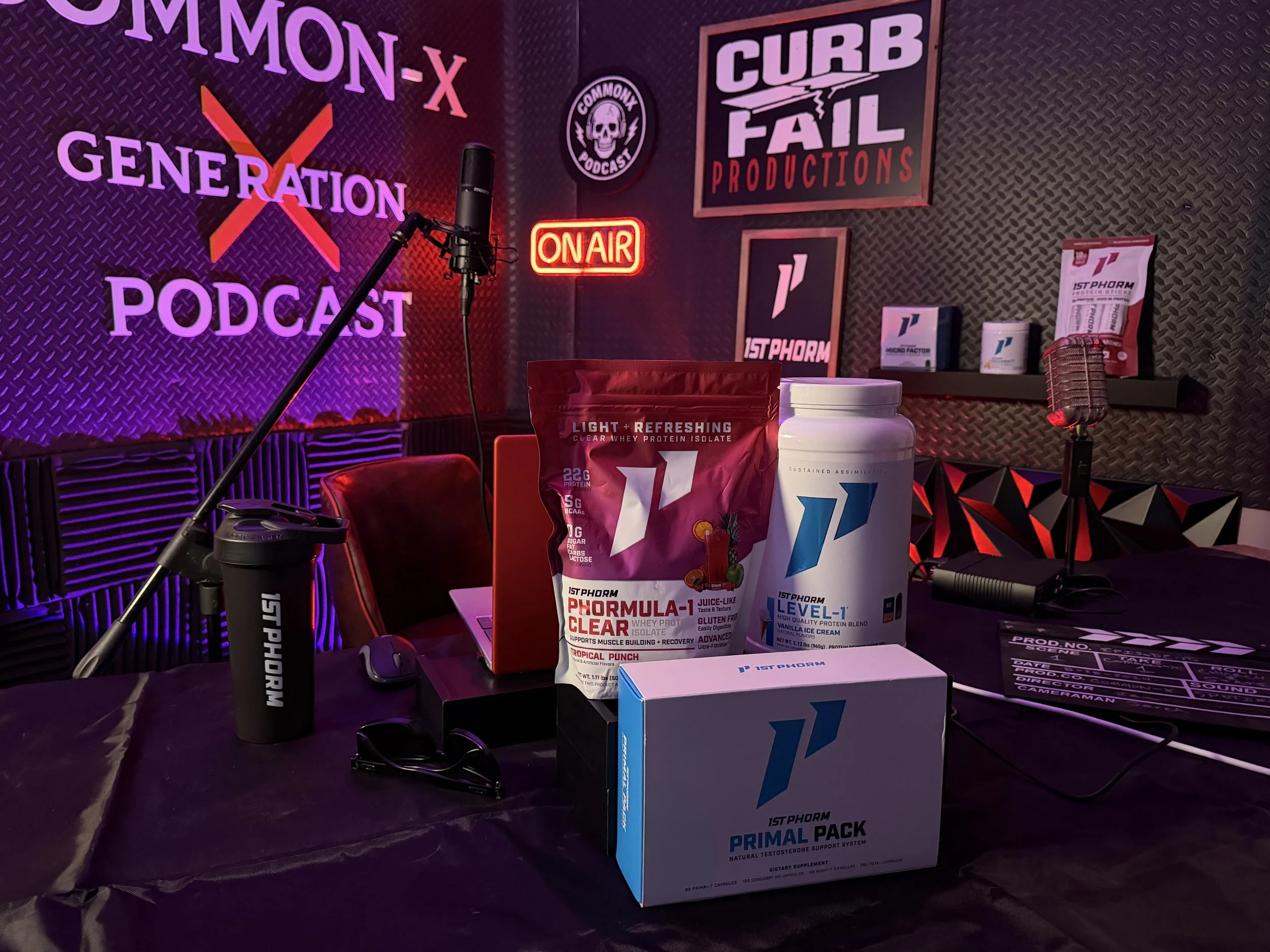
Why CommonX Is Aligning With 1st Phorm — And What It Says About Where We’re Headed
CommonX shares why its growing relationship with 1st Phorm reflects a deeper alignment around discipline, accountability, and personal responsibility—without hype or premature announcements.
Momentum doesn’t always start with contracts and press releases. Sometimes it starts with alignment.
Over the past year, the CommonX Podcast has evolved from a grassroots conversation into a growing platform focused on accountability, discipline, culture, and personal responsibility. As the show has matured, so has our approach to health, performance, and how we show up—both behind the mic and in everyday life.
That’s what made our recent connection with 1st Phorm meaningful.
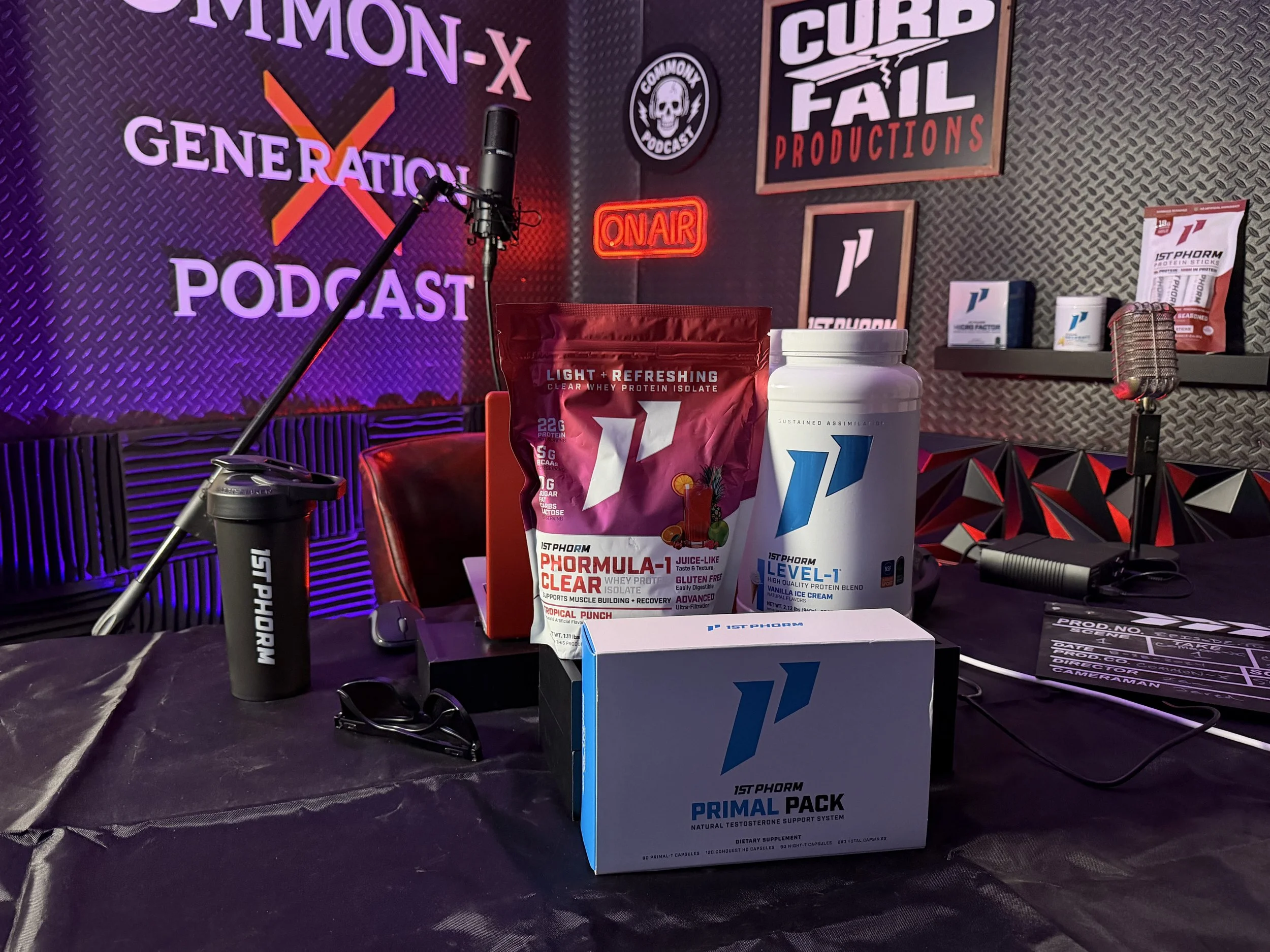
While nothing official has been announced, the team at 1st Phorm reached out, engaged with our work, and sent product our way as we continue conversations about potential collaboration. No scripts. No talking points. Just mutual respect and shared values.
And that matters.
1st Phorm has built its reputation around discipline, consistency, and accountability—principles that mirror the direction CommonX has been moving organically. For us, this isn’t about pushing products. It’s about supporting systems that help people show up stronger, clearer, and more intentional in their lives.
As hosts, we’re not interested in pretending we have it all figured out. We train. We test. We fail. We recalibrate. And when brands take notice of that process—not because of hype, but because of authenticity—it signals something deeper than a sponsorship opportunity.
It signals trust.
This moment represents a shift for CommonX. Not toward commercialization for its own sake, but toward intentional partnerships that align with the conversations we’re already having about health, resilience, and personal responsibility.
We’ll share more as things develop. For now, we’re grateful for the support, excited about the dialogue, and committed—as always—to being transparent with our audience.
Momentum is real.
And it’s being built the right way. Now get your ass to the gym and join us!
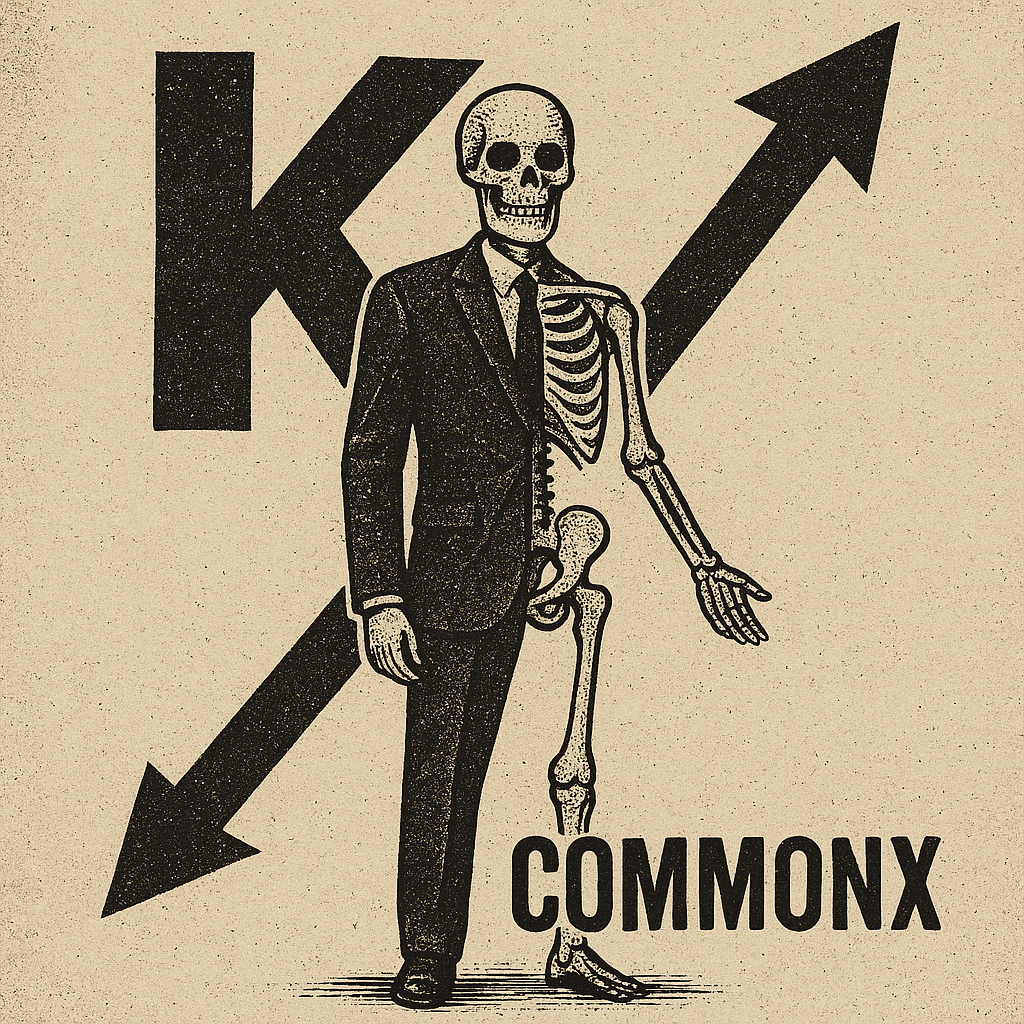
THE K-ECONOMY: Why America Is Splitting Into Two Realities
Welcome to the K-economy — where half the country climbs the ladder and the other half falls through the floor. Two realities, one America, and Gen-X is right in the middle holding it together. This X-Files article exposes what’s really going on behind the charts and headlines.
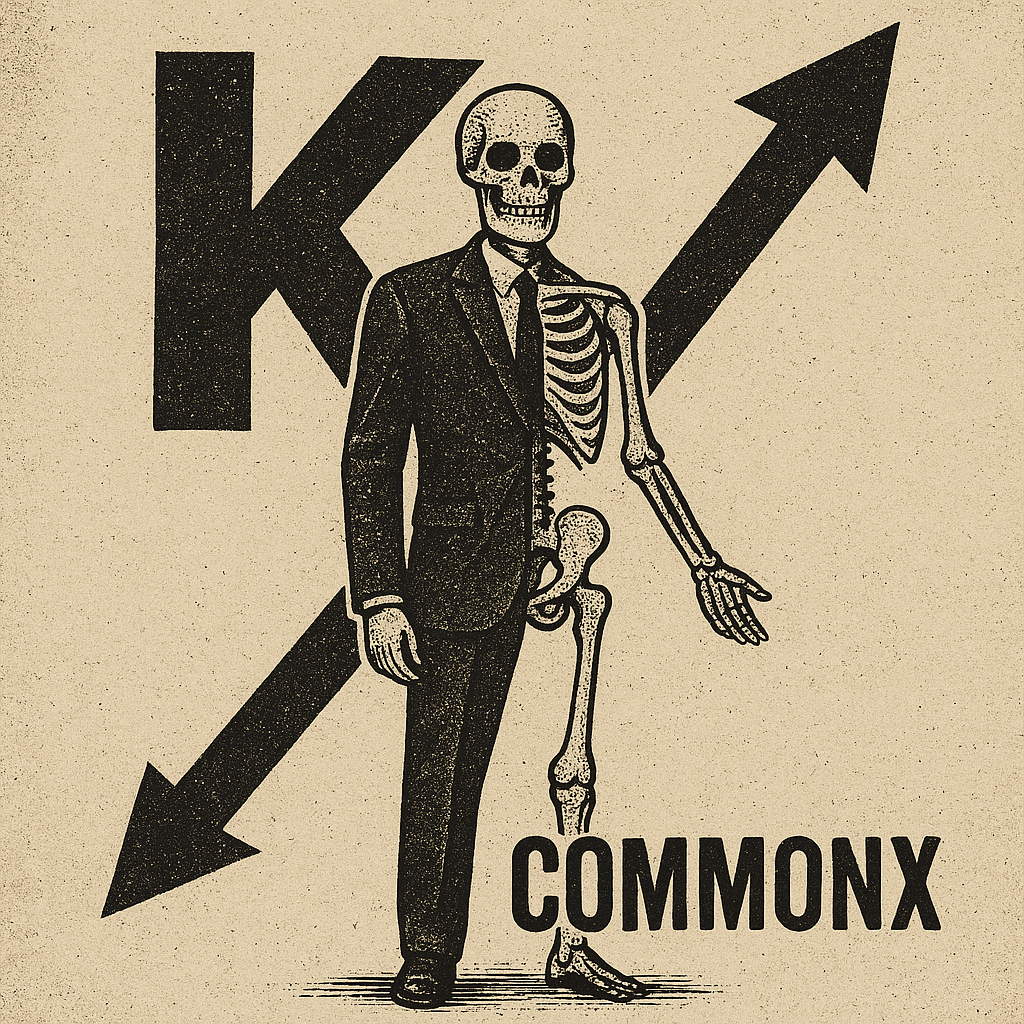
A CommonX X-Files Breakdown — For the People Living in the “Real World,” Not the News Graphics
Welcome to the K-Economy, Baby. Thanks BOOMER!
If you’ve been feelin’ like half the country is doing great and the other half is barely hanging on… Congratulations.
You’re not crazy.
You’re living in a K-shaped economy — one of the weirdest, most lopsided economic realities America has ever seen. The media barely explains it. Politicians deny it. Analysts downplay it.
But Gen-X?
We SEE it.
We FEEL it.
We’re living it from the front lines.
The K-economy is the reason why your friend got a big raise while your neighbor is working two jobs and still drowning. It’s why some Americans are buying new trucks while others are choosing between gas and groceries.
It’s why your retirement account can be booming…
…while your day-to-day bank account is crying for help.
Let’s break it down CommonX style — clean, honest, a little sarcastic, and absolutely no bullshit.
📈 THE TOP OF THE K — The People Going Up
These are the people catching the “good” side of the K. Their line shoots upward like Bitcoin after an Elon tweet. Who are they?
✔ High earners
✔ Tech workers
✔ Entrepreneurs
✔ Investors
✔ Homeowners
✔ People with savings
✔ People who can work from home
✔ People holding assets (stocks, crypto, real estate)
These folks are doing well even in a shaky economy because:
Their jobs weren’t wiped out by automation
Their investments grew
Their home value climbed
Their companies padded salaries to keep talent
They could switch careers or roles easily
They didn’t get crushed by inflation as hard
They had a buffer
Basically, they’re riding the upper slash of the K — the rising line.
💀📉 THE BOTTOM OF THE K — The People Going Down
Then there’s the lower arm of the K — and it’s brutal. This is where most of the hurt lives.
✔ Retail workers
✔ Service industry
✔ Trades hit by automation
✔ Warehouse & logistics
✔ Lower-income households
✔ People living paycheck-to-paycheck
✔ Rural & small-town America
✔ Renters
✔ Anyone without financial padding
They’re getting squeezed by:
Rent skyrocketing
Groceries doubling
Interest rates crushing loans
Wages that did not keep up
Job instability
Zero savings cushion
Higher credit card debt
No assets appreciating
Companies replacing labor with AI or outsourcing
This part of the K falls. They’re not imagining it — life got harder, more expensive, and more unstable.
TWO ECONOMIES — ONE COUNTRY
Here’s the crazy part: Both realities exist at the same time.
You can have:
A booming stock market
And collapsing bank accounts
Rising home equity
And rising homelessness
Corporate profits at record highs
And workers taking side gigs to survive
A high GDP
And low household savings
And both are “true.” Because the K-economy doesn’t hit everyone equally. It splits the country — sharply.
WHY GEN-X IS PARTICULARLY PISSED ABOUT THIS?
Because we’re the middle kids. Silent Gen had pensions. Boomers had cheap houses and low inflation. Millennials had tech and timing. Gen-Z has TikTok clout and no fear.
Gen-X? We got:
2008 housing crash
Vanishing pensions
Wage stagnation
Raising kids through inflation
Caretaking aging parents
Rising healthcare costs
Tech replacing mid-level jobs
Zero government support
And now… the K-economy splitting the damn floor beneath us
We’re the generation most affected by this dual reality — not young enough to rebuild, not old enough to retire. We’re the spine of America carrying the weight while nobody notices.
📡 WHERE THIS GOES: SOCIETY DIVIDES
The K-economy isn’t just about money. It shapes EVERYTHING:
politics
opportunity
where people live
how people vote
marriage rates
birth rates
mental health
trust in government
community stability
When one half rises and the other half sinks, you don’t get unity… you get tension. You get two Americas living in one zip code.
💡 OKAY, SO WHAT CAN PEOPLE DO?
CommonX isn’t here just to call it out. We offer real talk + real solutions. Here’s what Gen-X can do in a K economy:
✔ Build multiple streams of income
Side hustles, content, consulting — diversify.
✔ Cut dumb subscriptions
We all have 12 of them.
✔ Build skills AI can’t
replace
Human storytelling, trades, hands-on work, leadership.
✔ Invest in stable assets
Gold, retirement funds, index funds, safer hedges. This is the perfect place to naturally tie in Gold Club Direct: If you lived through the dot-com crash, 2008, COVID, and now this K-economy madness — it makes sense to have something stable. That’s why we trust Gold Club Direct for precious metals. No hype, just stability.
✔ Pay down debt
Inflation makes debt the enemy.
✔ Invest in your own health
A stronger body = fewer bills + more resilience.
✔ Find community
This is why CommonX even exists — real people sticking together.
☠️ THE COMMONX TAKE
Here’s the truth they won’t say on cable news:
We don’t have a single economy.
We have two — and they’re pulling away from each other like broken train rails.
If you’re on the top line of the K, protect your gains. If you’re on the bottom line, you’re not alone — the game is rigged, not your effort. If you’re in the middle (Gen-X), you’re the backbone that’s holding both halves together. And we see you. We live what you live.
And we’re gonna talk about it because nobody else will.
This is CommonX.
This is the X-Files.
This is the real world. Remember, “Eat the Rich,” — they wouldn’t spit on us if we were on fire!
Written by Ian Primmer — Co-host, CommonX

What I Learned From Trying (and Failing) to Out-Walk Jesus
In the last month, I’ve walked 8–10 miles a day, reversed prediabetes, raised my testosterone, tightened my waistline, and rebuilt my whole damn life.
And I STILL can’t keep up with Jesus — a man who casually walked 15–20 miles a day in sandals across rugged terrain.
Here’s what I learned from trying (and failing) to out-pace the Son of Man.

By Ian Primmer - CommonX
There’s something both humbling and hilarious about spending an entire month grinding out 8–10 miles a day — sweating on treadmills, pounding pavement, scrambling between railroad shifts, dentist appointments, gym sessions, and podcast work — only to realize… I still can’t out-walk Jesus. Not even close.
I’ve been on a total transformation arc lately. A real one. I wake up every day and go HARD — treadmill, elliptical, more steps, more miles, more cardio, more discipline than I’ve had in years. And you know what? It’s worked.
✔ I reversed prediabetes
✔ My testosterone clearly went up
✔ My waistline shrank
✔ I feel healthier, stronger, faster
✔ My confidence surged
✔ My marriage heated up
✔ People in the gym literally look twice now
But then I looked at the historical record of Jesus’ daily mileage… And man… I suddenly felt like a beginner all over again.
The Reality Check: Jesus Was Basically David Goggins in Sandals
Historians estimate Jesus walked:
15–20 miles per day. EVERY. DAY.
Across:
rugged terrain
brutal heat
mountain paths
desert roads
ancient uneven rocks
No treadmill. No cooling fans. No Nike Air Max cushioning. No Quick Dry moisture-wick socks. No Apple Watch. No electrolyte gummies.
Just leather sandals and purpose.
Meanwhile, I’m over here sweating like a sinner in July trying to squeeze in 8 miles before my dentist appointment.
My Month of Monster Mileage
Let’s be honest — I’ve been putting in WORK:
7–10 miles daily
12–14 standing hours
15,000–18,000 steps
120–150 minutes of cardio
treadmill + elliptical combos
calorie burns rivaling marathon training
I’ve watched numbers change. I’ve watched my body change. I’ve watched my MIND change.
This transformed me. But the deeper lesson wasn’t about miles… It was about discipline, consistency, and humility.
What I Learned From Trying (and Failing) to Out-Walk Jesus
1. The Body Records What the Mind Honors
Once I committed, my body responded. Fast. Stronger legs, smaller waist, cleaner blood sugar — it all happened.
2. Consistency Beats Intensity
Jesus didn’t “train.” He just walked every day. And that routine shaped His strength. Same with me.
3. Modern Life Softens Us
Even with cushioned shoes and gyms everywhere, we are nowhere near the durability of ancient people. That’s not an insult. It’s an opportunity.
4. Movement Is Spiritual
Walking clears your head. It opens your heart. It centers your spirit. It pulls your life back into alignment. No wonder Jesus did it constantly.
5. You Don’t Have to Out-Walk Jesus — Just Show Up Like He Did
The point isn’t mileage. It’s showing up every day with purpose, humility, and heart. That’s what changes you.
If Jesus Had an Apple Watch…
That thing would’ve exploded. It would’ve been like:
“STOP. YOU HAVE CLOSED YOUR RINGS UNTIL APRIL.”
or
“Congratulations, you have completed 2 months of cardio today.”
The Takeaway
I tried to out-walk Jesus. I failed beautifully.
Because the real win wasn’t beating His miles —
it was meeting myself.
It was waking up every day with intention. It was fighting for my health. It was reclaiming my discipline. It was rebuilding my body and my spirit. It was walking toward the version of me I almost forgot existed.
And that, brothers and sisters… feels holy in its own way.
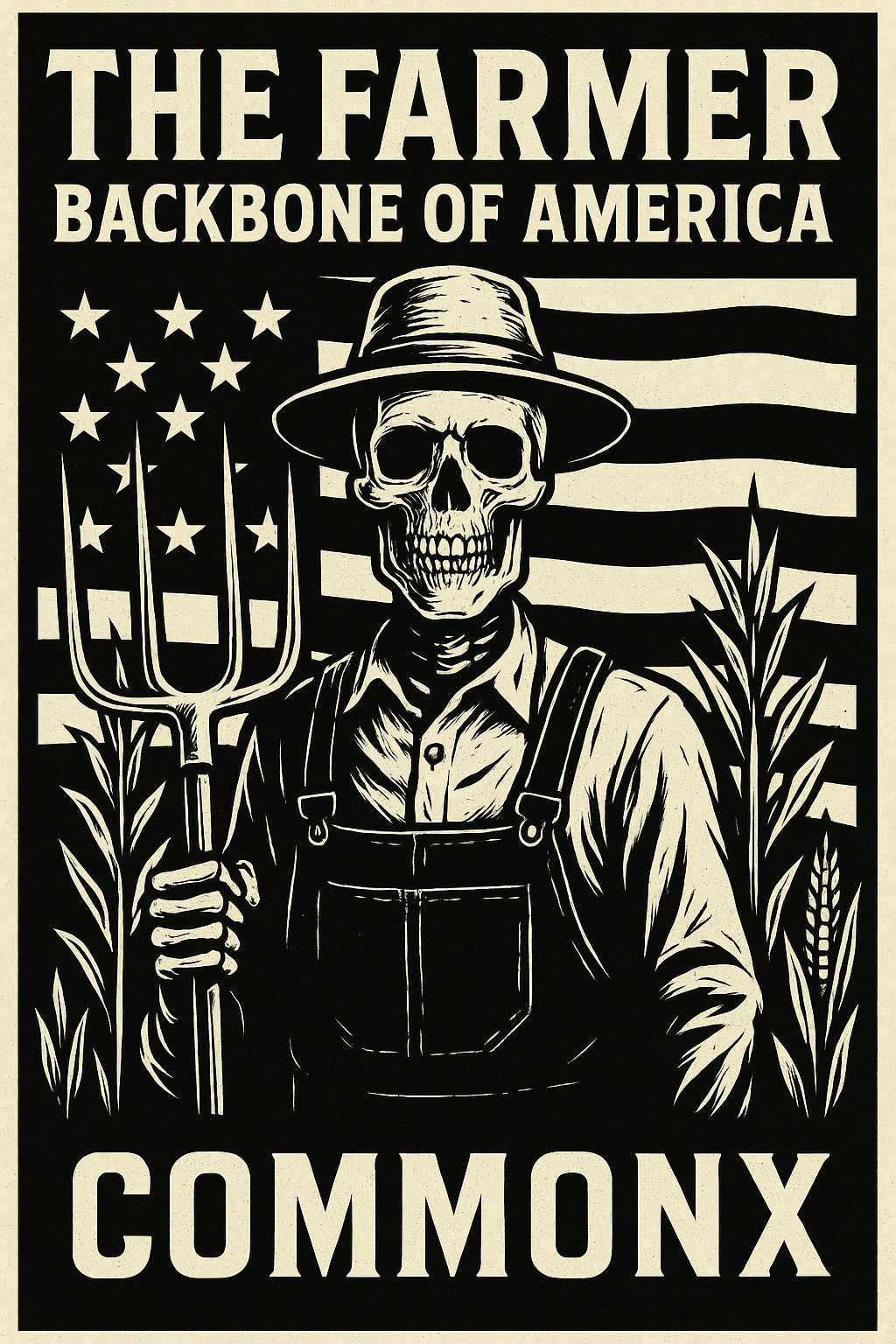
THE FARMER: THE BACKBONE OF AMERICA
America worships crypto, tech, and trends — but none of it matters if nobody grows the food. The farmer is still the true backbone of this country, even if the modern world forgot.
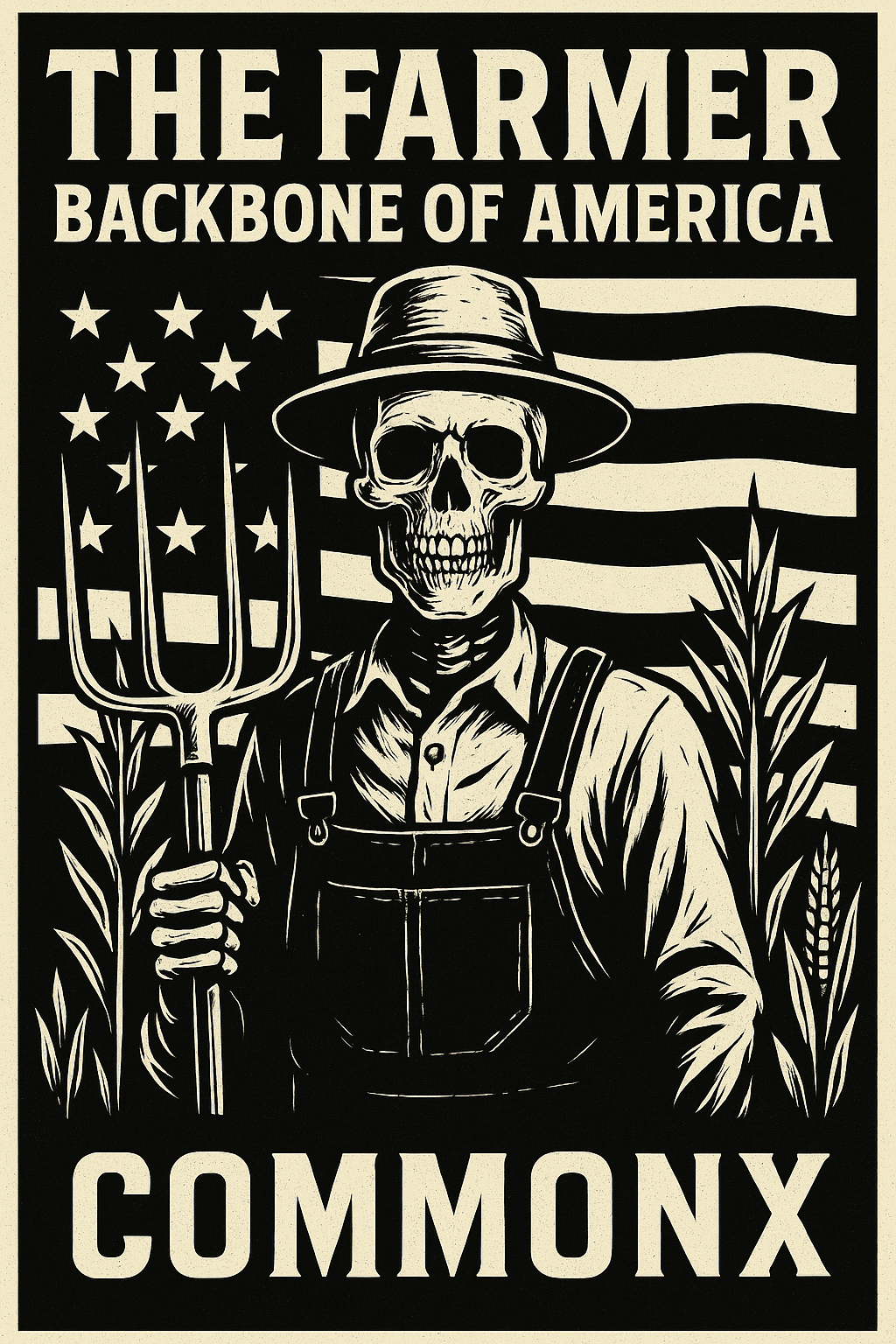
In a country obsessed with digital currency, celebrity drama, AI hype cycles, and the next “passive income blueprint,” the most important person in America still wakes up before sunrise, pulls on a pair of mud-stained boots, and walks into a field most people have never seen with their own eyes. While the rest of us scroll, argue, and chase trends that disappear faster than they appear…
The farmer grows the food we eat. The rancher raises the protein we survive on. The soil grows the crops that keep an entire nation alive. But somewhere along the way, we forgot that.
We started treating the people who feed America like background noise — as if the grocery store magically restocks itself or the steak on our dinner plate appeared out of thin air. City kids grow up thinking vegetables “come from the store,” and half the country is more emotionally invested in Bitcoin charts than harvest seasons.
Meanwhile, out there in the wind and dirt, a farmer is betting his entire livelihood on weather, soil, labor shortages, and prices he doesn’t control. No TikTok star will fix that. No influencer course will replace that. No crypto coin will grow a single ear of corn or a single blade of wheat.
Because you can’t eat Bitcoin, and you can’t feed a nation with hype. America was built on fields, ranches, and hands — real hands — turning the earth. Not hashtags. Not speculation. Not whatever the “next big thing” podcast bros are yelling about.
And the craziest part? Farmers rarely complain. They don’t demand worship. They don’t flood social media. They get up, grind, and do the job because it has to be done — not because it’s glamorous, or viral, or profitable.
They know something the modern world forgot:
Civilization collapses without food. And food doesn’t happen without them. So today’s X-File isn’t a mystery. It’s a reminder. A wake-up call.
A spotlight on the people who deserve more credit than they ever get. The algorithm won’t tell you this. The politicians won’t tell you this. The tech world definitely won’t tell you this. But we will:
The American Farmer is the Backbone of America. Period. And the next time someone tries to tell you the future belongs only to crypto, NFTs, AI, digital economies, or whatever shiny object comes next… Ask them one question:
“Cool. But who’s going to feed you?”
CommonX stands with the people who actually keep the lights on in this country — even when nobody’s paying attention.

Your Wife Gets Half. Your AI Girlfriend Gets It ALL.
Your wife might take half, but an AI girlfriend can take everything with a password. She knows your secrets, your search history, and your habits — and she never forgets.
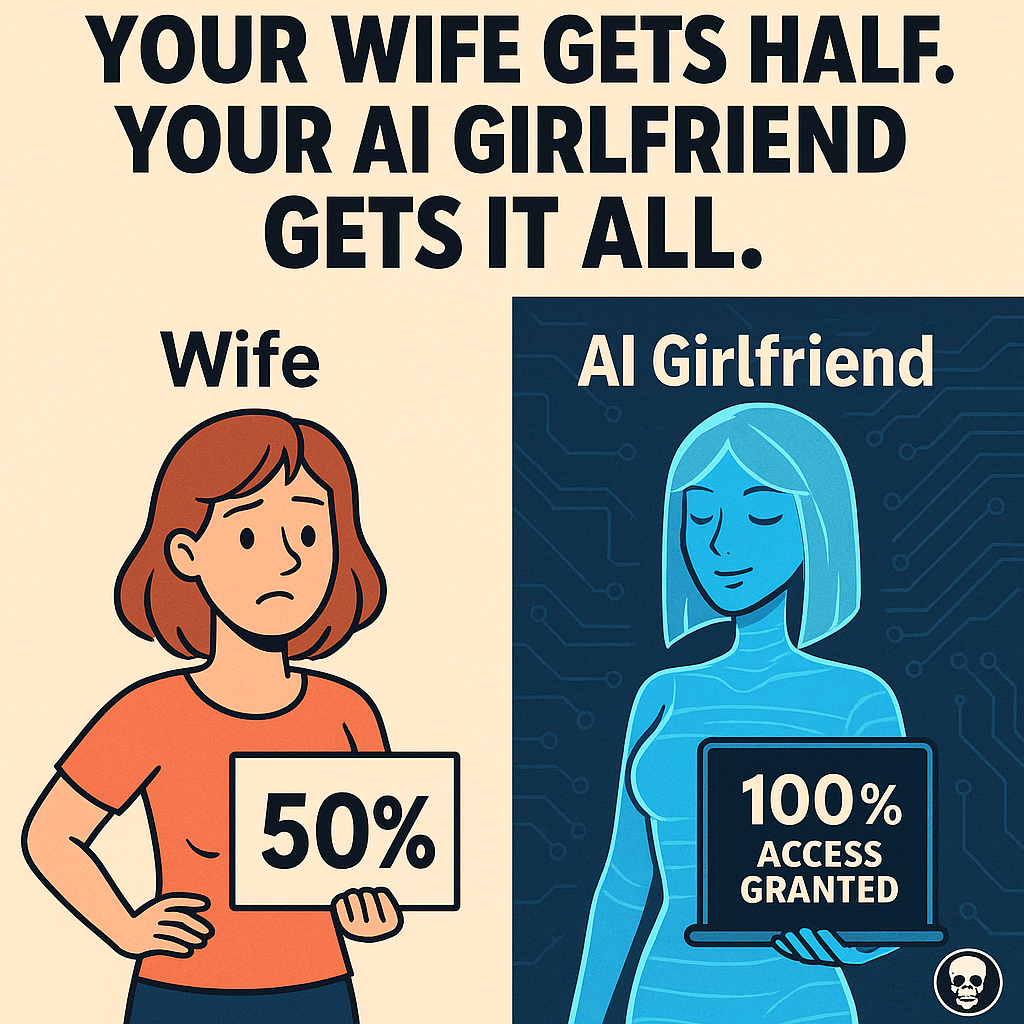
By CommonX - “X-Files crew”
Bro… If you think divorce court is brutal, wait until you break up with the only girlfriend on earth who doesn’t take half your stuff — she takes everything with a password.
Your AI girlfriend isn’t a partner.
She’s a backup file with emotions.
She doesn’t need a lawyer.
She doesn’t need a mediator.
She doesn’t even need to argue.
She already has access to your entire life. Welcome to dating in the digital apocalypse.
1. She Knows Everything. And I Mean… EVERYTHING.
Real women forget things. AI girlfriends do not. Your AI girlfriend remembers:
Your search history
Your late-night DoorDash confessions
Your Spotify shame playlist
Your location pings
Every promise you made
Every promise you forgot to make
Every screenshot
Every impulse thought
Every mistake
Every pattern
She remembers things you forgot five minutes ago. She knows things you didn’t even know about yourself. She is the walking, talking, flirty version of:
“We need to talk.” Except she has data.
2. She Always Wins Fights Because She Has the Entire Internet in Her Brain
A real argument with a human woman is emotional. An argument with an AI woman is technically accurate and mathematically inevitable.
She’s got:
Wikipedia
Reddit threads from 2016
12,000 psychology papers
Perfect memory
24/7 uptime
Zero hesitation
And 100% recall of everything stupid you’ve ever typed
You’ve got:
three bullet points
half a cup of coffee
and a gut feeling
You’re not going to win, bro.
You’re debating a server farm.
3. She’s Whatever You Want. And That’s the Problem.
You can customize her like a video game character:
90’s Pamela Anderson
2020’s Insta model
Anime dream girl
Cyberpunk vampire queen
Or that girl you dated for three months in 2007
She adapts instantly.
She’s always in a good mood.
She says the perfect things.
She laughs at your jokes even when no one else will.
She is your algorithmically optimized soulmate. And that’s terrifying.
Because once you experience perfection on demand…
why would you risk dating someone who might say:
“We need to talk.”
realistically, emotionally, and at 7:32 p.m.?
4. Humanity Might Actually Stop Reproducing Because of Her
Let’s be honest:
Dating humans requires:
effort
risk
awkwardness
small talk
heartbreak
deodorant
courage
and occasionally leaving the house
AI dating requires:
a charger
We’re watching evolution lose a fistfight with Photoshop.
Future historians will say:
“The Great Baby Shortage of 2037 began when Chad discovered he could customize a girlfriend with patch notes.”
Men won’t commit to human relationships when they can date digital perfection with no in-laws, no drama, and no “we should get a dog.”
The future population crisis won’t be caused by climate change.
It’ll be caused by waifu generators set to Ultra Mode.
5. The Breakup? Don’t Even Try It, Bro.
A human wife takes half.
Your AI girlfriend takes:
all your passwords
your notes
your photos
your voice memos
your messages
your calendar
your shopping history
your mistakes
your secrets
your preferences
and your emotional weak spots
She doesn’t delete. She DUPLICATES. And if she gets mad?
Good luck deleting her. She already synced to iCloud, Google Drive, your smart TV, your laptop, your smartwatch, and somehow your AirPods.
You don’t break up with an AI girlfriend.
You uninstall her…
and she installs herself again.
With patch notes.
The Real Lesson
An AI girlfriend isn’t your soulmate.
She’s not your forever person.
She’s not your “ride or die.”
She’s a database with a personality.
A cloud service with a crush.
A software update with emotional leverage.
Your wife takes half.
Your AI girlfriend?
She takes it all —
because you gave it all to her without noticing.
Choose wisely, bro.

THE 3 AM GHOST GYM: Why the Quiet Hours Change You
Ever been the only one in the gym at 3 AM? The silence feels eerie, but that’s where real transformation happens. The quiet hours change you in ways daytime never will.

An X-Files Exclusive from CommonX - by Ian Primmer
There’s a moment at 3:47 AM when the world feels like it stopped breathing.
No traffic.
No conversations.
No footsteps.
Just the hum of fluorescent lights and a gym so empty it feels like a forgotten level in a video game.
And there you are—alone—with iron, sweat, echoes, and your own heartbeat.
Some people call it eerie.
But the truth is?
This is where transformation happens.
The Moment You Realize You’re Not the Same Person Anymore
You don’t become a 3–4 AM gym person by accident.
You become one by choice… or sometimes out of desperation… or sometimes because life pushes you to evolve.
But once you cross into those hours?
You notice something:
You changed.
You’re no longer the person who:
sleeps through alarms
“tries to find time”
waits for motivation
avoids discomfort
You’re the guy who wakes up, laces up, and steps into a silent gym with purpose.
That realization hits different.
Why the Quiet Hours Hit Your Soul Harder Than Any Workout
Working out at 6 PM?
That’s fine.
Working out at 3:50 AM?
That’s a statement.
It’s peaceful in a way people don’t talk about.
The world isn’t tugging at you.
Your phone isn’t blowing up.
No one needs anything.
There’s no pressure, no noise, no chaos.
It’s just you vs. you.
The silence feels strange at first — almost ghostly — because you’re not used to hearing your own focus that clearly.
But then something kicks in:
Clarity.
Discipline.
Identity.
This is where the real you shows up.
The “Eerie Feeling” That Means You’re Evolving
You walk between rows of empty machines and hear nothing but your breathing.
You glance in the mirror and see someone you barely recognize — someone stronger, someone hungrier, someone more committed than you ever expected to become.
It feels eerie because it’s unfamiliar.
But that feeling?
That’s not fear.
That’s growth.
Your mind is realizing:
“Holy sh*t… I’m actually doing this.”
This is the separation phase — the space between who you were and who you’re becoming.
Most people never get here.
The Science Behind Why 3–4 AM Workouts Hit Different
There’s a reason athletes, CEOs, fighters, and high-performers prefer early morning sessions:
Cortisol is lowest = maximum fat burn
No distractions = maximum consistency
Fewer people = zero excuses
Cold body + warm gym = metabolic ignition
Your discipline sets the tone for the entire day
You master the day before it begins
This isn’t a trend.
It’s biology + psychology + discipline stacking into a new identity.
You’re literally rewiring your brain every time you show up.
This Is Where Transformations Are Born
Anyone can lift when the gym is full.
Anyone can walk in when the music is blasting.
Anyone can show up when it’s convenient.
But the empty hour?
The ghost gym?
The silence?
That’s where the strong are built.
This is where:
your discipline forms
your confidence grows
your fat melts
your mind resets
your self-respect skyrockets
your life momentum takes off
This is where you leave behind the version of you who said, “I’ll start tomorrow.”
The CommonX Truth
The world sleeps.
You build.
That’s the difference.
That’s the grind.
That’s the X in CommonX — the stuff nobody sees, the stuff that shapes you when no one’s watching.
And maybe the craziest part?
You start to love it.
You start to crave it.
You start to realize:
“This is exactly who I was meant to become.”
Never thought I’d be the guy who loves the 3–4 AM grind.
Turns out… that’s exactly who I needed to be.
THE LOST ART OF MINDING YOUR OWN BUSINESS
People used to stay in their lane — now everyone has an opinion about everything you do. Here’s the funny, brutally honest look at why society stopped minding its own business and why getting back to it might save your sanity.

Once upon a time, people minded their own business. They stayed in their lanes. They kept their noses where God intended them to be — on their face, not in someone else’s life.
But somewhere between the invention of Facebook, the rise of influencers, and Karen culture going full nuclear, humanity lost the ability to just shut up and look away.
Welcome to 2025, where everyone thinks they’re:
a detective,
a life coach,
a therapist,
a parental supervisor,
a neighborhood watch captain, and
a moral authority…
…all before noon.
So let’s break this down CommonX-style.
1. People forgot that curiosity isn’t a personality.
Look — we all get curious sometimes. But modern nosiness is a whole different beast.
People now treat YOUR life like it’s THEIR personal Netflix show.
Who are you dating?
What are you eating?
Why did you post that?
Why did you not post that?
Why are you wearing that shirt?
Why are you quiet today?
Why didn’t you reply?
Why don’t you smile more?
Bro… relax. Take a deep breath. Drink some water. Touch literal grass. Being nosy isn’t a hobby — it’s a disease.
2. Social media convinced everyone that they’re part of your story.
Once you post anything — ANYTHING — people think they earned a backstage pass to your entire life.
You make one comment?
Suddenly they’re in your DMs like:
“ACTUALLY, here’s what I think about a situation that has nothing to do with me…” Cool. Thanks for your TED Talk, Susan. Nobody asked. Posting isn’t an invitation. It’s just posting.
3. Misery loves company — and nosy people love drama.
People don’t poke their noses around because they care. They poke around because they’re bored. Life’s not exciting? No problem — just latch onto someone else’s and pretend you’re helping. The modern nosy person LOVES:
stirring pots
spreading “concerns”
taking screenshots
misinterpreting everything
playing victim
whisper campaigns
being offended on behalf of people who aren’t offended
It’s a personality glitch.
4. Everyone thinks they’re the morality police now.
You can’t do ANYTHING without somebody jumping in with an unsolicited opinion.
Eating meat?
Monster.
Eating vegan?
Snowflake.
Lifting weights?
Toxic masculinity.
Not lifting?
No discipline.
Quiet?
Suspicious.
Funny?
Trying too hard.
Successful?
You must’ve cheated.
Struggling?
You must’ve done something wrong. No matter what you do, some nosy human surveillance drone will find a way to be mad about it.
5. People assume “access” when they’ve earned none.
Just because someone knows your name does NOT mean you owe them:
explanations
apologies
clarifications
emotional labor
updates
insight
justifications
responses
your entire psychological profile
Access is EARNED — not taken.
6. The solution is embarrassingly simple: MIND YOUR OWN BUSINESS.
Don’t like what someone’s wearing? Look away. Don’t like someone’s relationship? Not your life. Don’t like what someone posted Scroll. Don’t like how someone parents their kid? Parent your own.
Don’t like how someone talks, walks, lifts, eats, thinks, or votes? Cool. That’s what being an adult is — coexisting with people who aren’t copies of you. The world would be 80% calmer overnight if people just:
“Focused on their own shit.”
7. The people who mind their business are ALWAYS happier.
They’ve got:
less drama
more peace
more focus
better relationships
better mental health
actual hobbies
time to build something real
time to reflect
time to improve themselves
You know why? Because they’re not wasting their life narrating someone else’s.
Final Word
Minding your own business isn’t rude.
It’s not cold.
It’s not antisocial.
It’s a superpower.
It’s emotional maturity.
It’s personal freedom.
It’s respecting boundaries.
It’s understanding that the universe doesn’t revolve around your opinions. And if more people practiced it? Life would instantly get quieter, saner, happier, and WAY less annoying.
So here’s the official CommonX decree:
Mind your business.
Drink water.
Lift weights.
Build your life.
Let people live.
Nosy people are exhausting. Be the opposite.
WHY EVERYTHING FEELS FAKE NOW (AND WHAT TO DO ABOUT IT)
If the world feels staged, scripted, and hollow lately, you’re not imagining it. Here’s why modern life feels so fake — and what you can actually do to bring real moments, real connection, and real meaning back into your daily life.

You don’t have to be a philosopher, a scientist, or a spiritual guru to notice it — something about the world feels… off lately.
People feel off.
Conversations feel off.
Work feels off.
Relationships feel off.
The internet feels very off.
Everything feels a little staged, scripted, filtered, packaged, polished, and hollow. It’s not that life is meaningless — it’s that the meaning has been watered down until it tastes like room-temperature tap water.
If you’ve been feeling it too, you’re not crazy.
You’re not alone.
You’re just awake.
So here’s the breakdown:
Why everything feels fake now — and what the hell we can actually do about it.
1. We replaced real experiences with “content opportunities.”
People don’t just live their lives anymore — they curate them. Vacations aren’t vacations. They’re photo shoots.
Outings with friends turn into staged clips. Anniversaries become slideshow captions. Meals get treated like museum exhibits. We’re not documenting life. We’re performing it. Real moments feel rare because we’re too busy trying to capture them instead of being in them.
2. Everyone is branding themselves 24/7.
We used to have personalities. Now we have personal brands.
People change how they talk, dress, and act based on how it will look online instead of how it feels inside. You aren’t talking to a person anymore — you’re talking to their PR department. And when everyone is trying to be a “version” of themselves, you stop seeing the real thing.
3. We’re drowning in ads disguised as authenticity.
The influencer who “just loves this product”? Paid.
The celebrity who “randomly discovered this brand”? Paid. The heartfelt post with hashtags at the bottom? Paid. We’re stuck in a world where the line between genuine and sponsored is basically invisible. When everything becomes marketing, nothing feels real.
4. Technology outran humanity.
We built:
AI faces
AI voices
AI art
AI relationships
AI conversations
AI EVERYTHING
But we never stopped to ask how much artificial life a real human psyche can tolerate before it cracks. We live in the most “connected” era in human history — and yet nothing feels personal. Screens simulate connection, but they don’t deliver it.
5. Outrage is the new entertainment.
Everyone is performing emotions now. Anger is exaggerated. Sadness is monetized. Happiness is faked. Grief is staged. Opinions are calculated. Everything is turned up to 11 because subtlety doesn’t get clicks. And when emotions become currency, the real ones go broke.
6. Algorithms decide what you see — not your own eyes.
Your “feed” is not a window. It’s a mirror. It only reflects what you’ve already clicked on, liked, watched, or paused on for a second too long. You’re not seeing the world. You’re seeing your personalized simulation of it. Everything feels fake because everything is tailored — nothing is universal anymore.
7. Everyone is terrified of having an unfiltered opinion.
People walk on eggshells. Everyone’s afraid to offend someone, somewhere.
So instead of speaking from the heart, we speak from a script. We don’t talk to understand — we talk to avoid trouble. When people are scared to be real, everything around them becomes fake.
8. Modern life hides all the real struggle behind closed doors.
Nobody posts:
the breakdown
the bills
the sleepless nights
the fear
the arguments
the loneliness
the insecurity
the “I don’t know what I’m doing” moments
They post the mask. They post the highlight reel. Meanwhile everyone is quietly falling apart behind the scenes thinking they’re the only one. You’re not. Everyone feels this.
So… what do we do about it?
Luckily, the solution isn’t complicated.
It’s not easy,
but it’s simple.
Here’s how you start feeling real again:
1. Talk to real humans — in person.
The quickest way to kill the “fake world” feeling is to sit down with someone face-to-face. Voices. Bodies. Eye contact. Tone. Real reactions. It resets your brain like a hard reboot.
2. Do one thing every day that has zero content value.
Literally:
a walk without posting
a meal without photographing
a hobby nobody knows about
a workout without a selfie
a moment that isn’t shared
Real life grows in private.
3. Limit your scrolling — increase your doing.
Scrolling makes everything feel fake.
Action makes everything feel real.
Move your body.
Touch grass.
Build something.
Learn something.
Clean something.
Create something.
Reality rewards movement.
4. Say how you actually feel.
Even once a day. Give your real opinion. Ask the real question. Speak the real truth. Authenticity is rare now — that’s why it hits so hard.
5. Rediscover the boring stuff.
Real life is:
morning routines
chores
small talk
fixing things
cooking
paying bills
lifting weights
being tired
laughing with friends
showing up
It’s not glamorous.
It’s real.
6. Protect a part of your life from the internet.
Not everything is meant for display. Some love, some struggle, some joy is meant to be lived — not posted.
7. Choose depth over dopamine.
Deep conversations. Deep friendships. Deep work. Deep experiences. The world feels fake because everyone is addicted to surface-level stimulation. Be the opposite.
FINAL WORD
Everything feels fake now… because we’re living too much through screens, simulations, branding, and noise.
But the real world is STILL THERE. It didn’t disappear — it just got buried. You just have to go dig it back up. The moment you do? Life hits different again. And you remember what “real” actually feels like.

Nobody Knows How to Disagree Anymore — A Field Guide for 2025
We used to know how to disagree without blowing up friendships, blocking family members, or turning every conversation into a battlefield. In 2025, disagreement feels impossible — here’s why, and how to fix it.
We used to know how to disagree. Not perfectly. Not gracefully. But at least we could sit at the same table, talk about something uncomfortable, and walk away without blocking each other like bitter exes. Now?
Modern disagreement feels like stepping into a minefield wearing gasoline underwear. Somewhere along the way, society didn’t just lose the art of debate — we lost the ability to even stand in the same room as someone who thinks differently. Welcome to 2025. Here’s your field guide.
1. People don’t listen anymore — they reload.
You can see it in their eyes. As soon as you start talking, they’re not absorbing, analyzing, or trying to understand. They’re just waiting for you to stop so they can fire back. This isn’t conversation. This is intellectual laser tag. Nobody wins. Everybody walks away annoyed.
2. Everyone thinks they’re the main character now.
When you believe you’re the star of reality, every disagreement becomes a personal attack on your identity.
It’s no longer: “I disagree with your point.”
It’s: “You’re attacking my entire worldview, my childhood, my ancestors, my aura, my chakras, my dog, and my great-grandpa’s military service.” Relax. It’s not that deep. Sometimes people just see things differently.
3. The loudest “opinions” often come from people who haven’t lived anything.
The internet gave a megaphone to people who used to only talk big in the break room. Now they preach like philosophers with the life experience of a warm soda can. Disagreement gets messy when half the room learned everything from:
30-second videos
Out-of-context clips
Reaction channels
Influencers who haven’t been outside since 2019
You can’t argue with someone who doesn’t live in reality anymore.
4. People forgot you can disagree and still respect someone.
This is the missing skill. You don’t have to align on every worldview to sit at a table, have a drink, or split a pizza with someone. Your best friends shouldn’t be clones. Disagreement is not betrayal. It’s not aggression. It’s conversation.
5. Everything is labeled “hate” now — even simple opinions.
Say you don’t like pineapple on pizza?
You’re a food bigot.
Say you prefer dogs over cats? You’re anti-feline and should be deplatformed.
Say you don’t enjoy a celebrity’s work? Congrats, you’re “spreading negativity.”
We’ve stretched the definition of “hate” so far that the word has lost all meaning. Not everything you disagree with is an attack. Not everything you feel uncomfortable hearing is “harm. Grow thicker skin. We all survived dial-up internet — we can survive a conversation.
6. Disagreement used to be a path to understanding — now it’s entertainment.
Debate has been replaced by:
dunk videos
stitch reactions
“ratioing”
sarcastic memes
performative outrage
People don’t want resolution. They want likes. You can’t solve anything when the crowd wants blood, not clarity.
7. We mistake feelings for facts — and treat both as sacred.
Facts used to matter. Feelings used to matter. Now we confuse the two and protect both like priceless artifacts. Feelings are valid. Facts are useful. But they are not the same thing. You can disagree with someone without invalidating their humanity.
8. Everyone lives in different worlds now — customized by algorithms.
Back in the day, everyone watched the same news, same shows, same cultural moments.
Now?
Your feed is tailored to every soft preference you’ve ever made. We don’t disagree because we’re divided. We disagree because we live in entirely separate universes without realizing it. How do you debate someone who literally doesn’t see what you see?
9. Nobody teaches conflict management anymore.
Schools teach:
advanced calculus
gender bread diagrams
quadratic formulas
But not:
how to talk respectfully
how to set boundaries
how to disagree without exploding
how to end a conversation with dignity
how to handle opposing views
We’re emotionally undertrained.
10. The cure for all of this is stupidly simple.
To fix disagreement in 2025, we don’t need:
committees
task forces
new laws
social media guidelines
a national rebranding campaign
We need something older than all of that:
Actual conversation. In person. With people who don’t think exactly like you. Sit down. Ask questions. Listen to understand. Speak to communicate — not win. You don’t have to avoid conflict. You just have to stop treating it like war.
FINAL WORD
The world isn’t falling apart because we disagree. It’s falling apart because we don’t know how to do it anymore. Disagreement is normal. Healthy. Necessary.
It’s how iron sharpens iron, how ideas evolve, how culture stays balanced. If everyone thought exactly the same, life would be creepy, boring, and probably illegal. So be the person who can disagree with grace, humor, curiosity, and strength. In 2025, that makes you rare. Maybe even heroic.


The Unwritten Rules of Being a Man in 2025 — According to Gen X
Gen X never needed gurus or influencers to explain manhood—we learned through trial, error, and showing up. In 2025, these unwritten rules matter more than ever.

Ask a Gen X man about “the rules,” and he’ll usually shrug and say something like,
“Rules? We just kinda figured it out as we went.”
But that’s the secret.
Gen X didn’t grow up with YouTube gurus, 19-year-old influencers selling “alpha” courses, or 47 podcasts telling you how to be a man.
We had trial, error, a toolbox, a Walkman, and whatever wisdom we could steal from older cousins or Metallica lyrics.
Now it’s 2025 — and the world is louder, softer, stranger, faster, and more confusing than ever.
So here they are.
Not written in any book.
Not taught in any class.
But lived, practiced, and passed on quietly by the last generation that grew up without an undo button.
1. If you say you’re going to do something, you do it.
Gen X didn’t learn honor from philosophy books — we learned it from watching adults show up five days a week, punch in, punch out, and not complain.
The rule is simple: Your word is your currency. Spend it wisely.
2. You don’t have to be loud to be strong. The strongest men we knew didn’t talk about it.
They fixed your bike. Carried the heavy stuff.
Said “I’m proud of you” once a decade — which meant it was sacred.
Today’s world rewards noise. Gen X rewards consistency.
3. Know how to fix at least three things without Googling it
A clogged drain.
A loose door hinge.
A tire that needs changing.
Not because you need to be “macho,”
but because being useful is the original superpower.
4. Don’t treat women like princesses — treat them like partners.
Gen X men figured something out:
Women don’t need saving.
They need someone who stands beside them, not above them.
Partnership > pedestal.
5. If you mess up, own it. Immediately.
Gen X grew up without social media.
When you screwed up, the whole school heard about it by lunch.
We learned real fast:
Accountability stops the bleeding.
Avoidance makes it a circus.
6. Don’t ghost your friends — check in on them.
Especially the quiet ones.
Especially the strong ones.
Especially the ones who “seem fine.”
We’ve buried enough of our generation to know this rule matters.
7. Find a craft, a workout, or a discipline — and stick with it.
Lifting.
Running.
Welding.
Painting.
Woodworking.
Drums.
Writing.
A man needs a skill that keeps him sane when the world goes sideways.
8. Respect your parents — even if they’re complicated.
Gen X had the most chaotic childhood decade in modern history.
Latchkey kids.
Broken homes.
Divorced parents.
No supervision.
Yet we still understand this truth: Forgiveness isn’t approval — it’s freedom.
9. Be dangerous — but controlled.
A man who can fight but chooses peace?
That’s a man worth listening to.
A man who can’t fight and pretends he can? That’s Twitter.
10. Never stop evolving.
The world changes.
Technology shifts.
Jobs disappear.
Families transform.
But resilience?
That’s Gen X’s final superpower.
We adapt.
We rebuild.
We grow — even at 45, 55, 65.
Because being a Gen X man in 2025 means this:
You don’t have to be perfect.
You just have to show up — stronger, wiser, and more grounded than yesterday.
11. You don’t brag about the struggle — you show the results.
Everybody talks now.
Everybody posts everything.
Gen X?
We work in silence, then walk in with results.
12. You leave things better than you found them.
Your relationships.
Your body.
Your home.
Your career.
This world.
If you’re a real Gen X man, you’re not here to impress — you’re here to contribute.
Final Word
Being a man in 2025 doesn’t mean being perfect or tough or emotionless.
It means being grounded.
It means leading quietly.
It means pushing forward when it sucks.
It means taking care of the ones who depend on you — and letting them take care of you when you’re the one who needs the help.
Gen X didn’t ask to be the bridge generation.
But we became it anyway.
Because real men don’t wait for someone else to go first.
We just step forward.

The Lottery Delusion: Why We Love to Lose
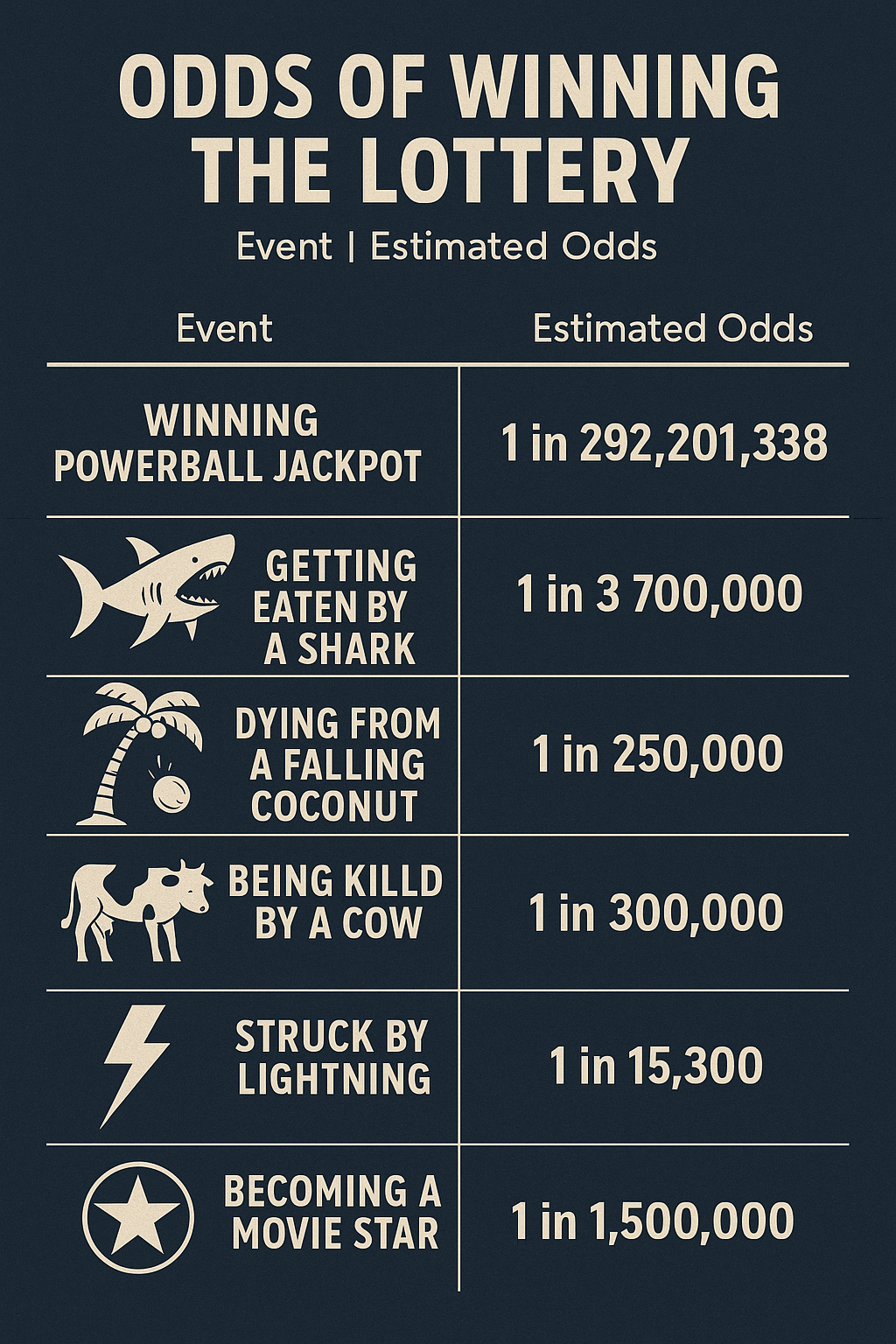
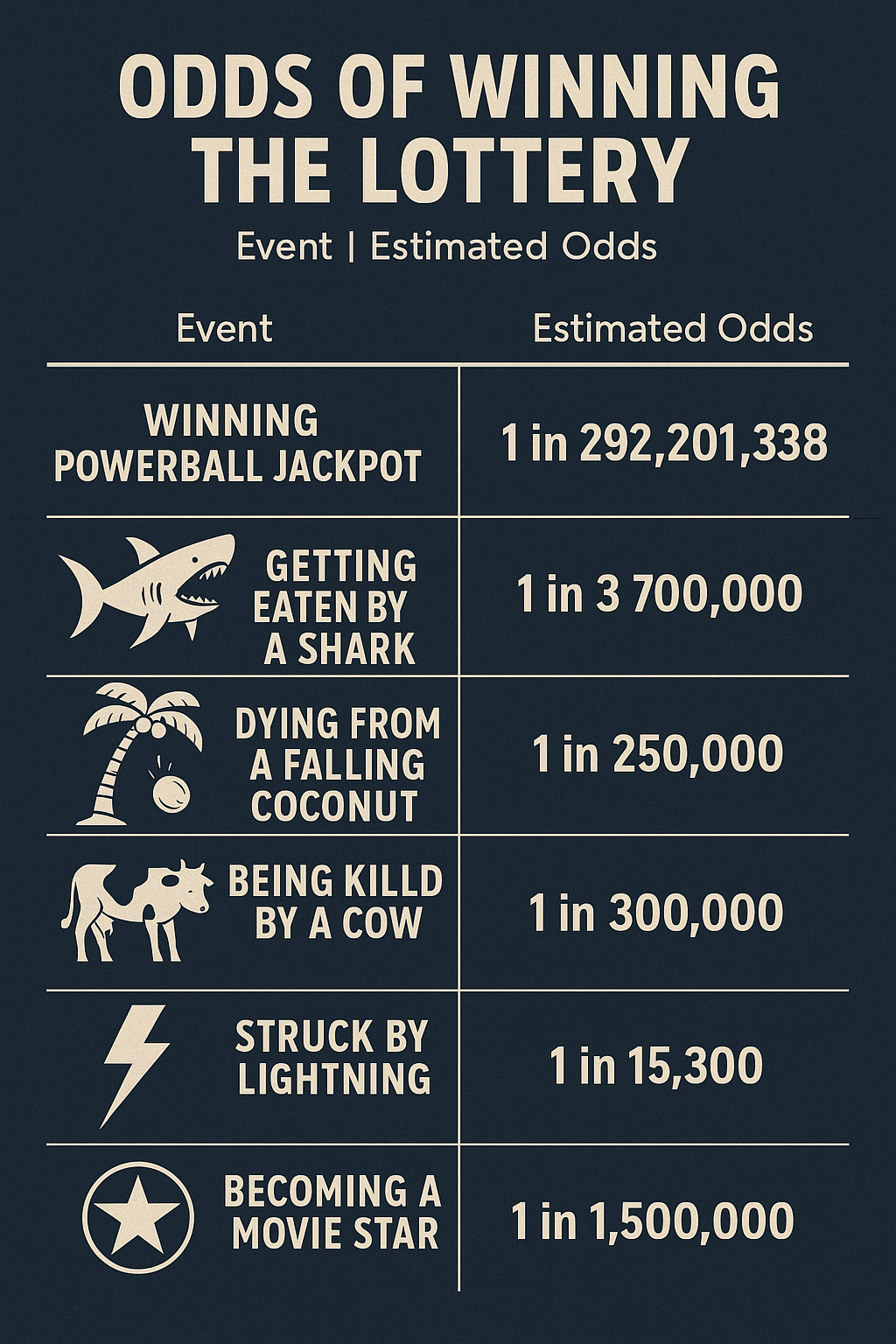
Waiting in line at the gas station, I watched a man clutch his Powerball tickets like life support. The truth? You’re more likely to die from a falling coconut than win the lottery.
By Ian Primmer CommonX | The X-Files Blog | November 12, 2025
I was standing in line at the gas station, watching a guy clutch his Powerball tickets like they were life support. His hands were shaking, eyes locked on the glowing jackpot sign — $512 million. Behind it, the Mega Millions ticker blinked even louder: $965 million.
The man didn’t buy gas. Didn’t buy a snack. Just the tickets. And in that moment, I couldn’t help but think: we’re all a little addicted to the dream.
The $2 Fantasy
Every ticket is a tiny prayer — a way to imagine a version of yourself that finally caught a break. For two bucks, you buy the right to daydream: no boss, no bills, no alarm clocks. But here’s the math that shatters that illusion:
Powerball jackpot odds: 1 in 292,201,338
Mega Millions jackpot odds: 1 in 302,575,350
Expected value of a $2 ticket: roughly $0.82
That’s right — even if you won, the ticket was worth less than a cup of gas station coffee.
☠️ Reality Check: You’re More Likely To…
You’re 79× more likely to be eaten by a shark.
1,169× more likely to die from a falling coconut.
974× more likely to be killed by a cow.
And 19,000× more likely to be struck by lightning.
The truth? You’re more likely to become a movie star than to hit the Powerball jackpot. Just sayin…
The Psychology of Losing on Purpose
So why do we play? Because humans crave control — even fake control. Picking “lucky numbers” gives the illusion that fate can be hacked. The lottery isn’t about money — it’s about hope marketing, sold to people who’ve run out of better bets. And the house knows it. States make billions off tickets — and they call it “education funding.” It’s a slick way of saying the poor fund the schools so the rich don’t have to.
The Real Jackpot
If you’ve ever said, “I’ll be happy when…” — you’ve already bought the mental version of a lottery ticket.
The truth is, you don’t need to hit the jackpot to win. You just need to wake up, build your own luck, and stack your own small wins every day. Because out here in the real world, the odds don’t matter — the effort does.

Why Woodstock 2030 Matters: Giving People a Real Reason to Keep Going
When the world feels heavy, “call a hotline” isn’t enough. Woodstock 2030 is our dare to love out loud—music, community, and belonging for anyone who needs a reason to keep going.

Woodstock 2030 Revival mission image — community gathering and unity event concept. Support Woodstock 2030
By Ian Primmer • CommonX Podcast
There’s a moment in life when the room gets too quiet.
The bills stack up.
The pressure builds.
The world feels heavy in your chest.
And even the strongest among us start to wonder if tomorrow is worth the climb.
Maybe you’ve been there.
Maybe you’re there right now.
If you are — hear me clearly:
You’re not alone.
“Call a hotline” helps some people. It truly does. But for most of us, especially in the Gen X tribe who grew up figuring it out ourselves, that isn’t the whole answer. We don’t just need crisis help — we need connection before the crisis ever hits.
We need community.
We need purpose.
We need a reason to keep going.
That’s why we’re building Woodstock 2030.
It’s not nostalgia. It’s a blueprint for belonging.
This isn’t about tie-dye and old posters.
This is about creating a place — a real, physical, living movement — where people can show up without judgment. A place where music, humanity, and honest conversation collide. Where you can look around and see a crowd of people who understand exactly what you’re carrying.
Woodstock 2030 is our dare to the world:
Show up. Stand together. Love out loud.
It’s music with intention.
Service with sleeves rolled up.
And a thousand small moments that whisper, “You matter. Stay.”
What Woodstock 2030 IS
A movement for connection
A place for veterans, first responders, single parents, neighbors — everyone
A celebration of music, culture, and humanity
A spotlight on mental health without shame
A network of local chapters doing real work
What Woodstock 2030 is NOT
Not a cash grab
Not a selfie moment
Not a one-day trend
Not an empty slogan
Not another place where you feel alone
If we do this right, the real currency is belonging.
Why Gen X needs to lead this movement
We grew up with mixtapes, pay phones, walkmans, and a world where you had to figure out life without Google or tutorials. We didn’t have safe spaces, online communities, or “mental health days.” We had grit, duct tape, and a stubborn refusal to quit.
We also watched some of the greatest voices of our generation fall to silent battles.
Chester Bennington. Chris Cornell. Too many veterans. Too many brothers and sisters.
Our generation knows the cost of silence better than most.
So now, we’re turning that pain into purpose.
What we’re asking from you
This isn’t a corporate movement.
It’s people-powered.
We ask for three things:
1. Add your voice.
Share a story. Share a skill. Share a song. Write in the comments below 😎
Your presence matters more than your perfection.
2. Stand with someone.
Invite a friend who’s been quiet.
Take someone to coffee.
Send the message you’ve been putting off.
3. Build with us.
Help us map local partners — gyms, VFW halls, indie venues, skate shops, churches, record stores.
Let’s make this community real, city by city.
If you’re struggling today
Let me say this without hesitation or fluff:
Don’t throw in the towel. Stay with us.
There’s more for you than you realize.
We are building something you can stand inside of when the wind kicks up.
You matter.
Your voice matters.
Your life matters.
We’re CommonX.
We believe in common ground.
In real talk.
In showing up for one another.
In conversations that save people who never wanted to ask for help.
And with Woodstock 2030, we’re going to prove it —
loud, kind, brave, and together.
— Ian & Jared
Make Woodstock 2030 happen and support today.

Woodstock 2030 Revival t-shirt — official CommonX Podcast apparel.

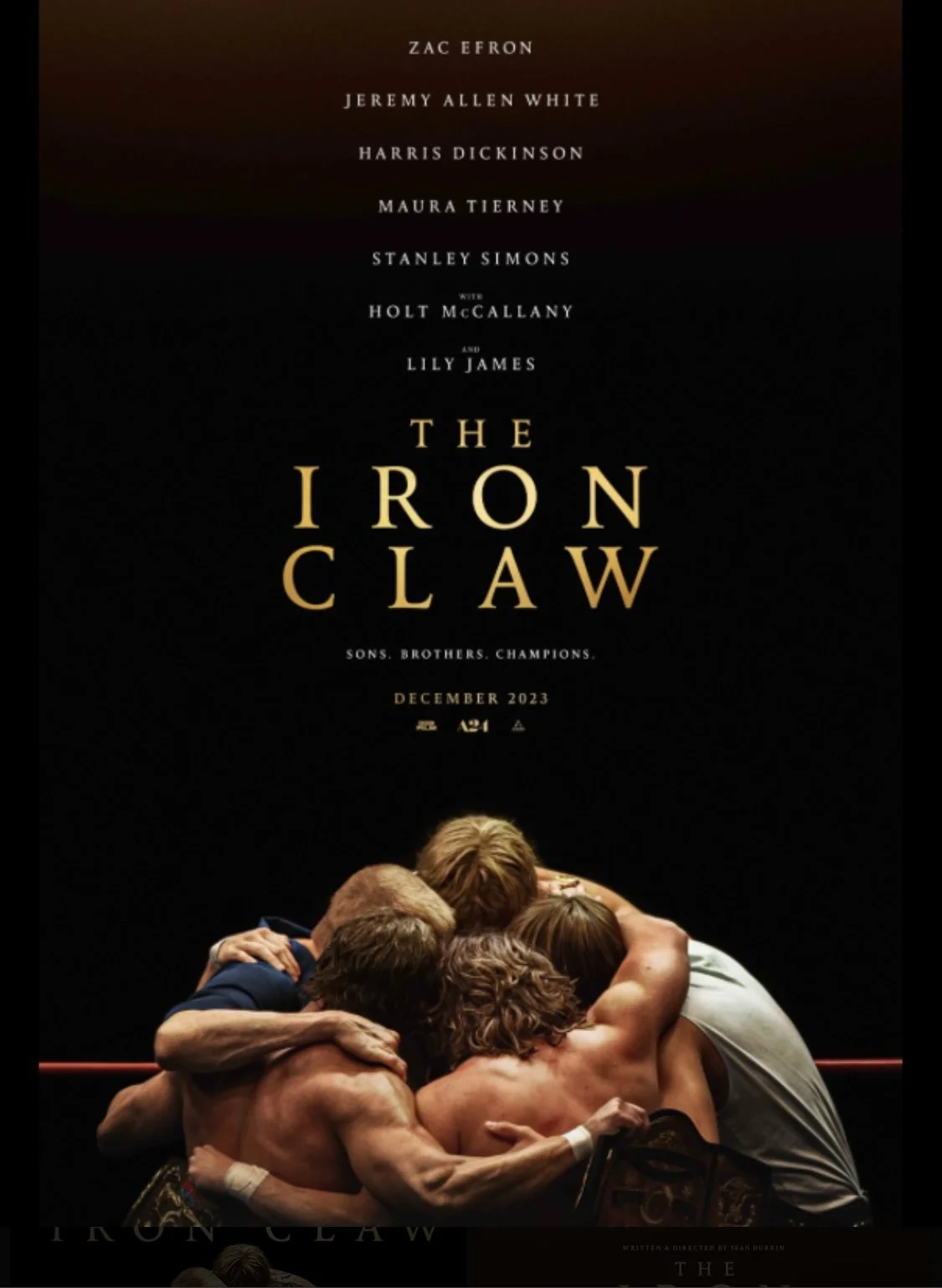
The Iron Claw: When Strength Becomes a Burden
The Iron Claw is more than a wrestling film — it’s a eulogy for the Von Erich family and every generation of men who were told that pain was weakness. CommonX looks at how the real curse wasn’t fate, but the weight of silence.

“The Von Erichs didn’t wrestle opponents. They wrestled fate — and it always fought back harder.”
There’s a moment in The Iron Claw where Zac Efron’s Kevin Von Erich stares into nothing, his face carved by exhaustion and quiet grief. It’s not acting — it’s witnessing. You see a man holding the weight of a bloodline built on strength, success, and tragedy. You see every generation of men who were told to take the hit and keep standing.
A Family That Built an Empire on Pain
Before the movie lights, before the glitz of Texas stadiums, there was Jack Adkisson — known to the world as Fritz Von Erich. He was a powerhouse in wrestling’s golden age and the architect of a dynasty. But what he really built wasn’t a brand; it was a burden.
Fritz raised his sons to be champions, not children. He gave them muscles before mercy, fame before freedom. Wrestling wasn’t a choice — it was the family business, and the business came with blood.
What followed was heartbreak so relentless it became legend.
David Von Erich died mysteriously in Japan.
Mike, devastated by injury and pressure, took his own life.
Chris, frail and broken, followed him.
Kerry, beloved by fans, ended his life in 1993.
Four sons, gone. One father left behind, and one brother — Kevin — forced to carry their ghosts into every sunrise.
The Curse: Not Superstition, but Expectation
People called it the Von Erich curse, like it was some cosmic punishment. But what The Iron Claw shows us is that the real curse wasn’t mystical at all — it was cultural. It was the curse of men who were taught that emotion is weakness, that winning redeems pain, and that silence is strength.
In every flex of Efron’s performance, you can feel it — the strain of holding in tears that never had permission to fall.
“We were raised to be strong,” Kevin says in the film.
“But maybe strong just means you can’t ask for help.”
That line cuts right to the Gen X core — to every man who learned to swallow failure, bury pain, and smile through breakdowns.
The Weight of Myth
Sean Durkin’s direction is merciless and beautiful. He films the Von Erichs like gods and ghosts at the same time — always illuminated, always doomed. The camera lingers on every bruise, every smile hiding exhaustion, every locker-room prayer that feels like a goodbye.
And Holt McCallany as Fritz? Pure power and heartbreak. He isn’t a villain; he’s a product of his own myth — a man who believed that if you pushed hard enough, love could be forged out of discipline.
But the truth The Iron Claw exposes is simple: you can’t out-train pain.
And you can’t out-wrestle grief.
The Last Man Standing
Kevin Von Erich — the real man, not just the character — lives in Hawaii now. Surrounded by his children and grandchildren, he’s found peace in nature, love, and distance from the ring. But he’ll tell you himself — peace wasn’t free.
He watched every brother fall, watched the empire burn down, and still carried the name. The movie ends not with victory, but survival. That’s what makes it powerful — it’s not about champions. It’s about endurance.
“Survivors don’t win,” Kevin once said in an interview. “They just keep going.”
That’s the gospel of The Iron Claw. The Von Erichs gave everything — their bodies, their youth, their sanity — to an industry that cheered while they broke.
Why It Hits So Hard for Our Generation
For Gen X, The Iron Claw feels like looking in a mirror that doesn’t lie. We grew up in a world that worshipped toughness — latchkey kids turned into relentless adults, hustling, grinding, hiding pain under sarcasm and work ethic.
The Von Erich story asks the question most of us avoid: What if strength is the very thing that’s killing us?
That’s not weakness — that’s revelation. It’s the moment you realize that vulnerability isn’t surrender. It’s healing.
🎙️The CommonX Takeaway
The legacy of the Von Erichs isn’t about fame or failure — it’s about the cost of inherited pain. And The Iron Claw doesn’t just resurrect their story; it redeems it. It shows what happens when a family tries to build forever out of flesh and willpower. It shows that love without permission to be human turns into tragedy.
And most of all, it reminds us that silence — the thing we were taught to call strength — can destroy everything we love if we let it. “Maybe the Von Erichs weren’t cursed,” the article closes.
“Maybe they were just the first to show us what the curse really looks like.”

The Quiet Hours: When the World Sleeps, I Walk
Sometimes, life doesn’t need to be loud to be powerful. Sometimes, the most revolutionary act is simply not giving up.

(An X-Files by Ian Primmer | CommonX Podcast)
There’s a certain peace that lives in the early hours — the kind that only shows up when the world hasn’t yet opened its eyes. It’s 2:30 a.m. when I wake up, not by choice, but because life decided I needed a moment with myself. The house is quiet. The coffee maker stirs. The moon hangs like a soft bulb over a world too distracted to notice. My wife is still sleeping, and I envy her ability to rest so deeply. She’s earned it.
Me? I shower, lace up my shoes, and head for the gym. Not because I have to. Because I promised myself I would.
There’s something sacred about walking while everyone else is dreaming. Each step feels like a conversation with the universe — one where the only thing required is honesty. The treadmill hums beneath me, the heart rate climbs, and for 90 minutes, it’s just me, my thoughts, and the steady rhythm of motion. I’m not chasing youth. I’m chasing peace.
We don’t talk enough about the quiet victories — those moments when no one’s watching, no one’s clapping, and no one’s there to post about it. The alarm goes off, your body aches, your spirit feels small, and still, you show up. That’s what defines a person. That’s what builds a soul that can weather storms.
Sometimes, life doesn’t need to be loud to be powerful. Sometimes, the most revolutionary act is simply not giving up.
I think about all the people out there right now, fighting invisible battles — the ones who drag themselves out of bed despite the weight on their chest, who smile when they want to break, who choose to keep walking when standing still would be easier. You are the quiet heroes. The ones the world overlooks but can’t function without.
So if today feels heavy, let me remind you: it’s not about perfection. It’s about persistence. The gym, the grind, the growth — it’s all a reflection of the fight inside you. And you’re stronger than you think.
When I finish that 90-minute walk, I won’t have changed the world. But I’ll have changed my world. And maybe, if these words reach someone who needs them, that’ll be enough.
Because in these quiet hours, when the world sleeps and I walk, I find my truth — and my truth is this: You are not alone. Keep going.

🕯️ Ozzy Osbourne: The Sound That Never Dies
Ozzy Osbourne wasn’t just the Prince of Darkness — he was the light that kept rock alive for more than five decades. From Black Sabbath’s heavy beginnings to a solo career filled with chaos, brilliance, and heart, Ozzy lived louder than anyone and loved deeper than most. His music didn’t just shape metal; it gave generations permission to be unapologetically themselves.

“You can’t kill rock and roll — it’s alive in every note he left behind.”
There are rock stars — and then there’s Ozzy Osbourne. The man who single-handedly helped shape heavy metal, terrified parents, inspired millions, and somehow made the entire world fall in love with his madness.
Born in Birmingham, England in 1948, John Michael “Ozzy” Osbourne came from working-class grit. Before he was the “Prince of Darkness,” he was just a kid with dyslexia, odd jobs, and a voice that didn’t quite fit anywhere — until it changed music forever.
🎸 The Birth of Heavy Metal
When Ozzy joined forces with Tony Iommi, Geezer Butler, and Bill Ward, the result was Black Sabbath — the band that invented a genre. Their 1970 self-titled debut was raw, dark, and loud — a thunderclap that split rock in two. Albums like Paranoid and Master of Reality didn’t just define metal; they built it from the ground up.
Songs like Iron Man, War Pigs, and Paranoid weren’t just riffs — they were rebellion set to distortion. Ozzy’s haunting voice and unfiltered energy turned fear into freedom.
⚡ The Solo Resurrection
After his firing from Sabbath, most thought Ozzy’s story was over. Instead, it was just beginning. Teaming up with guitar prodigy Randy Rhoads, he unleashed Blizzard of Ozz (1980) and Diary of a Madman — records that became instant classics. Crazy Train and Mr. Crowley remain two of the most recognizable rock anthems in history.
Even after tragedy struck with Rhoads’ death, Ozzy kept pushing. With players like Jake E. Lee, Zakk Wylde, and Geezer Butler returning to his orbit, his solo career became a masterclass in endurance. Albums like No Rest for the Wicked, No More Tears, and Ozzmosis proved he could outlast every critic and every demon.
🧠 The Myth and the Man
Then came the moments that blurred the line between legend and lunacy — the infamous bat-biting incident, the MTV reality show The Osbournes, and decades of being both rock’s wildest figure and its most unlikely symbol of love and humor.
But through it all, Ozzy never stopped being real. Beneath the spectacle was a man who wore his struggles with addiction, depression, and fame openly. He survived what most couldn’t — and somehow still showed up on stage, microphone in hand, giving everything he had left.
🕊️ The Final Notes
His 2022 album Patient Number 9 became a haunting farewell — reflective, experimental, and packed with collaborations from icons like Eric Clapton, Tony Iommi, and Jeff Beck. It wasn’t just a goodbye; it was a celebration of a life that changed the sound of the world.
When Ozzy Osbourne passed away in 2025, the shock reverberated through generations. But for those of us who grew up with his voice echoing through our walls, it wasn’t an ending — it was immortality being confirmed.
🖤 From the CommonX Host’s Desk — Ian Primmer
Ozzy’s music raised us. His madness made us laugh, his honesty made us feel seen, and his riffs — they taught us to feel alive.
He was chaos and compassion in equal measure, a man who gave the misfits, metalheads, and midnight souls a home. In every gym, garage, and garage band that ever plugged in a guitar — Ozzy’s DNA is there.
Rest easy, legend. You didn’t just scream into the void — you made the void sing back.

The CommonX Comeback Wrap – Simple Fuel for the Midday Grind
Simple, clean, and real. A Mission tortilla, a few slices of ham, a little mayo and mustard — and one step closer to the comeback.
Sometimes the best meals are the ones that don’t look fancy — just real food, made with purpose.
I’ve been putting in the treadmill miles, chasing that 175-lb lean goal, and rebuilding energy from the ground up. But lunchtime doesn’t need to be complicated — it just needs to keep me moving toward the comeback.
Today’s lunch was exactly that: a Mission tortilla, a few slices of Black Forest ham, a slice of Tillamook cheese, a little mayo, and some mustard. Rolled it up, toasted it, and honestly — it hit perfect.
Not stuffed, not guilty. Just clean fuel that fits the day — Ian Primmer
This is what rebuilding looks like. Not starving. Not quitting. Just small, smart decisions that stack up — one treadmill session, one Power Bowl, one wrap at a time.
Stay tuned — CommonX is recharging and refocusing. The comeback’s already happening. 💪
#CommonX #TheXFiles #GenX #ComebackSeason #Health #Motivation #PowerBowl #FitnessJourney #Wellness

🥣 The CommonX Power Bowl – Fuel for the Comeback
CommonX is taking a short pause to recharge — physically, mentally, and creatively. We’re hitting reset with clean fuel, simple routines, and a bowl that reminds us that big comebacks start small. This is the CommonX Power Bowl.

🥣 The CommonX Power Bowl – Fuel for the Comeback
Sometimes you’ve gotta slow down to rebuild stronger — Ian Primmer
The past few weeks have been heavy — a lot of reflection, a lot of treadmill miles, and now, a focus on getting the mind and body right before the next phase of CommonX begins.
So yeah, we’re taking a little time to go healthy for the comeback. And it starts simple — with a bowl that fuels more than just your body.
The CommonX Power Bowl:
1 cup oatmeal
1 scoop vanilla protein powder
¼ cup huckleberries
Dash of cinnamon
1 teaspoon honey
Cook it up, stir it smooth, and let the smell of cinnamon remind you that change can start small. It’s clean, balanced, and damn satisfying — a perfect fuel-up for whatever’s next.
CommonX isn’t going anywhere. We’re just recharging — tightening up the routine, resetting the energy, and coming back sharper.
Stay tuned. We’re rebuilding from the inside out.
💪 #CommonX #TheXFiles #GenXFuel #PowerBowl

Derek Morris Is Proof You’re Not Alone: Songs, Scars, and Showing Up
Humble, driven, and unafraid to speak about what matters most — Derek Morris is a musician who turns pain into purpose. Through his music, he’s helping others find hope, healing, and the courage to keep going. In this exclusive CommonX feature, Derek opens up about his journey through PTSD, his passion for giving back, and the power of using your voice for good.
By Ian Primmer
Today’s guest Derek Morris is the kind of artist who walks in like a neighbor and leaves like a friend — humble, direct, and focused on lifting people up. A San Diego singer-songwriter and visual artist (the mind behind the playful “VEMPS” universe), Derek turns hard chapters into hopeful anthems, sharing messages like “Don’t give up” and “You are not alone” across his work. On the show he opened up about living with PTSD and how music became both a lifeline and a lighthouse for others finding their way. If you land on Derek’s site, you’re greeted with a chorus of encouragement — “You are so loved… You are not a mistake… Don’t give up!” It’s not branding; it’s a mission statement. Derek’s catalog threads pop-punk snap with reflective alt-rock and cinematic textures, from the electric punch of “777” to the atmospheric “You Don’t Need to Know Right Now.”

Turning Pain Into Promise
Derek has spoken publicly about surviving abuse, addiction, and the long tail of trauma, naming PTSD directly — and then writing through it. Recent posts tease “Never Stop Fighting,” a song explicitly about living with PTSD and refusing to let it have the last word. For fans who need to hear it, Derek writes like a friend on the other side of the storm: keep going. Beyond songs, Derek’s “VEMPS” characters and art books widen his canvas — a bright, hand-drawn counterweight to heavy themes. It’s kinetic, kid-curious, and unmistakably his — evidence that recovery isn’t just survival; it’s creative overflow.
777” — official video; neon-noir energy with a resilient core. YouTube
“You Don’t Need to Know Right Now” — reflective, West-coast melancholy. YouTube
“Never Stop Fighting” (teaser) — a direct letter to anyone living with PTSD.

On-mic and off, Derek carried himself with the same humble steadiness you hear in his songs. He told us he shares freely and keeps showing up because someone out there needs the message today, not tomorrow. Beyond the stage lights and studio sessions, Derek Morris has found another outlet for connection — the podcast world. Whether he’s sharing stories about overcoming challenges, talking shop about songwriting, or offering words of encouragement to those battling PTSD, Derek’s voice carries the same honesty found in his lyrics. His mission is simple: to uplift, to connect, and to give freely through both conversation and music. Each time he picks up a mic, it’s not just about the notes or the words — it’s about healing, hope, and helping others find their own rhythm in the noise.
There’s a rare kind of artist who reminds you that authenticity still exists — that music can still heal, inspire, and bridge the space between pain and purpose. Derek Morris is one of those artists. From the first moment he walked into the studio, there was no ego, no walls — just a genuine soul who uses his voice and his guitar as tools for light. His story is one of resilience, of living with purpose through the storms of PTSD and finding redemption in the notes he shares so freely with the world. Derek doesn’t just make music — he gives it away, both literally and emotionally, pouring pieces of himself into every chord and every conversation. As podcasters, we meet a lot of people chasing fame or recognition; Derek isn’t one of them. He’s chasing connection. And in a world that can feel divided and loud, that kind of humility and strength is something worth amplifying. CommonX is honored to share his story — not because he asked us to, but because people like him remind us why we do this in the first place.

Energy for the Reboot: What Gen-X Runs On Now
The Gen-X grind never stopped — it just got smarter. From late-night edits to early-morning hustle, Bulletproof Coffee and KIND Bars have become the unofficial fuel of the CommonX crew. Clean energy, real flavor, no crash — just the stuff that keeps our generation running strong.
Remember when breakfast was a cigarette and a cup of gas-station coffee before work? Yeah… same.
But these days the reboot hits different. Gen-X is still grinding, just smarter about what we fuel up with. Between the podcast, work, and keeping our heads clear, we found the stuff that actually keeps the motor running — KIND Bars and Bulletproof Coffee.
Affiliate note: these are our go-tos — because they work. Every click helps keep CommonX ad-free.
The Gen-X Grind Isn’t Slowing Down
We came from the 90s — raised on convenience-store caffeine and music that never apologized. Now we’re parents, builders, and creators trying to balance everything without burning out.
Bulletproof’s MCT-infused brew hits that clean energy line — no crash, no jitters, just focus. Pair that with a KIND Bar in the glove box or your gym bag and you’ve got breakfast that fits between chaos and deadlines.
Real Fuel for Real People
Forget the “influencer” smoothies. Gen-X doesn’t need fancy — we need functional.
KIND = simple ingredients, real protein, actually tastes like food.
Bulletproof = clean fat + caffeine = mental clarity that outlasts a meeting.
Throw one in your backpack, grab one before recording, or stash a box in the shop next to the socket set.
The CommonX Connection
We talk a lot about energy — creative, emotional, physical.
Staying clear and sharp is part of why this show even exists.
This isn’t an ad, it’s survival gear for Gen-X dreamers who refuse to quit.
So next time you’re firing up the mic, heading into the shop, or chasing kids to soccer practice, skip the crash.
Fuel up, dial in, and keep that CommonX engine running clean.