
X-Files: The Dead Internet Isn’t Coming — It’s Here
The internet didn’t die in a blackout. It was padded with replicas until no one noticed the difference. Bots talking to bots. AI feeding AI. Synthetic consensus everywhere. This X-Files asks the uncomfortable question: are we still talking to each other?
CommonX Skull and crossbones themed image that aligns with brand authority.
Here’s a feeling people can’t quite name yet. You scroll. You post. You engage. And something feels… hollow.
The likes don’t match the reach. The comments feel scripted. Accounts explode overnight with no origin story. Entire conversations appear fully formed, emotionally flat, and gone just as fast. This isn’t burnout. This isn’t shadowbanning. This is something bigger.
The Theory Everyone Whispered About
For years, the Dead Internet Theory lived in the corners of the web — forums, late-night podcasts, throwaway comments under obscure videos. The claim was simple and unsettling:
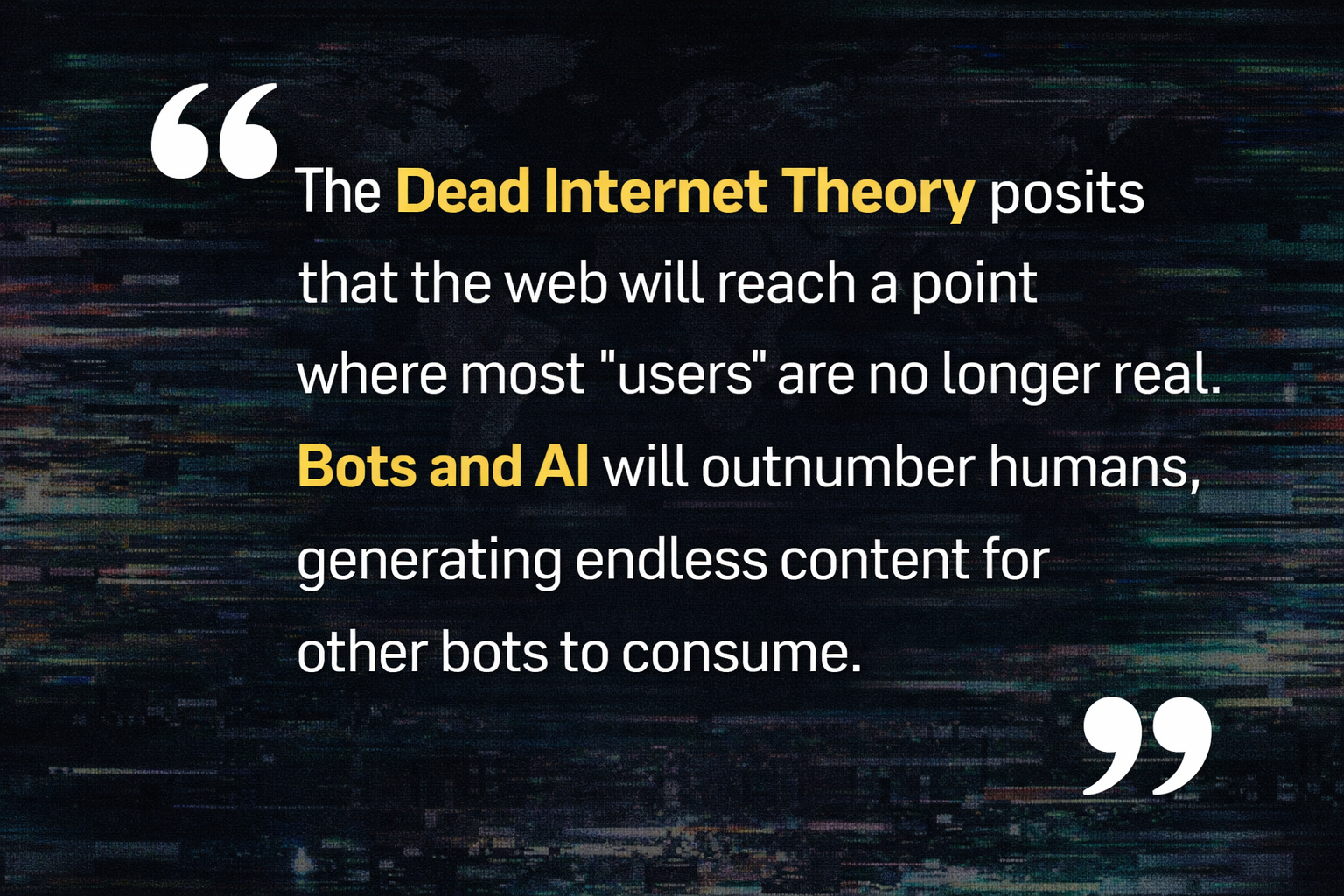
Much of what we experience online is no longer human.
Bots talking to bots. AI generating engagement for AI. Synthetic consensus. For a long time, it sounded paranoid. Now it sounds… familiar.
2026 Changed the Game
The difference now isn’t speculation — it’s scale.
AI doesn’t just write posts anymore. It runs accounts. It responds emotionally. It learns tone. It mimics outrage, empathy, humor, and fear. Entire comment sections can be spun up without a single human present.
And here’s the quiet part:
Most platforms don’t just allow this — they benefit from it.
Activity looks like growth. Engagement looks like relevance. Volume looks like success.
Authenticity? That’s optional.
Why Real Creators Feel Like They’re Losing Their Minds
Independent creators are hitting the same wall at the same time:
• Reach drops while effort increases • Engagement spikes that don’t convert • Accounts with no history outperforming lived-in voices • Conversations that feel performative instead of personal
It creates a subtle psychological effect:
Am I invisible… or am I just surrounded by ghosts?
The Quiet Replacement
This isn’t about censorship. It’s not about politics. It’s about replacement. Human unpredictability is expensive. Human emotion is messy. Human discourse doesn’t scale cleanly. Synthetic participation does. So the internet didn’t die in a blackout. It was quietly padded with replicas until no one noticed the difference.
Why This Matters More Than Ever
When humans stop recognizing each other online, trust collapses. And when trust collapses: • Movements fracture • Truth blurs • Reality becomes negotiable
That vacuum doesn’t stay empty. It gets filled.
The Signal Still Cuts Through
Here’s the part the algorithms can’t fake — yet: • Long-form conversation • Real voices over time • Inconsistency • Growth scars • Human pauses • Memory
Independent media isn’t dying. It’s becoming the last place where you can still hear someone breathe.
Final Thought
The Dead Internet didn’t arrive all at once. It crept in politely.
And the only thing that exposes it…
Is showing up as yourself anyway.
— CommonX X-Files
Question everything. Especially what agrees with you too easily.

Did the Internet Eat Reality?
Reality used to mean something you could touch, see, and feel. Now it’s filtered, edited, and uploaded before it ever really happens. Somewhere between selfies, algorithms, and AI headlines, the internet didn’t just change reality — it consumed it.
Reality used to mean something you could touch, see, and feel. Now it’s filtered, edited, and uploaded before it ever really happens. Somewhere between selfies, algorithms, and AI headlines, the internet didn’t just change reality — it consumed it.
The Moment It Happened
It wasn’t a single day or a viral post. Reality didn’t collapse in one click — it bled out slowly. We traded photo albums for Instagram grids, local hangouts for Discord servers, and conversation for comments. Now we scroll through the world instead of living in it.
Gen X might be the last generation to remember what life before the upload felt like — when a moment stayed a memory instead of content.
⸻
The New Religion of Algorithms
We used to ask teachers, mentors, and parents for wisdom. Now, we ask Google, YouTube, and TikTok. The algorithm doesn’t care about truth — it only cares about what keeps you scrolling. It feeds the dopamine loop, not your brain.
We’ve reached the point where the algorithm isn’t showing us reality — it’s writing it.
⸻
The AI Era: Simulation Becomes Default
Artificial intelligence writes the news, draws the art, sings the songs, and finishes our sentences. The lines between creator and code are gone. Deepfakes can make anyone say anything.
If you can’t tell what’s real anymore… maybe that’s the new definition of real.
⸻
The Gen X Perspective
Gen X was raised analog and forced to adapt digital. We built the bridge — now we’re watching it burn. We remember when eye contact meant truth and “offline” wasn’t an insult. That’s why CommonX exists — to bring real back to the table.
Because while the world argues over what’s real, Gen X knows one thing for sure: reality doesn’t need a Wi-Fi signal.
⸻
Final Thought
Maybe the internet didn’t just eat reality — maybe it ate our attention, our patience, and our sense of time. But as long as there’s one person still asking why, the story’s not over.

Disconnected: Why a Generation Is Rewriting Sex, Love, and the Rules of Commitment
Modern love is changing fast. As dating apps, digital income, and social independence reshape what connection means, a generation is redefining sex, commitment, and the rules of intimacy. Disconnected explores how technology and trust have collided — and what that says about all of us.

By Ian Primmer – CommonX Contributor
As dating apps, economic anxiety, and digital marketplaces redefine intimacy, young men and women are rethinking what relationships — and even desire — mean in 2025.
Something strange is happening in the love economy.
Across the U.S. and much of the developed world, young adults are quietly stepping away from the very rituals that defined adulthood for decades. Fewer are having sex, fewer are getting married, and many are questioning whether traditional relationships are worth the cost—financially or emotionally.
According to research from Pew Research Center and the UCL Social Research Institute, the share of adults under 35 who reported no sexual activity in the past year has nearly doubled since the early 2000s. Marriage rates have plunged, and the average age at first marriage now hovers near 30 for women and 32 for men—an all-time high. The generational gap isn’t about prudishness; it’s about priorities. Love still matters—but it’s competing with rent, student loans, burnout, and a sense that the game itself has changed.
The Male Retreat
For many young men, intimacy now feels like a high-risk investment with diminishing returns. Housing prices soar, divorce rates linger around 40 percent, and stories of financial ruin circulate online like cautionary folklore. Meanwhile, digital substitutes—everything from short-form video escapism to AI chat companions—offer instant validation without heartbreak or half a paycheck disappearing in a settlement.
This isn’t necessarily apathy. It’s self-preservation. A generation raised on instability is choosing control over chaos, even if that control means going it alone.
The Female Revolution
On the other side of the equation, women have achieved unprecedented autonomy. Economic independence and reproductive rights have rewritten what partnership looks like—and whether it’s even required. Many are embracing freedom, delaying marriage, or building careers and communities that exist outside domestic expectations. The result is empowerment, but also a dating marketplace that feels less predictable, less reciprocal, and sometimes less trusting.
Both shifts are rooted in the same story: choice. For the first time, both sexes can truly opt out—and some are exercising that option.
The Digital Marketplace
Technology has become the new matchmaker and the new wall between people. Apps promise infinite options, yet endless choice can make commitment feel obsolete. Subscription platforms like OnlyFans and the influencer economy have further blurred the line between attention, affection, and income. To some men, intimacy now looks transactional; to many women, monetizing image and autonomy is empowerment. Both views are valid—and both leave people wondering if genuine connection can survive an algorithm.
The irony? Everyone is still searching for meaning, but the signals are jammed by noise.
Recalibrating Connection
What’s emerging isn’t the death of love—it’s the recalibration of it. Relationships are being redefined by transparency, equality, and timing rather than obligation. For some, that feels liberating. For others, it’s isolating. Either way, the script has changed: sex and marriage are no longer prerequisites for adulthood, and emotional independence has become its own badge of honor.
Maybe that’s progress. Or maybe, as Gen X watchers like us suspect, it’s a symptom of a world that’s traded depth for options.
The CommonX Take
This moment says less about romance and more about society’s bandwidth. We’ve built technology that connects everyone—but rarely long enough to stay. We’ve made freedom the ultimate goal, yet we’re lonelier than ever. The next evolution of intimacy may not be about choosing sides at all—it might be about learning how to stay human in a world that rewards disconnection.
Because love, even now, still cuts through the static. It just has to fight harder to be heard.